QUESTION IMAGE
Question
topic 10 block 10 homework name
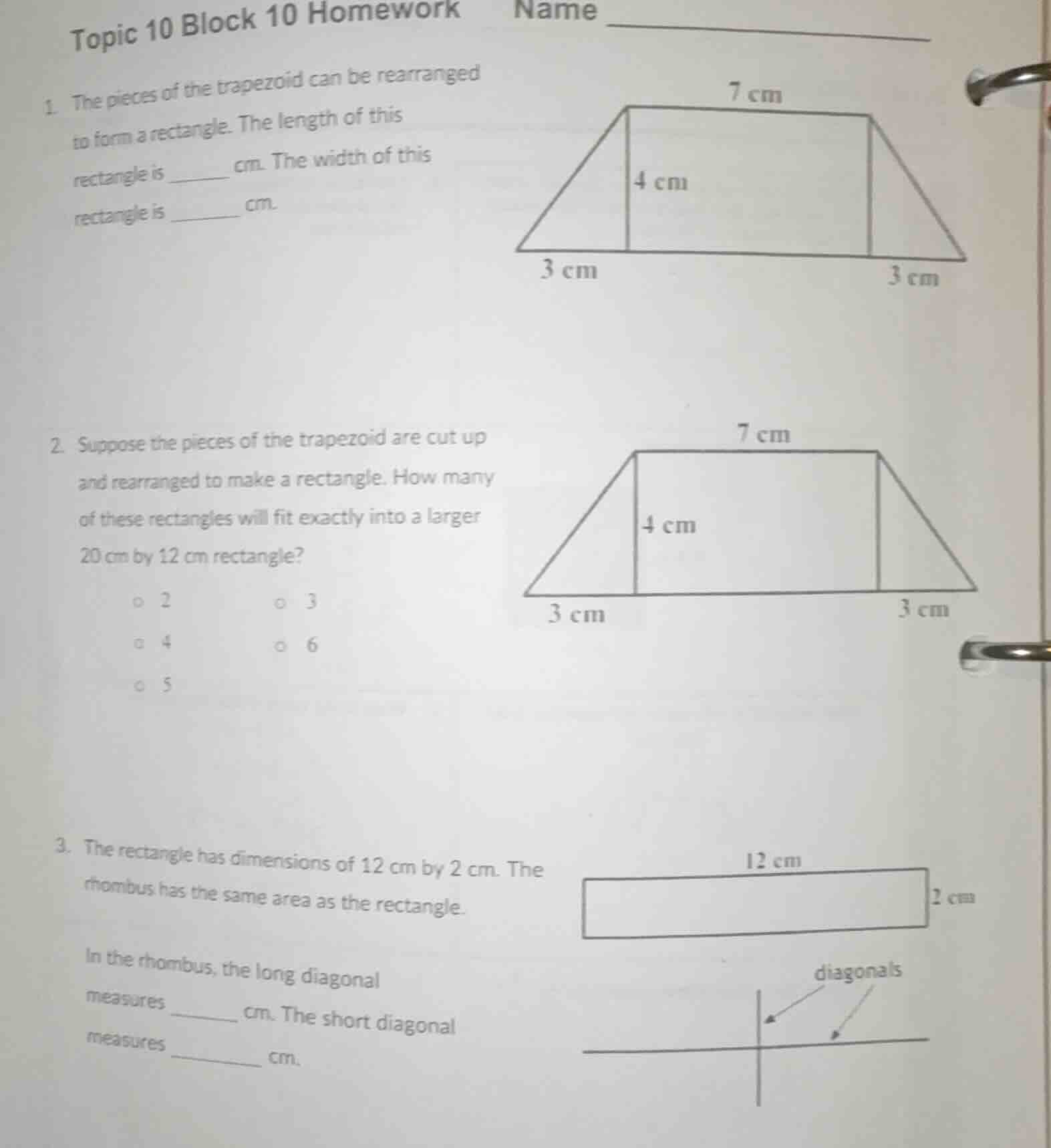
- the pieces of the trapezoid can be rearranged to form a rectangle. the length of this rectangle is ____ cm. the width of this rectangle is ____ cm.
- suppose the pieces of the trapezoid are cut up and rearranged to make a rectangle. how many of these rectangles will fit exactly into a larger 20 cm by 12 cm rectangle?
○ 2 ○ 3
○ 4 ○ 6
○ 5
- the rectangle has dimensions of 12 cm by 2 cm. the rhombus has the same area as the rectangle.
in the rhombus, the long diagonal measures ____ cm. the short diagonal measures ____ cm.
Step1: Find rectangle length
The two triangular pieces each have a base of 3 cm, so combining them gives a length equal to the top base of the trapezoid plus one triangle base: $7 + 3 = 10$ cm.
Step2: Identify rectangle width
The width of the rectangle matches the height of the trapezoid, which is 4 cm.
Step3: Calculate area of small rectangle
Area = length × width: $10 \times 4 = 40$ cm²
Step4: Calculate area of large rectangle
Area = $20 \times 12 = 240$ cm²
Step5: Find number of small rectangles
Divide large area by small area: $\frac{240}{40} = 6$
Step6: Calculate rectangle (and rhombus) area
Area = $12 \times 2 = 24$ cm²
Step7: Relate rhombus area to diagonals
Rhombus area formula: $\frac{1}{2}d_1d_2 = 24$, so $d_1d_2 = 48$. A valid pair of positive integers (common for such problems) is $d_1=12$ cm (long diagonal) and $d_2=4$ cm (short diagonal), as $12 \times 4 = 48$.

Snap & solve any problem in the app
Get step-by-step solutions on Sovi AI
Photo-based solutions with guided steps
Explore more problems and detailed explanations
- Length: 10 cm, Width: 4 cm
- 6
- Long diagonal: 12 cm, Short diagonal: 4 cm