QUESTION IMAGE
Question
topic 1: multi-step equations
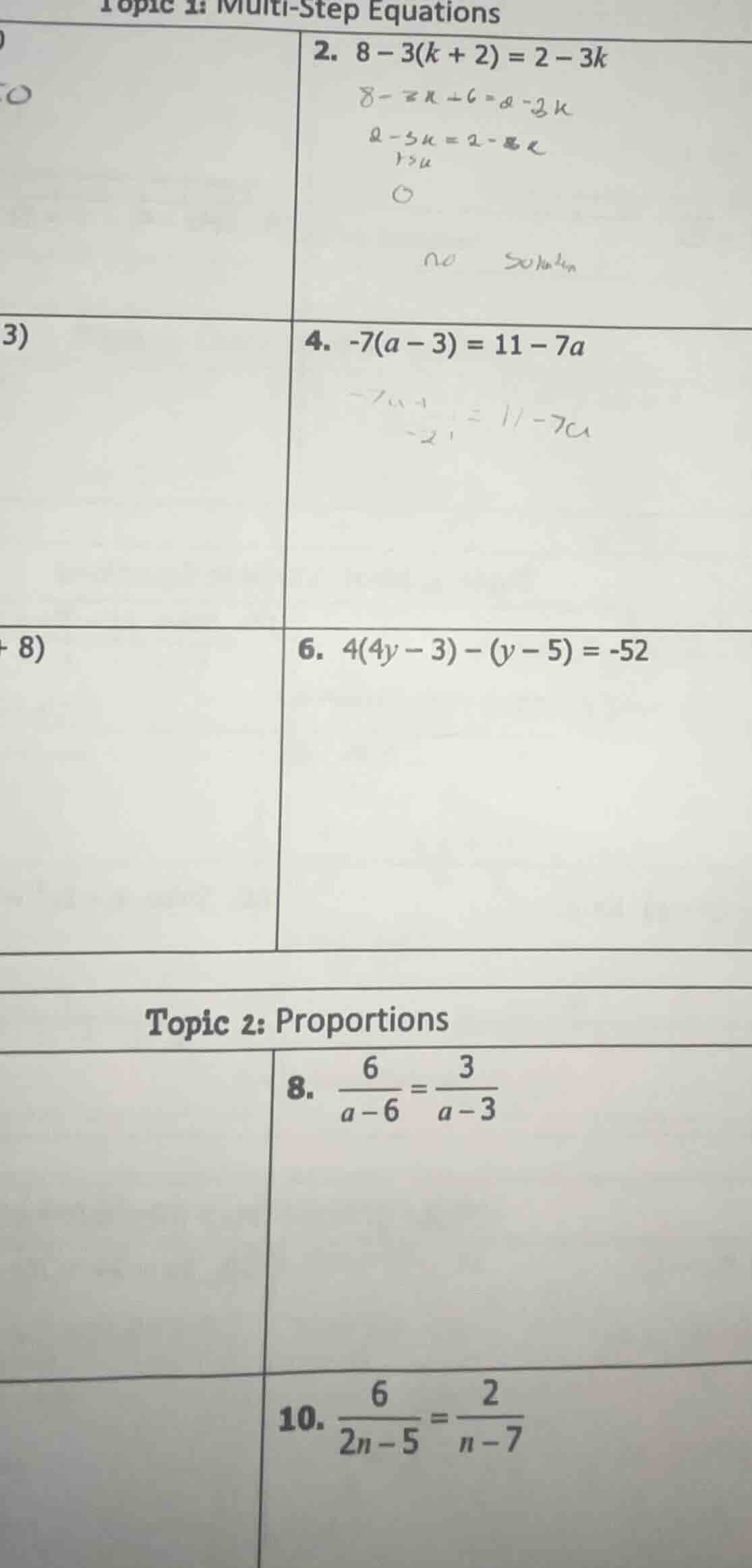
- $8 - 3(k + 2) = 2 - 3k$
- $-7(a - 3) = 11 - 7a$
- $4(4y - 3) - (y - 5) = -52$
topic 2: proportions
- $\frac{6}{a - 6} = \frac{3}{a - 3}$
- $\frac{6}{2n - 5} = \frac{2}{n - 7}$
Response
Problem 2: \( 8 - 3(k + 2) = 2 - 3k \)
Step 1: Distribute the -3
\( 8 - 3k - 6 = 2 - 3k \)
Step 2: Simplify left side
\( 2 - 3k = 2 - 3k \)
Step 3: Analyze the equation
Subtract \( 2 - 3k \) from both sides: \( 0 = 0 \)
This is always true, meaning the equation has infinitely many solutions. But the handwritten note says "no solution" which is incorrect. The correct conclusion is all real numbers are solutions.
Step 1: Distribute the -7
\( -7a + 21 = 11 - 7a \)
Step 2: Add \( 7a \) to both sides
\( 21 = 11 \)
Step 3: Analyze the result
\( 21 = 11 \) is false, so the equation has no solution.
Step 1: Distribute the 4 and the negative sign
\( 16y - 12 - y + 5 = -52 \)
Step 2: Combine like terms
\( 15y - 7 = -52 \)
Step 3: Add 7 to both sides
\( 15y = -45 \)
Step 4: Divide by 15
\( y = -3 \)

Snap & solve any problem in the app
Get step-by-step solutions on Sovi AI
Photo-based solutions with guided steps
Explore more problems and detailed explanations
All real numbers (or infinitely many solutions)