QUESTION IMAGE
Question
topic: proper and improper fractions
progress:
the movement of the progress bar may be uneven because questions can be worth more or less (including zero) depending on your answer.
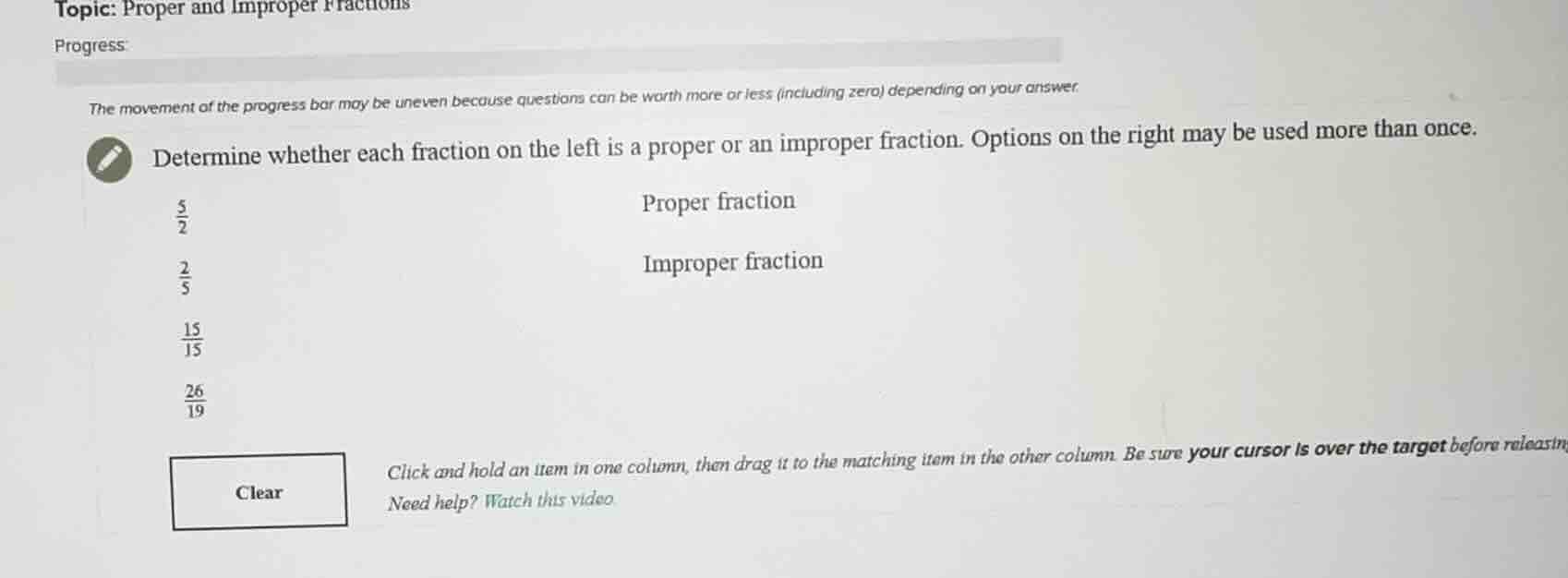
determine whether each fraction on the left is a proper or an improper fraction. options on the right may be used more than once.
\\(\frac{5}{2}\\) proper fraction
\\(\frac{2}{5}\\) improper fraction
\\(\frac{15}{15}\\)
\\(\frac{26}{19}\\)
clear click and hold an item in one column, then drag it to the matching item in the other column. be sure your cursor is over the target before releasing
need help? watch this video
To determine if a fraction is proper or improper, we use the definitions:
- A proper fraction has a numerator less than its denominator (\( \text{numerator} < \text{denominator} \)).
- An improper fraction has a numerator greater than or equal to its denominator (\( \text{numerator} \geq \text{denominator} \)).
Analyzing each fraction:
- \( \boldsymbol{\frac{5}{2}} \): Numerator \( 5 \), Denominator \( 2 \). Since \( 5 \geq 2 \), this is an Improper fraction.
- \( \boldsymbol{\frac{2}{5}} \): Numerator \( 2 \), Denominator \( 5 \). Since \( 2 < 5 \), this is a Proper fraction.
- \( \boldsymbol{\frac{15}{15}} \): Numerator \( 15 \), Denominator \( 15 \). Since \( 15 \geq 15 \), this is an Improper fraction.
- \( \boldsymbol{\frac{26}{19}} \): Numerator \( 26 \), Denominator \( 19 \). Since \( 26 \geq 19 \), this is an Improper fraction.
Final Matching:
- \( \frac{5}{2} \) → Improper fraction
- \( \frac{2}{5} \) → Proper fraction
- \( \frac{15}{15} \) → Improper fraction
- \( \frac{26}{19} \) → Improper fraction

Snap & solve any problem in the app
Get step-by-step solutions on Sovi AI
Photo-based solutions with guided steps
Explore more problems and detailed explanations
To determine if a fraction is proper or improper, we use the definitions:
- A proper fraction has a numerator less than its denominator (\( \text{numerator} < \text{denominator} \)).
- An improper fraction has a numerator greater than or equal to its denominator (\( \text{numerator} \geq \text{denominator} \)).
Analyzing each fraction:
- \( \boldsymbol{\frac{5}{2}} \): Numerator \( 5 \), Denominator \( 2 \). Since \( 5 \geq 2 \), this is an Improper fraction.
- \( \boldsymbol{\frac{2}{5}} \): Numerator \( 2 \), Denominator \( 5 \). Since \( 2 < 5 \), this is a Proper fraction.
- \( \boldsymbol{\frac{15}{15}} \): Numerator \( 15 \), Denominator \( 15 \). Since \( 15 \geq 15 \), this is an Improper fraction.
- \( \boldsymbol{\frac{26}{19}} \): Numerator \( 26 \), Denominator \( 19 \). Since \( 26 \geq 19 \), this is an Improper fraction.
Final Matching:
- \( \frac{5}{2} \) → Improper fraction
- \( \frac{2}{5} \) → Proper fraction
- \( \frac{15}{15} \) → Improper fraction
- \( \frac{26}{19} \) → Improper fraction