QUESTION IMAGE
Question
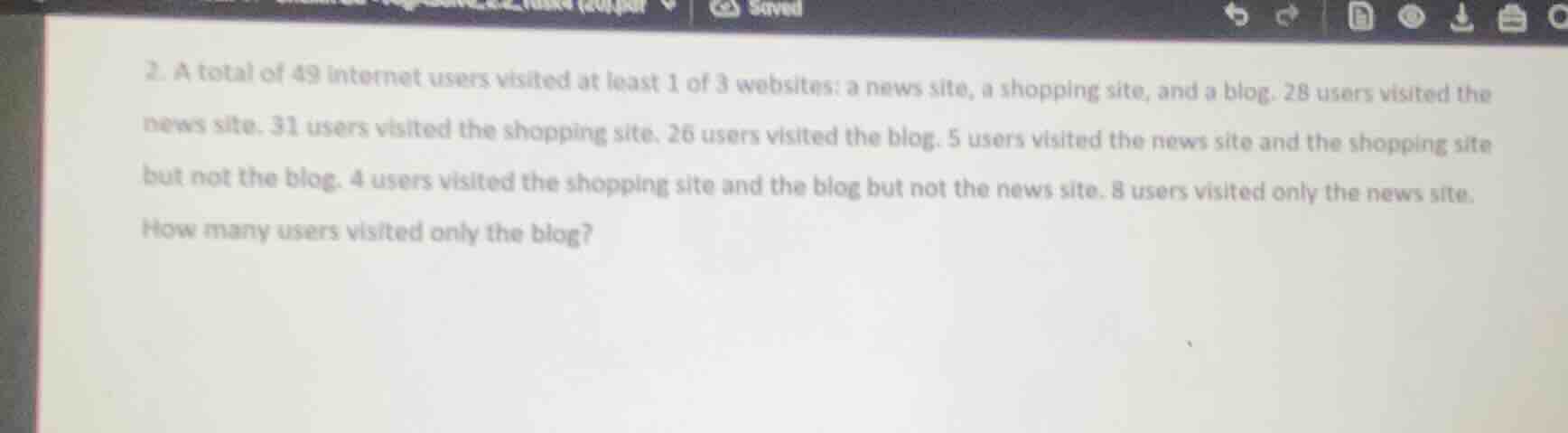
- a total of 49 internet users visited at least 1 of 3 websites: a news site, a shopping site, and a blog. 28 users visited the news site. 31 users visited the shopping site. 26 users visited the blog. 5 users visited the news site and the shopping site but not the blog. 4 users visited the shopping site and the blog but not the news site. 8 users visited only the news site. how many users visited only the blog?
Step1: Find users who visited news and shopping (including blog)
We know 5 users visited news and shopping but not blog, and 8 users visited only news. The total for news site is 28. So users who visited news and shopping (including those who also visited blog) is \(28 - 8 - \text{only news and blog}\). Wait, first, let's find the number of users who visited news and shopping and blog. Wait, no, first, let's handle the news site.
Total news site visitors: 28. Only news: 8. News and shopping but not blog: 5. Let \(x\) be news and blog but not shopping, and \(y\) be all three (news, shopping, blog). So \(8 + 5 + x + y = 28\). So \(x + y = 28 - 8 - 5 = 15\).
Now shopping site: 31. News and shopping but not blog: 5. Shopping and blog but not news: 4. Let \(y\) be all three. So only shopping: \(31 - 5 - 4 - y\). Wait, only shopping would be \(31 - (5 + 4 + y)\). But we can also use the total users.
Total users: 49. Let \(z\) be only blog.
We have:
Only news: 8
News and shopping not blog: 5
Shopping and blog not news: 4
Only shopping: let's find it. Wait, shopping site: 31. So only shopping = 31 - (5 + 4 + y).
News site: 28 = 8 (only news) + 5 (news&shopping not blog) + x (news&blog not shopping) + y (all three). So \(x + y = 15\) as before.
Blog site: 26 = x (news&blog not shopping) + 4 (shopping&blog not news) + y (all three) + z (only blog). So \(x + y + 4 + z = 26\). But \(x + y = 15\), so \(15 + 4 + z = 26\)? Wait, no, wait: \(x + y + 4 + z = 26\) => \(z = 26 - 15 - 4 = 7\)? Wait, no, that can't be, because total users:
Total users = only news (8) + only shopping + only blog (z) + news&shopping not blog (5) + news&blog not shopping (x) + shopping&blog not news (4) + all three (y).
So total: \(8 + \text{only shopping} + z + 5 + x + 4 + y = 49\).
We know \(x + y = 15\), so substitute: \(8 + \text{only shopping} + z + 5 + 15 + 4 = 49\) => \(8 + 5 + 15 + 4 + \text{only shopping} + z = 49\) => \(32 + \text{only shopping} + z = 49\) => \(\text{only shopping} + z = 17\).
Now, shopping site: 31 = 5 (news&shopping not blog) + 4 (shopping&blog not news) + y (all three) + \(\text{only shopping}\). So \(5 + 4 + y + \text{only shopping} = 31\) => \(9 + y + \text{only shopping} = 31\) => \(y + \text{only shopping} = 22\).
From news site: \(x + y = 15\), and from blog site: \(x + y + 4 + z = 26\) => \(15 + 4 + z = 26\) => \(z = 7\)? Wait, that seems off. Wait, no, let's check total users again.
Wait, maybe a better approach with Venn diagrams.
Let’s define:
- \(N\) = news, \(S\) = shopping, \(B\) = blog.
Given:
- \(|N \cup S \cup B| = 49\)
- \(|N| = 28\), \(|S| = 31\), \(|B| = 26\)
- \(|N \cap S \cap
eg B| = 5\)
- \(|S \cap B \cap
eg N| = 4\)
- \(|N \cap
eg S \cap
eg B| = 8\)
We need to find \(|B \cap
eg N \cap
eg S| = z\) (only blog).
First, find \(|N \cap S \cap B| = y\) (all three), and \(|N \cap B \cap
eg S| = x\) (news and blog, not shopping).
From \(|N| = 8 + 5 + x + y = 28\) => \(x + y = 28 - 8 - 5 = 15\) --- (1)
From \(|S| = |N \cap S \cap
eg B| + |S \cap B \cap
eg N| + |N \cap S \cap B| + |S \cap
eg N \cap
eg B|\)
So \(31 = 5 + 4 + y + |S \cap
eg N \cap
eg B|\)
Let \(a = |S \cap
eg N \cap
eg B|\) (only shopping), then \(31 = 5 + 4 + y + a\) => \(a = 22 - y\) --- (2)
From \(|N \cup S \cup B| = 8 + 5 + x + y + 4 + a + z = 49\)
Substitute \(x + y = 15\) (from 1) and \(a = 22 - y\) (from 2):
\(8 + 5 + 15 + 4 + (22 - y) + z = 49\)
Simplify: \(8 + 5 = 13; 13 + 15 = 28; 28 + 4 = 32; 32 + 22 = 54; 54 - y + z = 49\) => \(-y + z = -5\) => \(z = y - 5\) --- (3)
From \(|B| = x + y + 4…

Snap & solve any problem in the app
Get step-by-step solutions on Sovi AI
Photo-based solutions with guided steps
Explore more problems and detailed explanations
7