QUESTION IMAGE
Question
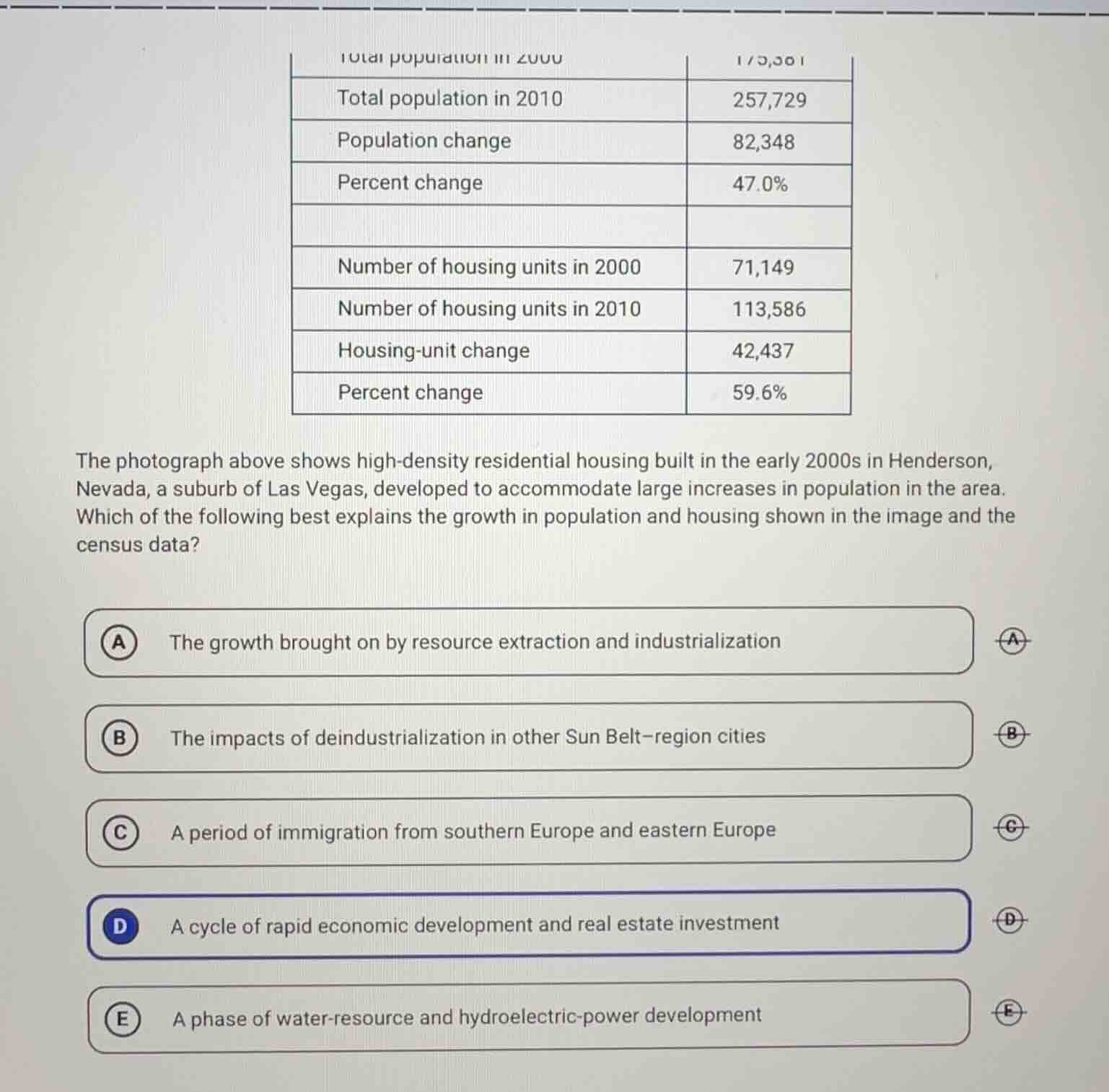
total population in 2000
175,381
total population in 2010
257,729
population change
82,348
percent change
47.0%
number of housing units in 2000
71,149
number of housing units in 2010
113,586
housing - unit change
42,437
percent change
59.6%
the photograph above shows high - density residential housing built in the early 2000s in henderson, nevada, a suburb of las vegas, developed to accommodate large increases in population in the area. which of the following best explains the growth in population and housing shown in the image and the census data?
a the growth brought on by resource extraction and industrialization
b the impacts of deindustrialization in other sun belt - region cities
c a period of immigration from southern europe and eastern europe
d a cycle of rapid economic development and real estate investment
e a phase of water - resource and hydroelectric - power development
To determine the best explanation for the population and housing growth in Henderson, Nevada (a Las Vegas suburb) in the early 2000s:
- Option A: Resource extraction/industrialization is not the main driver for Las Vegas - Henderson growth (Las Vegas is more about tourism/real estate, not resource - based industrialization).
- Option B: Deindustrialization in other Sun Belt cities would not cause growth in Henderson; it would likely affect those cities negatively, not drive growth elsewhere.
- Option C: Immigration from southern/eastern Europe was more prominent in earlier waves (e.g., late 19th/early 20th century), not the early 2000s in this region.
- Option D: Las Vegas and its suburbs like Henderson experienced rapid economic development (tourism, entertainment) and real estate investment in the early 2000s, leading to population and housing growth, which matches the data.
- Option E: Water - resource and hydroelectric - power development is not the primary growth driver for this urban/suburban area.

Snap & solve any problem in the app
Get step-by-step solutions on Sovi AI
Photo-based solutions with guided steps
Explore more problems and detailed explanations
D. A cycle of rapid economic development and real estate investment