QUESTION IMAGE
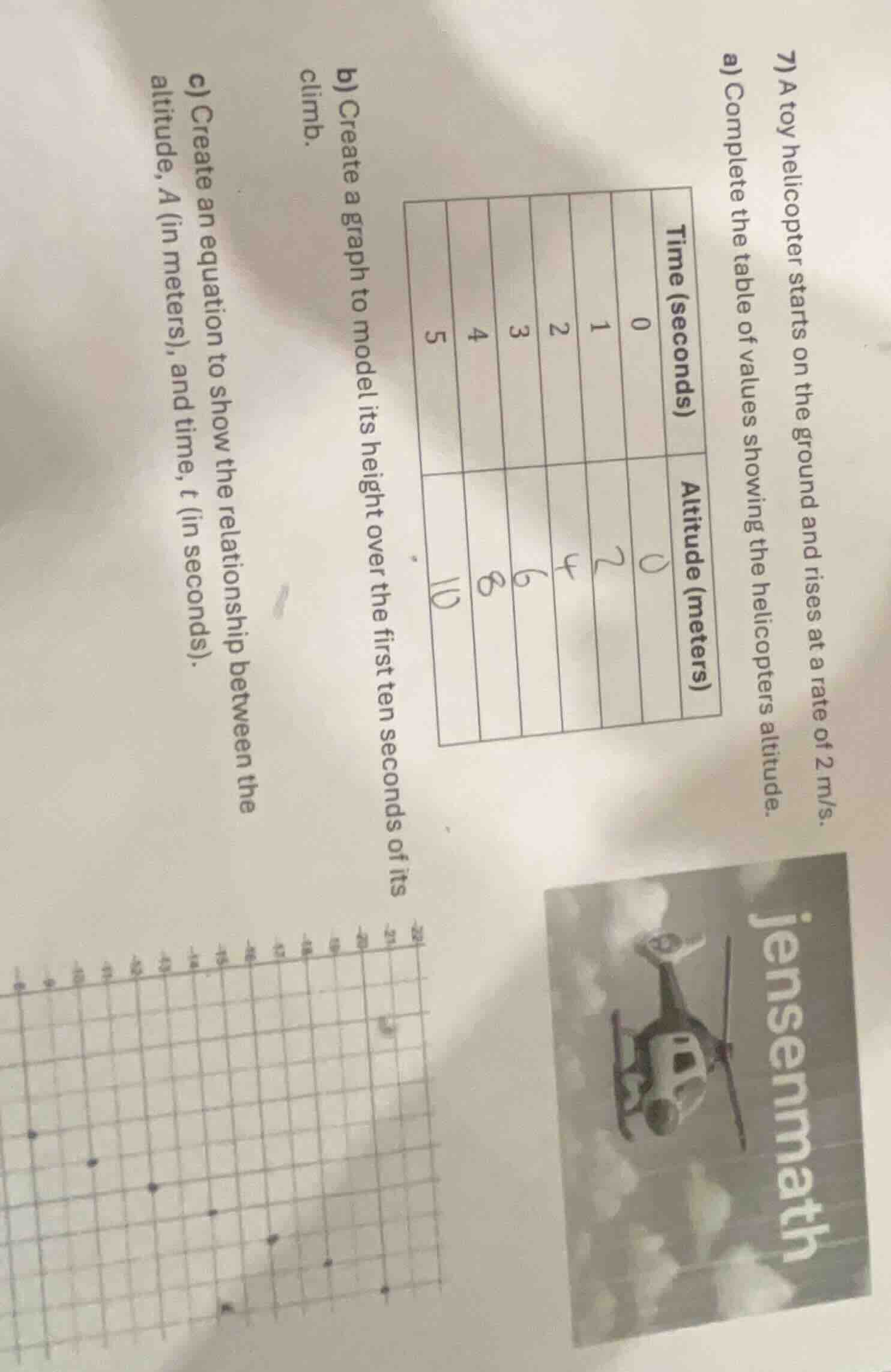
Question
- a toy helicopter starts on the ground and rises at a rate of 2 m/s.
a) complete the table of values showing the helicopters altitude.
| time (seconds) | 0 | 1 | 2 | 3 | 4 | 5 |
| altitude (meters) | 0 | 2 | 4 | 6 | 8 | 10 |
b) create a graph to model its height over the first ten seconds of its climb.
c) create an equation to show the relationship between the altitude, a (in meters), and time, t (in seconds).
Part (a)
Step1: Determine the altitude formula
The helicopter rises at a rate of \( 2 \, \text{m/s} \), so the altitude \( A \) (in meters) at time \( t \) (in seconds) is given by \( A = 2t \).
Step2: Calculate altitude for each time
- For \( t = 0 \): \( A = 2(0) = 0 \)
- For \( t = 1 \): \( A = 2(1) = 2 \)
- For \( t = 2 \): \( A = 2(2) = 4 \)
- For \( t = 3 \): \( A = 2(3) = 6 \)
- For \( t = 4 \): \( A = 2(4) = 8 \)
- For \( t = 5 \): \( A = 2(5) = 10 \)
So the completed table is:
| Time (seconds) | 0 | 1 | 2 | 3 | 4 | 5 |
|---|
Part (b)
Step1: Identify the variables
The independent variable is time \( t \) (in seconds) and the dependent variable is altitude \( A \) (in meters).
Step2: Plot the points
Using the table from part (a), we have the points \((0, 0)\), \((1, 2)\), \((2, 4)\), \((3, 6)\), \((4, 8)\), \((5, 10)\), and we can continue up to \( t = 10 \) (since we need the first ten seconds). For \( t = 6 \), \( A = 12 \); \( t = 7 \), \( A = 14 \); \( t = 8 \), \( A = 16 \); \( t = 9 \), \( A = 18 \); \( t = 10 \), \( A = 20 \).
Step3: Draw the graph
Plot these points on a coordinate plane with the x - axis as time (from 0 to 10) and the y - axis as altitude (from 0 to 20). Then draw a straight line through these points since the relationship is linear.
Part (c)
Step1: Determine the type of relationship
The altitude of the helicopter is increasing at a constant rate of \( 2 \, \text{m/s} \). This is a linear relationship.
Step2: Write the linear equation
The general form of a linear equation is \( y=mx + b \), where \( m \) is the slope (rate of change) and \( b \) is the y - intercept. Here, the initial altitude (when \( t = 0 \)) is \( 0 \), so \( b = 0 \), and the rate of change \( m=2 \) (since it rises 2 meters per second). So the equation relating altitude \( A \) (in meters) and time \( t \) (in seconds) is \( A = 2t \).

Snap & solve any problem in the app
Get step-by-step solutions on Sovi AI
Photo-based solutions with guided steps
Explore more problems and detailed explanations
s:
a) The completed table is as shown above.
b) The graph is a straight line passing through the points \((t,A)\) where \( A = 2t \) for \( t\in[0,10]\).
c) The equation is \( A = 2t \)