QUESTION IMAGE
Question
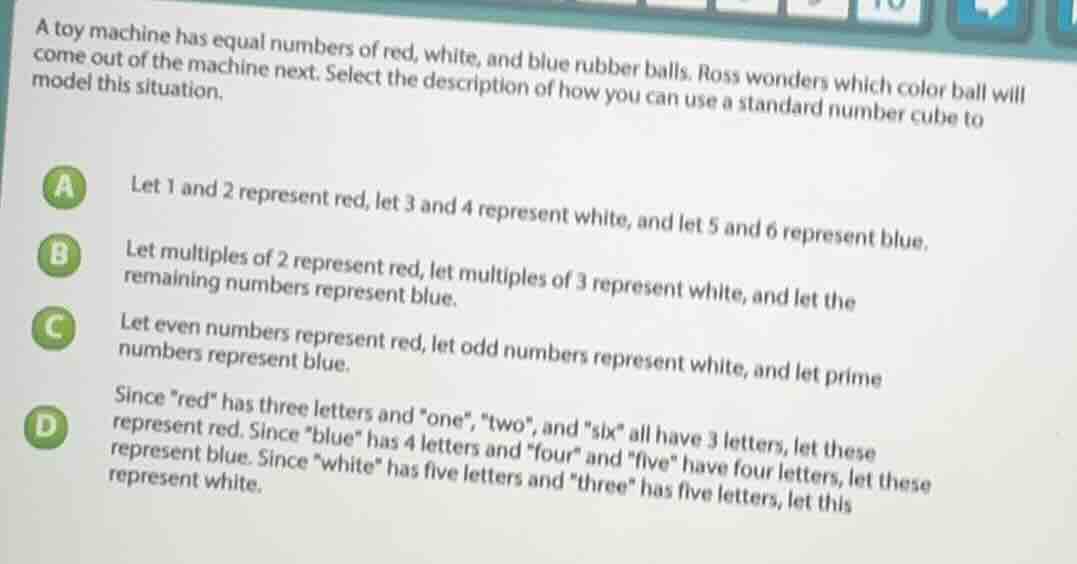
a toy machine has equal numbers of red, white, and blue rubber balls. ross wonders which color ball will come out of the machine next. select the description of how you can use a standard number cube to model this situation.
a let 1 and 2 represent red, let 3 and 4 represent white, and let 5 and 6 represent blue.
b let multiples of 2 represent red, let multiples of 3 represent white, and let the remaining numbers represent blue.
c let even numbers represent red, let odd numbers represent white, and let prime numbers represent blue.
d since
ed\ has three letters and \one\, \two\, and \six\ all have 3 letters, let these represent red. since \blue\ has 4 letters and \four\ and \five\ have four letters, let these represent blue. since \white\ has five letters and \three\ has five letters, let this represent white.
The situation requires equal probability for red, white, and blue balls (each with a $\frac{1}{3}$ chance). A standard number cube has 6 outcomes, so each color needs to map to 2 equally likely outcomes to maintain equal probability.
- Option A assigns 2 numbers to each color, creating equal $\frac{2}{6}=\frac{1}{3}$ probability for each.
- Option B: Multiples of 2 (2,4,6: 3 outcomes), multiples of 3 (3,6: overlap, only 1 unique new outcome), remaining (1: 1 outcome) → unequal probabilities.
- Option C: Even numbers (3 outcomes), odd numbers (3 outcomes), prime numbers (2,3,5: overlap) → unequal probabilities.
- Option D: Red maps to 3 numbers, blue to 2, white to 1 → unequal probabilities.

Snap & solve any problem in the app
Get step-by-step solutions on Sovi AI
Photo-based solutions with guided steps
Explore more problems and detailed explanations
A. Let 1 and 2 represent red, let 3 and 4 represent white, and let 5 and 6 represent blue.