QUESTION IMAGE
Question
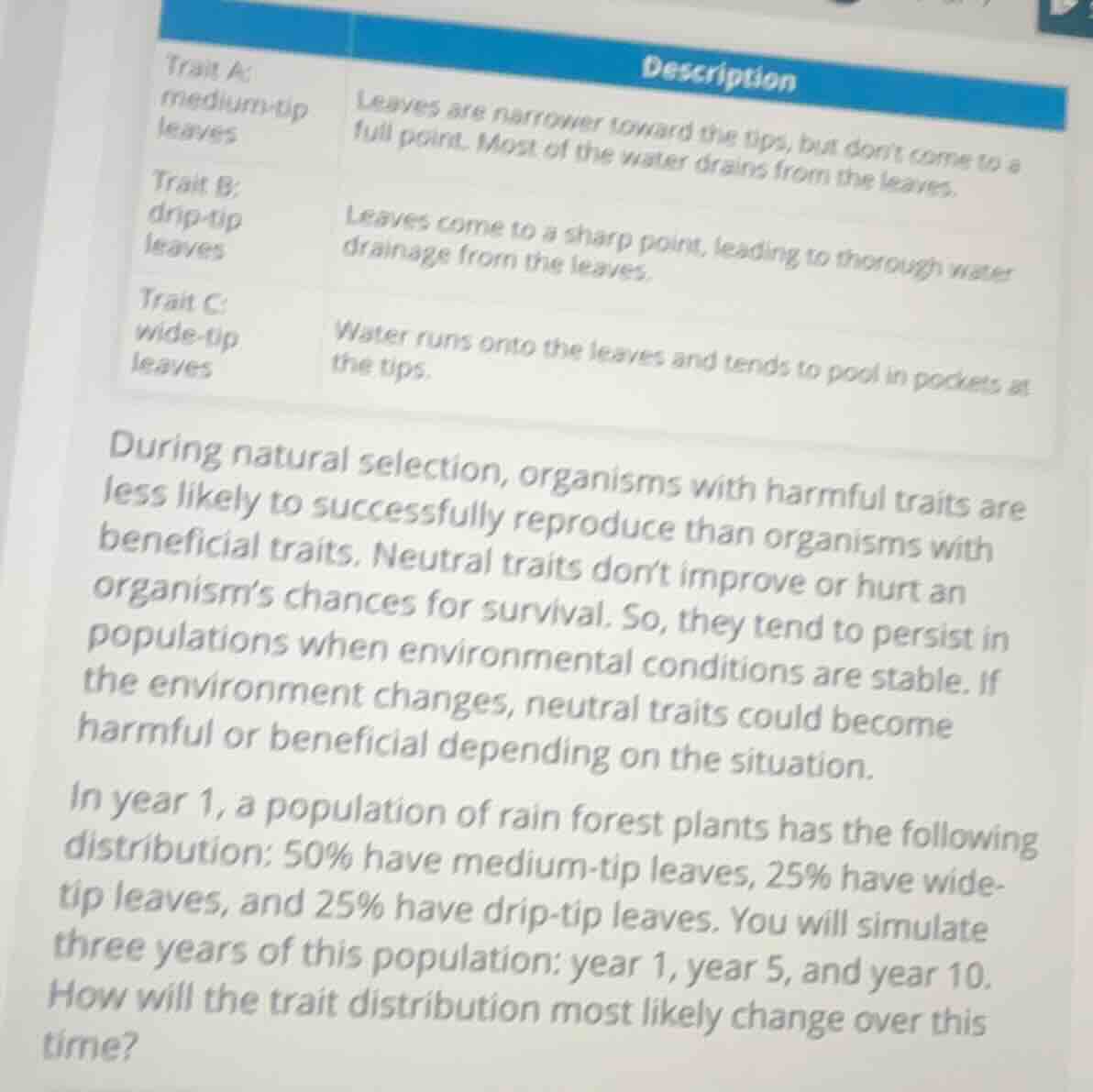
trait a: medium-tip leaves
description
leaves are narrower toward the tips, but dont come to a full point. most of the water drains from the leaves.
trait b: drip-tip leaves
leaves come to a sharp point, leading to thorough water drainage from the leaves.
trait c: wide-tip leaves
water runs onto the leaves and tends to pool in pockets at the tips.
during natural selection, organisms with harmful traits are less likely to successfully reproduce than organisms with beneficial traits. neutral traits dont improve or hurt an organisms chances for survival. so, they tend to persist in populations when environmental conditions are stable. if the environment changes, neutral traits could become harmful or beneficial depending on the situation.
in year 1, a population of rain forest plants has the following distribution: 50% have medium-tip leaves, 25% have wide-tip leaves, and 25% have drip-tip leaves. you will simulate three years of this population: year 1, year 5, and year 10. how will the trait distribution most likely change over this time?
Step1: Analyze trait fitness in rainforest
Rainforests have high rainfall. Drip-tip leaves (Trait B) enable thorough water drainage, preventing fungal/bacterial growth on leaves, so this is a beneficial trait. Medium-tip leaves (Trait A) allow most water to drain, so this is a neutral or slightly beneficial trait. Wide-tip leaves (Trait C) pool water, which promotes harmful microbial growth, so this is a harmful trait.
Step2: Apply natural selection rules
Beneficial traits increase in population, harmful traits decrease, neutral traits persist or change slowly.
Step3: Predict year 5 distribution
Drip-tip (B) increases, wide-tip (C) decreases, medium-tip (A) stays stable or slightly changes. Example: 45% A, 15% C, 40% B.
Step4: Predict year 10 distribution
Drip-tip (B) continues to increase, wide-tip (C) nears low levels, medium-tip (A) remains stable or slightly decreases. Example: 40% A, 5% C, 55% B.

Snap & solve any problem in the app
Get step-by-step solutions on Sovi AI
Photo-based solutions with guided steps
Explore more problems and detailed explanations
- Year 1: 50% medium-tip leaves, 25% wide-tip leaves, 25% drip-tip leaves
- Year 5: ~45% medium-tip leaves, ~15% wide-tip leaves, ~40% drip-tip leaves
- Year 10: ~40% medium-tip leaves, ~5% wide-tip leaves, ~55% drip-tip leaves
Over time, the proportion of drip-tip leaves (beneficial for rainforest conditions) will increase significantly, wide-tip leaves (harmful) will decrease drastically, and medium-tip leaves will remain relatively stable but may decline slightly.