QUESTION IMAGE
Question
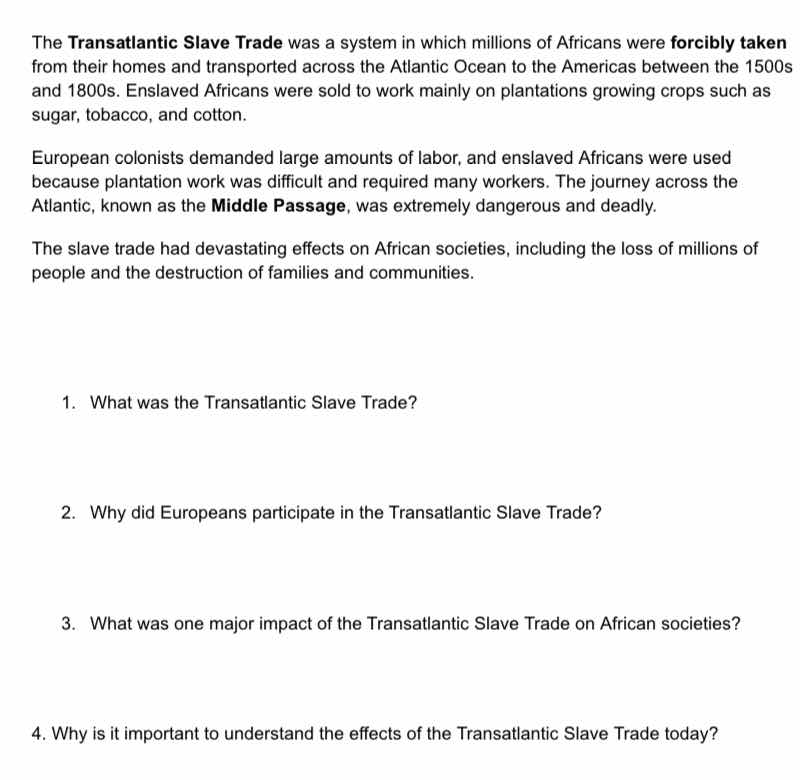
the transatlantic slave trade was a system in which millions of africans were forcibly taken from their homes and transported across the atlantic ocean to the americas between the 1500s and 1800s. enslaved africans were sold to work mainly on plantations growing crops such as sugar, tobacco, and cotton.
european colonists demanded large amounts of labor, and enslaved africans were used because plantation work was difficult and required many workers. the journey across the atlantic, known as the middle passage, was extremely dangerous and deadly.
the slave trade had devastating effects on african societies, including the loss of millions of people and the destruction of families and communities.
- what was the transatlantic slave trade?
- why did europeans participate in the transatlantic slave trade?
- what was one major impact of the transatlantic slave trade on african societies?
- why is it important to understand the effects of the transatlantic slave trade today?
- Defined using the provided text's core description of the system.
- Based on the stated labor demand for plantation work.
- Pulled directly from the listed devastating effects on African societies.
- Framed around contextualizing historical inequities and their modern legacies.

Snap & solve any problem in the app
Get step-by-step solutions on Sovi AI
Photo-based solutions with guided steps
Explore more problems and detailed explanations
- The Transatlantic Slave Trade was a system where millions of Africans were forcibly taken from their homes, transported across the Atlantic to the Americas between the 1500s and 1800s, and sold to work mainly on plantations growing crops like sugar, tobacco, and cotton.
- European colonists participated because they demanded large amounts of labor for difficult plantation work, and enslaved Africans provided the needed workforce.
- One major impact was the loss of millions of people, along with the destruction of African families and communities.
- Understanding its effects today is important to recognize and address the historical inequities, intergenerational trauma, and ongoing social and economic legacies that stem from this system, as it helps contextualize modern disparities and promotes informed discussions about justice and reconciliation.