QUESTION IMAGE
Question
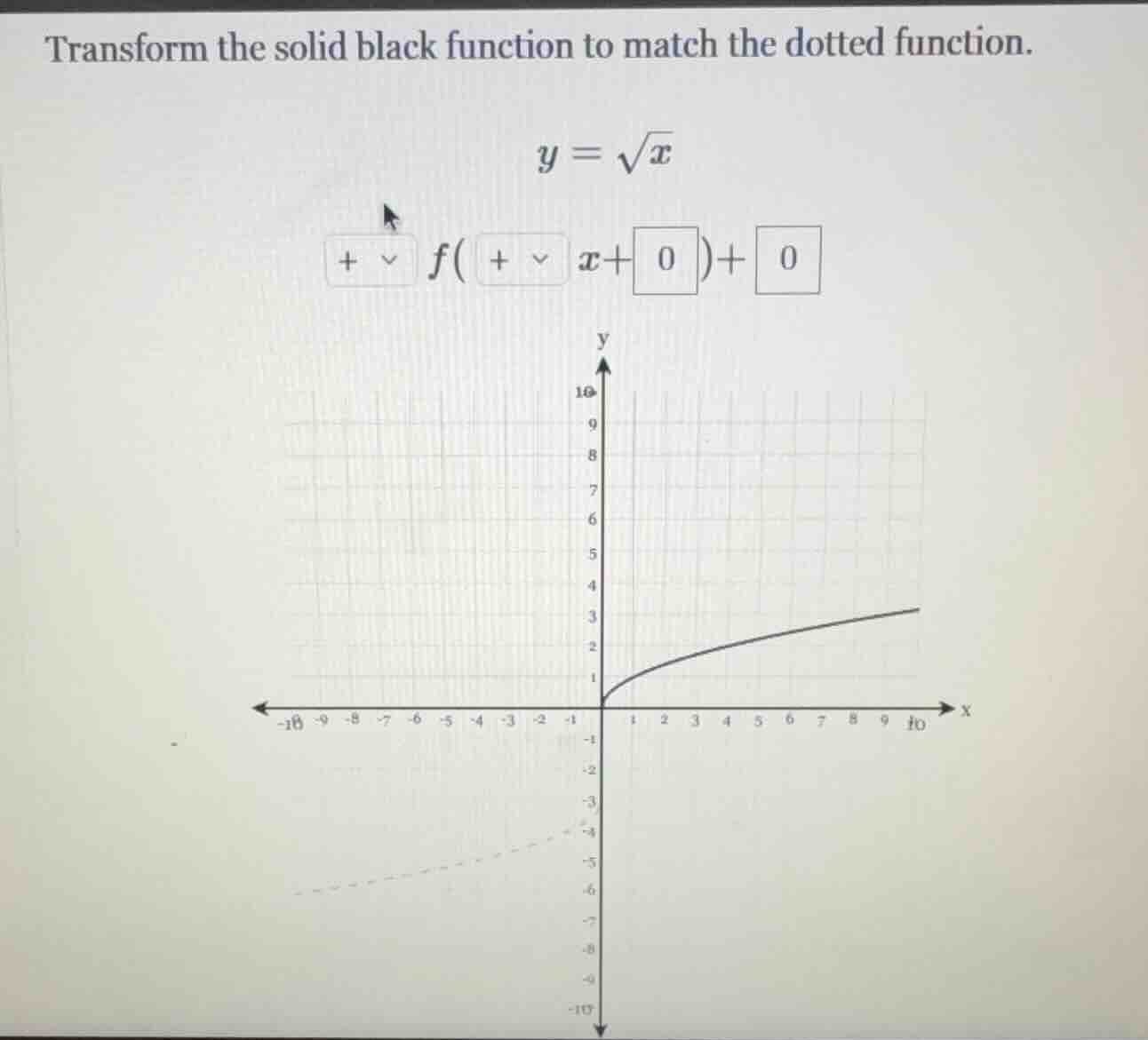
transform the solid black function to match the dotted function.
$y = \sqrt{x}$
$+ \\ f(+ \\ x + 0) + 0$
Step1: Analyze vertical reflection
The solid function is \( y = \sqrt{x} \) (opening up, starting at origin). The dotted function is below the x - axis, so we need a vertical reflection. A vertical reflection of a function \( y = f(x) \) is \( y=-f(x) \). So the first sign (outside the function) should be negative.
Step2: Analyze horizontal transformation
Looking at the dotted function, it seems to be a horizontal shift? Wait, no, the dotted function's shape: let's check the form. Wait, the original function is \( y = \sqrt{x} \), the dotted function is a reflection and maybe shift? Wait, the dotted function is in the third quadrant - like, so first, vertical reflection (\( -f(x) \)), and then horizontal shift? Wait, no, let's see the form given: \( \pm f(\pm x + 0)+0 \). Wait, the horizontal part: if we have \( f(-x) \), that's a horizontal reflection. But also, the dotted function is shifted left? Wait, no, let's check the graph. The solid function is \( y=\sqrt{x} \) (domain \( x\geq0 \), range \( y\geq0 \)). The dotted function has domain \( x\leq0 \) (since it's on the left side) and range \( y\leq0 \). So first, horizontal reflection: replace \( x \) with \( -x \), so \( f(-x)=\sqrt{-x} \), then vertical reflection: \( -f(-x)=-\sqrt{-x} \). So the form is \( -f(-x + 0)+0 \), so the first sign (outside) is \( - \), the sign inside (for \( x \)) is \( - \).
Wait, let's re - express. The general form of transformations: \( a\cdot f(b(x - h))+k \), where \( a \) is vertical stretch/reflection, \( b \) is horizontal stretch/reflection, \( h \) is horizontal shift, \( k \) is vertical shift. Here \( h = 0 \), \( k = 0 \). For the solid function \( f(x)=\sqrt{x} \), to get the dotted function:
- Vertical reflection: \( a=- 1 \), so the first sign (the one outside \( f \)) is \( - \).
- Horizontal reflection: \( b=-1 \), so the sign inside (for \( x \)) is \( - \) (since \( b(x - h)=-1\cdot(x - 0)=-x \), so in the form \( f(\pm x+0) \), it's \( f(-x + 0) \)).

Snap & solve any problem in the app
Get step-by-step solutions on Sovi AI
Photo-based solutions with guided steps
Explore more problems and detailed explanations
The first box (outside \( f \)): \( - \), the second box (inside \( f \) for \( x \)): \( - \)
So the transformation is \( -f(-x + 0)+0 \)