QUESTION IMAGE
Question
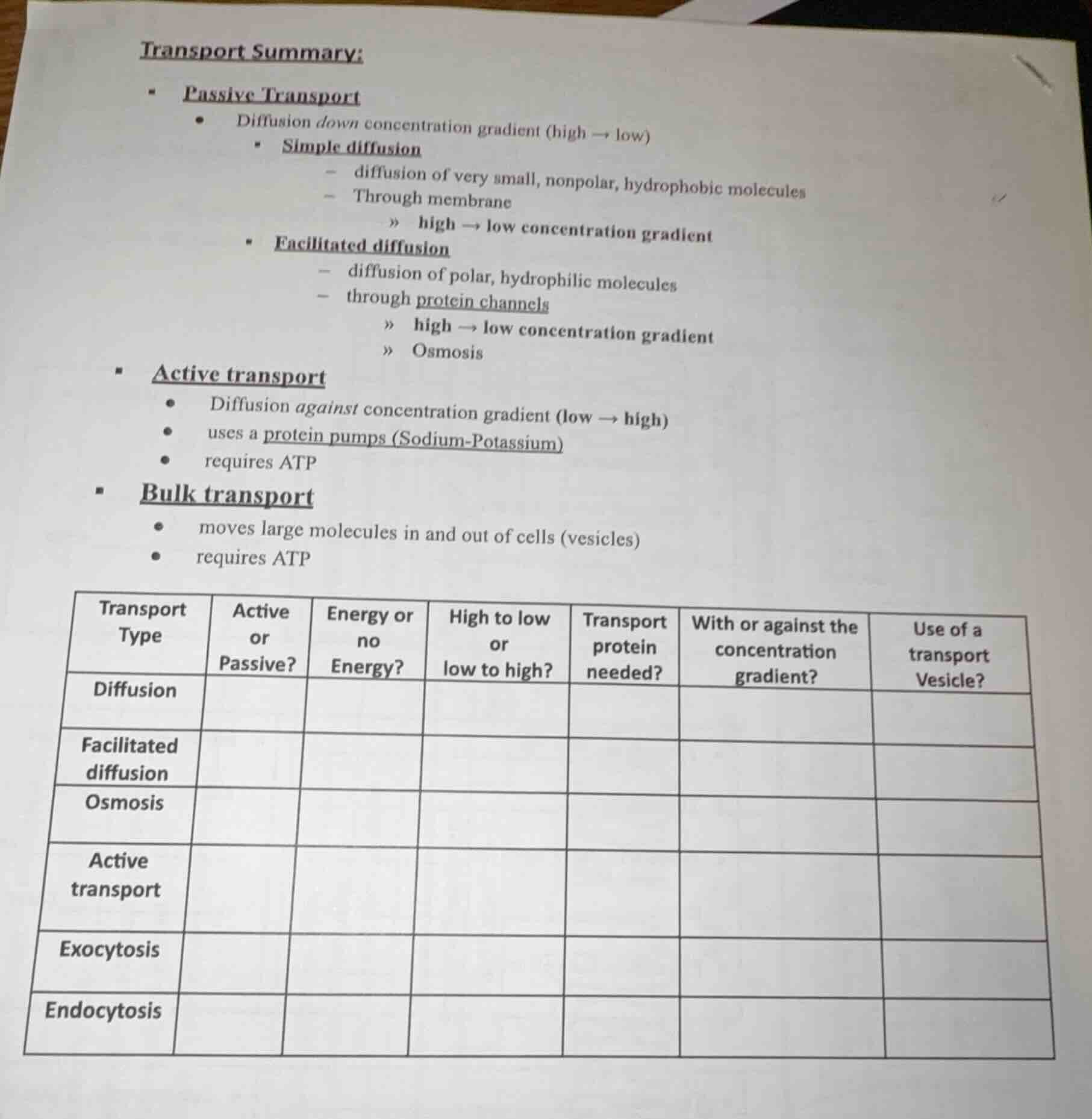
transport summary:
- passive transport
- diffusion down concentration gradient (high → low)
- simple diffusion
- diffusion of very small, nonpolar, hydrophobic molecules
- through membrane
» high → low concentration gradient
- facilitated diffusion
- diffusion of polar, hydrophilic molecules
- through protein channels
» high → low concentration gradient
» osmosis
- active transport
- diffusion against concentration gradient (low → high)
- uses a protein pumps (sodium - potassium)
- requires atp
- bulk transport
- moves large molecules in and out of cells (vesicles)
- requires atp
| transport type | active or passive? | energy or no energy? | high to low or low to high? | transport protein needed? | with or against the concentration gradient? | use of a transport vesicle? |
|---|---|---|---|---|---|---|
| facilitated diffusion | ||||||
| osmosis | ||||||
| active transport | ||||||
| exocytosis | ||||||
| endocytosis |
Response
To fill the table, we analyze each transport type using the provided summary:
1. Diffusion
- Active or Passive?: Passive (diffusion down concentration gradient, no energy needed)
- Energy or no Energy?: No Energy (passive transport)
- High to low or low to high?: High to low (down concentration gradient)
- Transport protein needed?: No (simple diffusion through membrane)
- With or against the concentration gradient?: With (down gradient: high → low)
- Use of a transport Vesicle?: No (small molecules, no vesicles)
2. Facilitated diffusion
- Active or Passive?: Passive (still diffusion down gradient, just facilitated)
- Energy or no Energy?: No Energy (passive)
- High to low or low to high?: High to low (down gradient)
- Transport protein needed?: Yes (through protein channels)
- With or against the concentration gradient?: With (down gradient)
- Use of a transport Vesicle?: No (uses channels, not vesicles)
3. Osmosis
- Active or Passive?: Passive (type of facilitated diffusion for water, down gradient)
- Energy or no Energy?: No Energy (passive)
- High to low or low to high?: High to low (water moves to high solute, low water → high water? Wait, osmosis: water moves from low solute (high water) to high solute (low water) → so water gradient is high → low (water concentration). So overall, for water, high (water) → low (water) which is high to low in water, but solute is low → high. But the question is "High to low or low to high?" (for the substance moving? Wait, osmosis is water moving. So water moves from high water (low solute) to low water (high solute) → so high to low (water). So answer: High to low.
- Transport protein needed?: Yes (aquaporins, a type of protein channel)
- With or against the concentration gradient?: With (water moves down its concentration gradient)
- Use of a transport Vesicle?: No (uses aquaporins)
4. Active transport
- Active or Passive?: Active (requires ATP, moves against gradient)
- Energy or no Energy?: Energy (requires ATP)
- High to low or low to high?: Low to high (against concentration gradient)
- Transport protein needed?: Yes (protein pumps like Sodium - Potassium pump)
- With or against the concentration gradient?: Against (low → high)
- Use of a transport Vesicle?: No (uses pumps, not vesicles)
5. Exocytosis
- Active or Passive?: Active (requires ATP, bulk transport)
- Energy or no Energy?: Energy (requires ATP)
- High to low or low to high?: High to low (moves large molecules out, but the gradient for the molecule? Wait, bulk transport moves large molecules regardless, but the process is active. Wait, exocytosis is moving molecules out of the cell, often from high concentration inside to low outside? Or not? Wait, bulk transport (exo/endo) is active, requires ATP, uses vesicles. So for the direction: it's moving molecules out (exocytosis) - the concentration gradient? Maybe not the main factor, but the process is active. So "High to low or low to high?" - maybe the answer is not straightforward, but since it's active, it can move against, but often it's moving from inside (where concentration may be high) to outside (low). But the key is the process is active. However, for the table, let's go by the summary: bulk transport moves large molecules, requires ATP (active), uses vesicles. So:
- Active or Passive?: Active
- Energy or no Energy?: Energy
- High to low or low to high?: Let's assume it can be either, but the process is active. But maybe the answe…
for each row:
Diffusion:
- Active or Passive?: Passive (diffusion down concentration gradient, no energy).
- Energy or no Energy?: No Energy (passive transport doesn't need energy).
- High to low or low to high?: High to low (diffusion moves from high to low concentration).
- Transport protein needed?: No (simple diffusion through the membrane, no proteins).
- With or against the concentration gradient?: With (moves down the concentration gradient).
- Use of a transport Vesicle?: No (small molecules, no vesicles involved).
Facilitated diffusion:
- Active or Passive?: Passive (still diffusion down gradient, just with help).
- Energy or no Energy?: No Energy (passive, uses concentration gradient as energy source).
- High to low or low to high?: High to low (down concentration gradient).
- Transport protein needed?: Yes (uses protein channels for polar molecules).
- With or against the concentration gradient?: With (down the gradient).
- Use of a transport Vesicle?: No (uses protein channels, not vesicles).
Osmosis:
- Active or Passive?: Passive (type of facilitated diffusion for water, down water gradient).
- Energy or no Energy?: No Energy (passive, water moves down its gradient).
- High to low or low to high?: High to low (water moves from high water concentration to low water concentration).
- Transport protein needed?: Yes (aquaporins, protein channels for water).
- With or against the concentration gradient?: With (water moves down its concentration gradient).
- Use of a transport Vesicle?: No (uses aquaporins, not vesicles).
Active transport:
- Active or Passive?: Active (requires ATP, moves against gradient).
- Energy or no Energy?: Energy (requires ATP for protein pumps).
- High to low or low to high?: Low to high (moves against the concentration gradient).
- Transport protein needed?: Yes (protein pumps like Sodium - Potassium pump).
- With or against the concentration gradient?: Against (moves from low to high concentration).
- Use of a transport Vesicle?: No (uses protein pumps, not vesicles).
Exocytosis:
- Active or Passive?: Active (bulk transport, requires ATP for vesicle fusion).
- Energy or no Energy?: Energy (ATP required for vesicle movement and fusion).
- High to low or low to high?: High to low (molecules move out from high concentration inside the cell to low outside).
- Transport protein needed?: No (uses vesicles, not transport proteins for pumping).
- With or against the concentration gradient?: With (molecules move down their concentration gradient out of the cell) but the process is active because energy is needed for vesicle processes.
- Use of a transport Vesicle?: Yes (forms vesicles to secrete molecules out of the cell).
Endocytosis:
- Active or Passive?: Active (bulk transport, requires ATP for vesicle formation).
- Energy or no Energy?: Energy (ATP required for vesicle formation and movement).
- High to low or low to high?: Low to high (molecules move into the cell from outside, often against their concentration gradient).
- Transport protein needed?: No (uses vesicles to engulf molecules, not transport proteins for pumping).
- With or against the concentration gradient?: Against (moves into the cell, often against the molecule's concentration gradient).
- Use of a transport Vesicle?: Yes (forms vesicles to take in molecules from outside the cell).

Snap & solve any problem in the app
Get step-by-step solutions on Sovi AI
Photo-based solutions with guided steps
Explore more problems and detailed explanations
for each row:
Diffusion:
- Active or Passive?: Passive (diffusion down concentration gradient, no energy).
- Energy or no Energy?: No Energy (passive transport doesn't need energy).
- High to low or low to high?: High to low (diffusion moves from high to low concentration).
- Transport protein needed?: No (simple diffusion through the membrane, no proteins).
- With or against the concentration gradient?: With (moves down the concentration gradient).
- Use of a transport Vesicle?: No (small molecules, no vesicles involved).
Facilitated diffusion:
- Active or Passive?: Passive (still diffusion down gradient, just with help).
- Energy or no Energy?: No Energy (passive, uses concentration gradient as energy source).
- High to low or low to high?: High to low (down concentration gradient).
- Transport protein needed?: Yes (uses protein channels for polar molecules).
- With or against the concentration gradient?: With (down the gradient).
- Use of a transport Vesicle?: No (uses protein channels, not vesicles).
Osmosis:
- Active or Passive?: Passive (type of facilitated diffusion for water, down water gradient).
- Energy or no Energy?: No Energy (passive, water moves down its gradient).
- High to low or low to high?: High to low (water moves from high water concentration to low water concentration).
- Transport protein needed?: Yes (aquaporins, protein channels for water).
- With or against the concentration gradient?: With (water moves down its concentration gradient).
- Use of a transport Vesicle?: No (uses aquaporins, not vesicles).
Active transport:
- Active or Passive?: Active (requires ATP, moves against gradient).
- Energy or no Energy?: Energy (requires ATP for protein pumps).
- High to low or low to high?: Low to high (moves against the concentration gradient).
- Transport protein needed?: Yes (protein pumps like Sodium - Potassium pump).
- With or against the concentration gradient?: Against (moves from low to high concentration).
- Use of a transport Vesicle?: No (uses protein pumps, not vesicles).
Exocytosis:
- Active or Passive?: Active (bulk transport, requires ATP for vesicle fusion).
- Energy or no Energy?: Energy (ATP required for vesicle movement and fusion).
- High to low or low to high?: High to low (molecules move out from high concentration inside the cell to low outside).
- Transport protein needed?: No (uses vesicles, not transport proteins for pumping).
- With or against the concentration gradient?: With (molecules move down their concentration gradient out of the cell) but the process is active because energy is needed for vesicle processes.
- Use of a transport Vesicle?: Yes (forms vesicles to secrete molecules out of the cell).
Endocytosis:
- Active or Passive?: Active (bulk transport, requires ATP for vesicle formation).
- Energy or no Energy?: Energy (ATP required for vesicle formation and movement).
- High to low or low to high?: Low to high (molecules move into the cell from outside, often against their concentration gradient).
- Transport protein needed?: No (uses vesicles to engulf molecules, not transport proteins for pumping).
- With or against the concentration gradient?: Against (moves into the cell, often against the molecule's concentration gradient).
- Use of a transport Vesicle?: Yes (forms vesicles to take in molecules from outside the cell).