QUESTION IMAGE
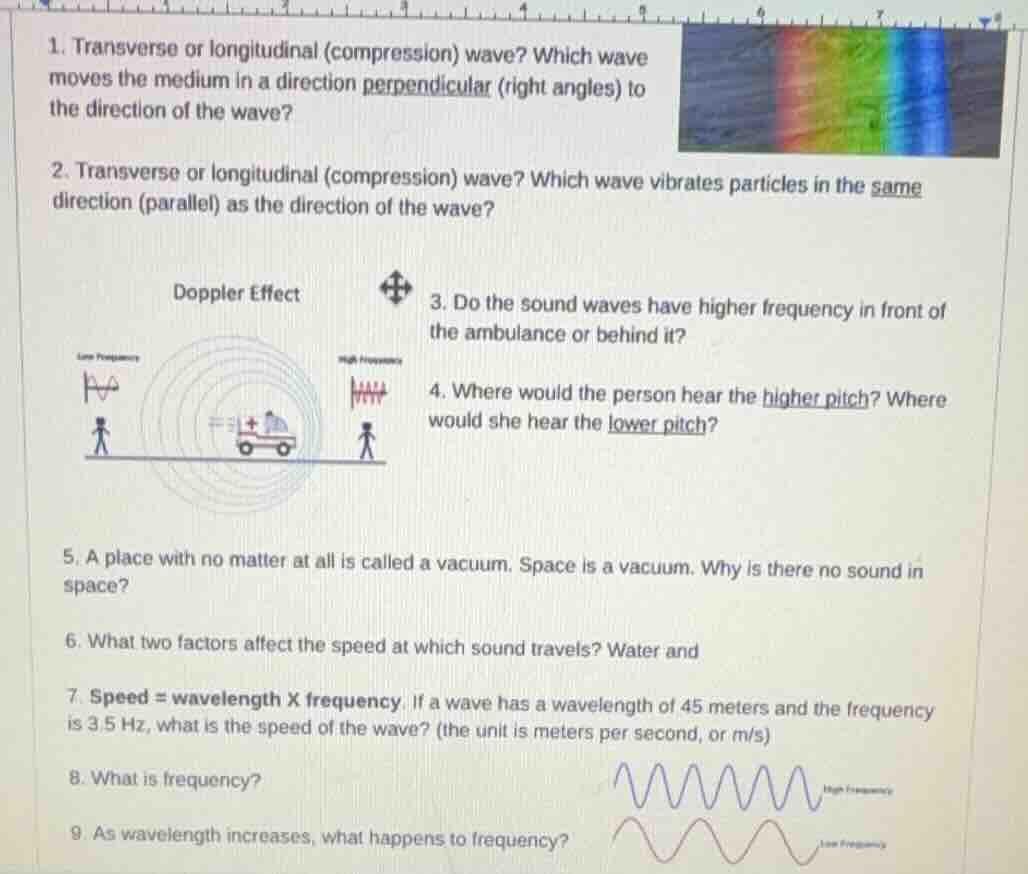
Question
- transverse or longitudinal (compression) wave? which wave moves the medium in a direction perpendicular (right angles) to the direction of the wave?
- transverse or longitudinal (compression) wave? which wave vibrates particles in the same direction (parallel) as the direction of the wave?
- do the sound waves have higher frequency in front of the ambulance or behind it?
- where would the person hear the higher pitch? where would she hear the lower pitch?
- a place with no matter at all is called a vacuum. space is a vacuum. why is there no sound in space?
- what two factors affect the speed at which sound travels? water and
- speed = wavelength × frequency. if a wave has a wavelength of 45 meters and the frequency is 3.5 hz, what is the speed of the wave? (the unit is meters per second, or m/s)
- what is frequency?
- as wavelength increases, what happens to frequency?
Question 1
Transverse waves are defined as waves where the medium's particles move perpendicular to the wave's direction of propagation. Longitudinal waves have particles moving parallel. So the wave with medium motion perpendicular is transverse.
Longitudinal (compression) waves have particles vibrating in the same (parallel) direction as the wave's travel. Transverse is perpendicular, so the wave with same - direction vibration is longitudinal.
By the Doppler Effect, when a source (ambulance) moves towards an observer, the waves in front are compressed, leading to a higher frequency. So sound waves have higher frequency in front of the ambulance.

Snap & solve any problem in the app
Get step-by-step solutions on Sovi AI
Photo-based solutions with guided steps
Explore more problems and detailed explanations
Transverse wave