QUESTION IMAGE
Question
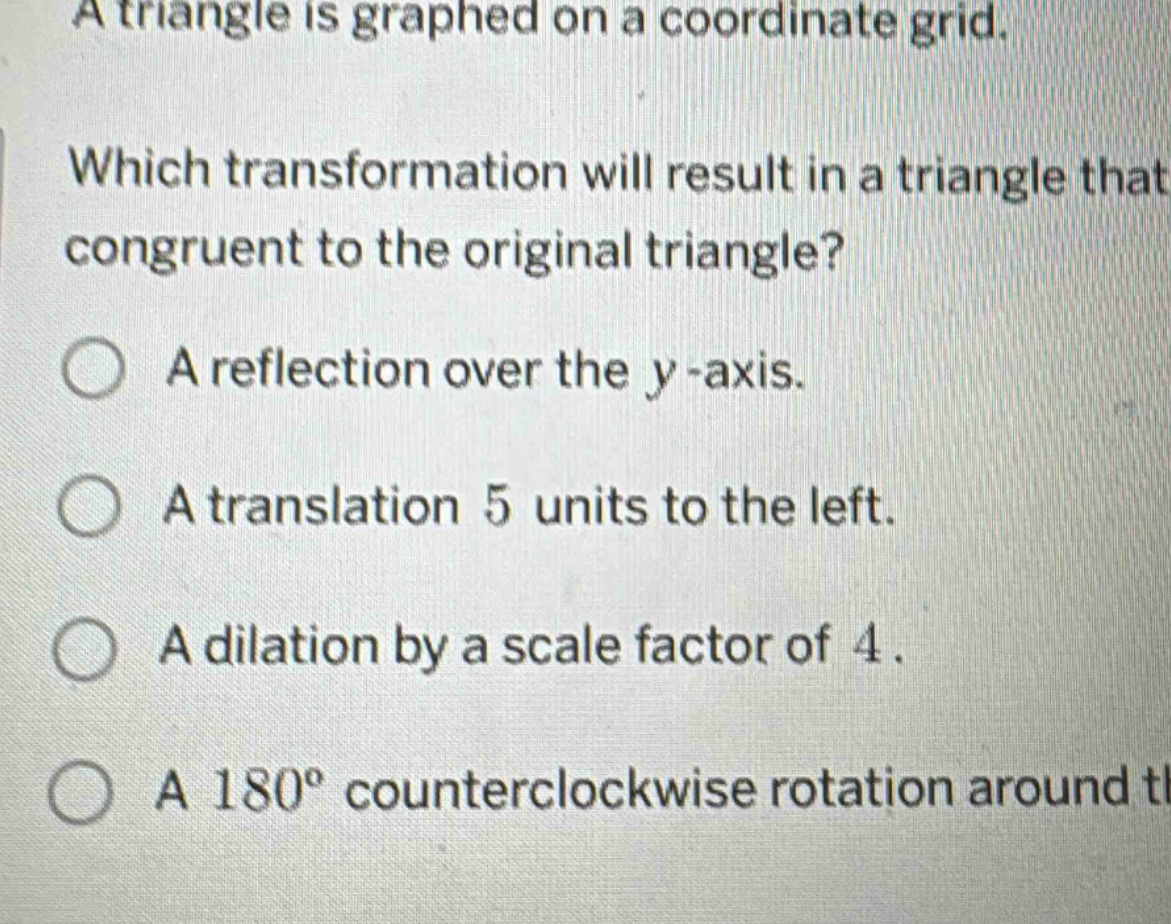
a triangle is graphed on a coordinate grid. which transformation will result in a triangle that congruent to the original triangle? a reflection over the y -axis. a translation 5 units to the left. a dilation by a scale factor of 4. a 180° counterclockwise rotation around t
To determine which transformation results in a congruent triangle, we recall the definitions of congruence and transformations:
- Reflection over the y - axis: A reflection is a rigid transformation. Rigid transformations (reflections, translations, rotations) preserve the shape and size of the figure. So, a reflection over the y - axis will produce a triangle with the same side lengths and angles as the original, hence congruent.
- Translation 5 units to the left: A translation is also a rigid transformation. It only moves the figure without changing its shape or size. So, a translation 5 units to the left will result in a triangle congruent to the original.
- Dilation by a scale factor of 4: Dilation is a non - rigid transformation. It changes the size of the figure (it scales the figure by the scale factor). So, a dilation with a scale factor of 4 will produce a triangle that is similar (but not congruent, unless the scale factor is 1) to the original triangle.
- 180° counterclockwise rotation: A rotation is a rigid transformation. It rotates the figure around a point but does not change its shape or size. So, a 180° counterclockwise rotation will produce a triangle congruent to the original.
Since the question asks for which transformation will result in a congruent triangle, reflections, translations, and rotations (rigid transformations) all result in congruent figures, while dilation (non - rigid) does not. The options A (reflection over y - axis), B (translation 5 units left), and the fourth option (180° rotation) are correct. But since the user might expect the analysis of each option:
For option A: Reflection over y - axis is a rigid transformation. It flips the triangle over the y - axis, but the side lengths and angles remain the same. So, the reflected triangle is congruent.
For option B: Translation 5 units left is a rigid transformation. It moves the triangle 5 units to the left, and the shape and size remain unchanged. So, the translated triangle is congruent.
For option C: Dilation by scale factor 4 changes the size of the triangle (makes it 4 times larger), so the resulting triangle is not congruent (it is similar).
For the fourth option (rotation): A 180° counterclockwise rotation is a rigid transformation. It rotates the triangle around a point, and the shape and size remain the same, so the rotated triangle is congruent.

Snap & solve any problem in the app
Get step-by-step solutions on Sovi AI
Photo-based solutions with guided steps
Explore more problems and detailed explanations
A. A reflection over the y - axis.
B. A translation 5 units to the left.
D. A 180° counterclockwise rotation around the origin (assuming the rotation is around the origin, as is typical in coordinate grid problems). (Note: The fourth option in the original problem seems to have a typo at the end, but assuming it's a rotation around a point like the origin, it is a rigid transformation and results in a congruent triangle.)