QUESTION IMAGE
Question
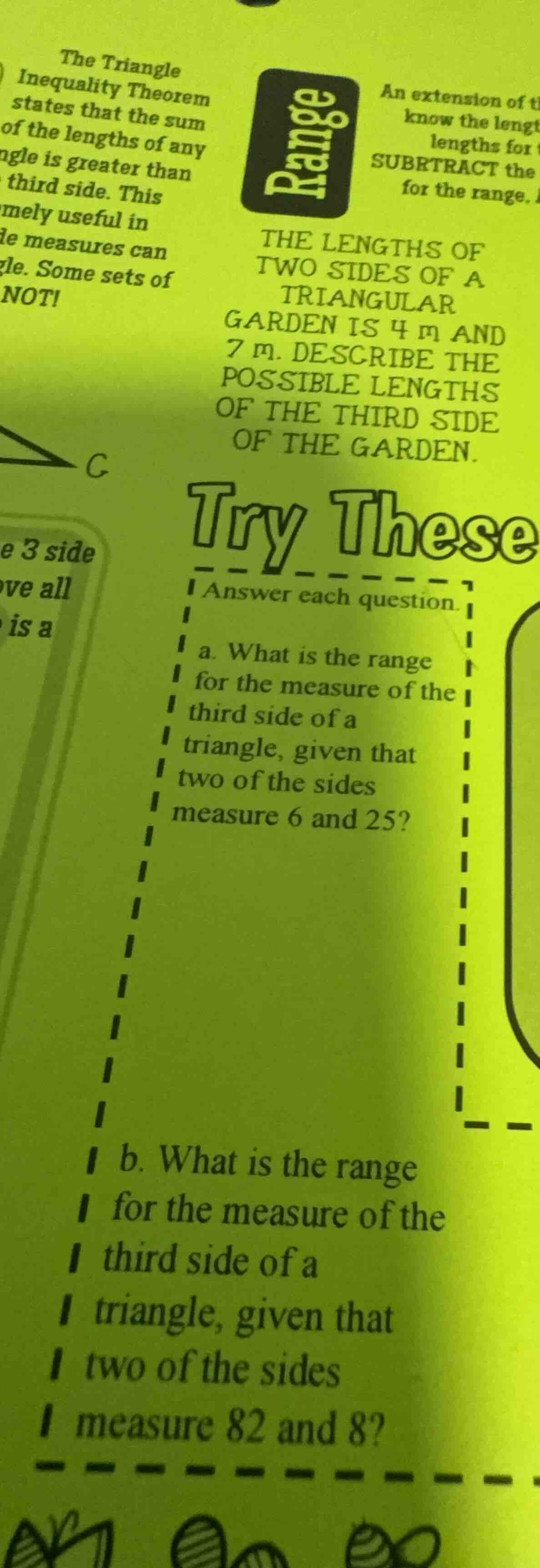
the triangle inequality theorem states that the sum of the lengths of any two sides of a triangle is greater than the length of the third side. this is extremely useful in determining if given side measures can form a triangle. some sets of side lengths just wont work!
range
an extension of this is when you know the lengths of two sides, you can find the possible lengths for the third side. subtract the two given lengths to get the lower bound for the range, and add the two given lengths to get the upper bound for the range.
the lengths of two sides of a triangular garden is 4 m and 7 m. describe the possible lengths of the third side of the garden.
try these
answer each question.
a. what is the range for the measure of the third side of a triangle, given that two of the sides measure 6 and 25?
b. what is the range for the measure of the third side of a triangle, given that two of the sides measure 82 and 8?
Step1: Define third side as \(x\)
Let the third side length be \(x\).
Step2: Apply Triangle Inequality (a)
For sides 6, 25, \(x\):
- \(6 + 25 > x \implies 31 > x\)
- \(6 + x > 25 \implies x > 19\)
- \(25 + x > 6 \implies x > -19\) (irrelevant, length positive)
Combine: \(19 < x < 31\)
Step3: Apply Triangle Inequality (b)
For sides 82, 8, \(x\):
- \(82 + 8 > x \implies 90 > x\)
- \(82 + x > 8 \implies x > -74\) (irrelevant)
- \(8 + x > 82 \implies x > 74\)
Combine: \(74 < x < 90\)

Snap & solve any problem in the app
Get step-by-step solutions on Sovi AI
Photo-based solutions with guided steps
Explore more problems and detailed explanations
a. \(19 < x < 31\)
b. \(74 < x < 90\)