QUESTION IMAGE
Question
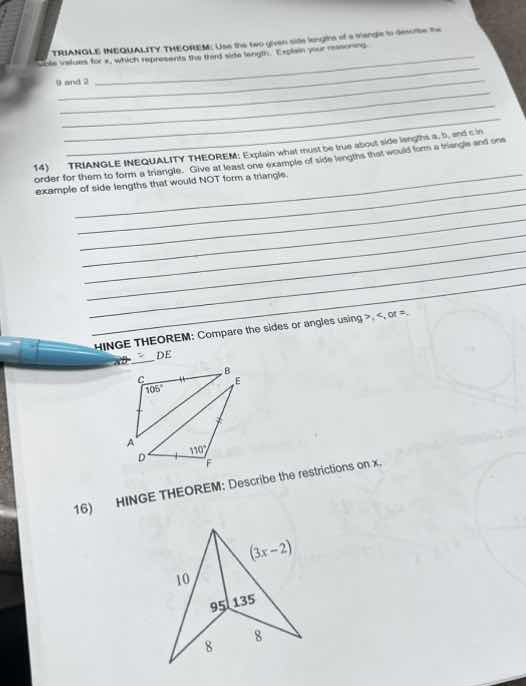
triangle inequality theorem: use the two given side lengths of a triangle to describe the possible values for x, which represents the third side length. explain your reasoning.
9 and 2
- triangle inequality theorem: explain what must be true about side lengths a, b, and c in order for them to form a triangle. give at least one example of side lengths that would form a triangle and one example of side lengths that would not form a triangle.
hinge theorem: compare the sides or angles using >, <, or =.
ac ___ de.
- hinge theorem: describe the restrictions on x.
For Question 14
The Triangle Inequality Theorem states that for three side lengths \(a\), \(b\), \(c\) to form a triangle, the sum of any two sides must be greater than the third side. This means:
- \(a + b > c\)
- \(a + c > b\)
- \(b + c > a\)
Valid example: Side lengths 3, 4, 5. Check the inequalities:
- \(3+4>5\) (7>5, true)
- \(3+5>4\) (8>4, true)
- \(4+5>3\) (9>3, true)
Invalid example: Side lengths 1, 2, 4. Check the inequalities:
- \(1+2=3 < 4\), which violates the theorem, so these cannot form a triangle.
Step1: Identify included angles
In \(\triangle ABC\) and \(\triangle DEF\), \(AC=DF\), \(BC=EF\). The included angles are \(\angle ACB=105^\circ\) and \(\angle DFE=110^\circ\).
Step2: Apply Hinge Theorem
The Hinge Theorem states that if two sides of one triangle are congruent to two sides of another triangle, the triangle with the larger included angle has the longer third side. Since \(105^\circ < 110^\circ\), the side opposite the smaller angle is shorter.
Step1: Identify congruent sides
The two triangles share the side with length \(3x-2\), and the other pairs of sides are congruent (10 & 10, 8 & 8).
Step2: Relate angles to sides via Hinge Theorem
The included angle opposite the side of length 10 is \(95^\circ\), and the included angle opposite \(3x-2\) is \(135^\circ\). By the Hinge Theorem, the side opposite the larger angle is longer, so \(3x-2 > 10\).
Step3: Solve for lower bound
\(3x-2 > 10\)
\(3x > 12\)
\(x > 4\)
Step4: Apply triangle inequality
The side length must also be positive, and we also need to ensure \(3x-2 < 10+8\) (triangle inequality for the triangle with sides 10, 8, \(3x-2\)):
\(3x-2 < 18\)
\(3x < 20\)
\(x < \frac{20}{3} \approx 6.67\)

Snap & solve any problem in the app
Get step-by-step solutions on Sovi AI
Photo-based solutions with guided steps
Explore more problems and detailed explanations
For side lengths \(a\), \(b\), \(c\) to form a triangle, the sum of any two sides must be greater than the third side (\(a+b>c\), \(a+c>b\), \(b+c>a\)).
Valid example: 3, 4, 5
Invalid example: 1, 2, 4
---