QUESTION IMAGE
Question
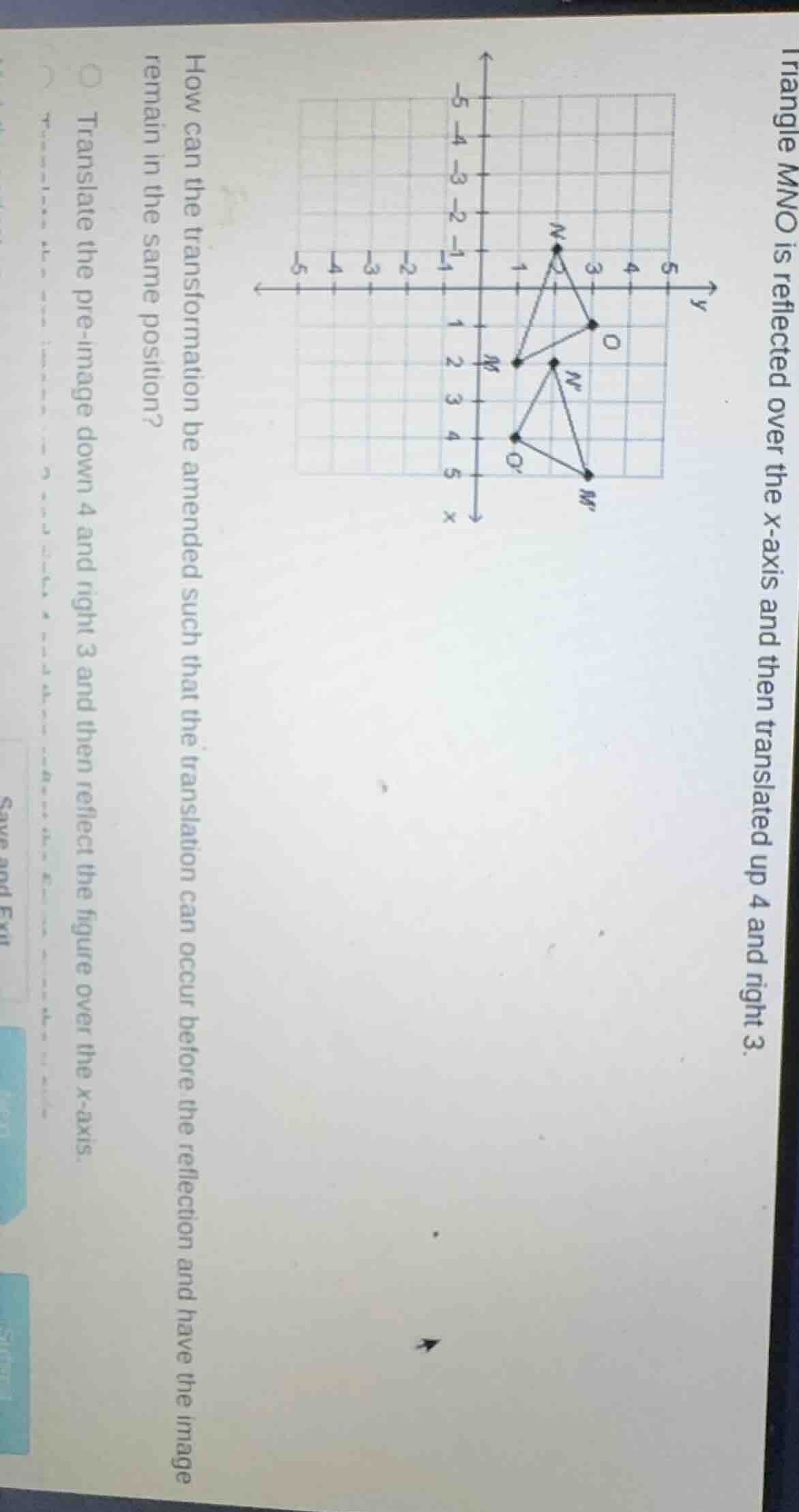
triangle mno is reflected over the x - axis and then translated up 4 and right 3. how can the transformation be amended such that the translation can occur before the reflection and have the image remain in the same position? translate the pre - image down 4 and right 3 and then reflect the figure over the x - axis.
Step1: Analyze the original transformation
The original transformation is a reflection over the \(x\)-axis followed by a translation up 4 and right 3. Let's consider the effect of the reflection and translation on the \(y\)-coordinate. A reflection over the \(x\)-axis changes the sign of the \(y\)-coordinate, say a point \((x,y)\) becomes \((x,-y)\). Then translating up 4 changes the \(y\)-coordinate to \(-y + 4\).
Step2: Determine the new translation for pre - reflection
If we want to translate before reflecting, let the translation be \((h,k)\) (right \(h\), up \(k\)) and then reflect over the \(x\)-axis. The translation before reflection: a point \((x,y)\) becomes \((x + h,y + k)\), then after reflection over \(x\)-axis becomes \((x + h,-(y + k))=(x + h,-y - k)\).
We want this to be equal to the result of the original transformation. The original transformation result for a point \((x,y)\) is \((x + 3,-y+4)\) (since we reflect to get \((x,-y)\) then translate up 4 (so \(y\)-coordinate \(-y + 4\)) and right 3 (so \(x\)-coordinate \(x+3\))).
So we set \(x+h=x + 3\) (so \(h = 3\)) and \(-y - k=-y + 4\). Solving \(-y - k=-y + 4\) for \(k\), we subtract \(-y\) from both sides: \(-k = 4\), so \(k=-4\) (which means a translation down 4).
So the translation before reflection should be right 3 and down 4, and then reflect over the \(x\)-axis. Looking at the options, the option "Translate the pre - image down 4 and right 3 and then reflect the figure over the \(x\)-axis" matches this.

Snap & solve any problem in the app
Get step-by-step solutions on Sovi AI
Photo-based solutions with guided steps
Explore more problems and detailed explanations
Translate the pre - image down 4 and right 3 and then reflect the figure over the \(x\)-axis.