QUESTION IMAGE
Question
2.
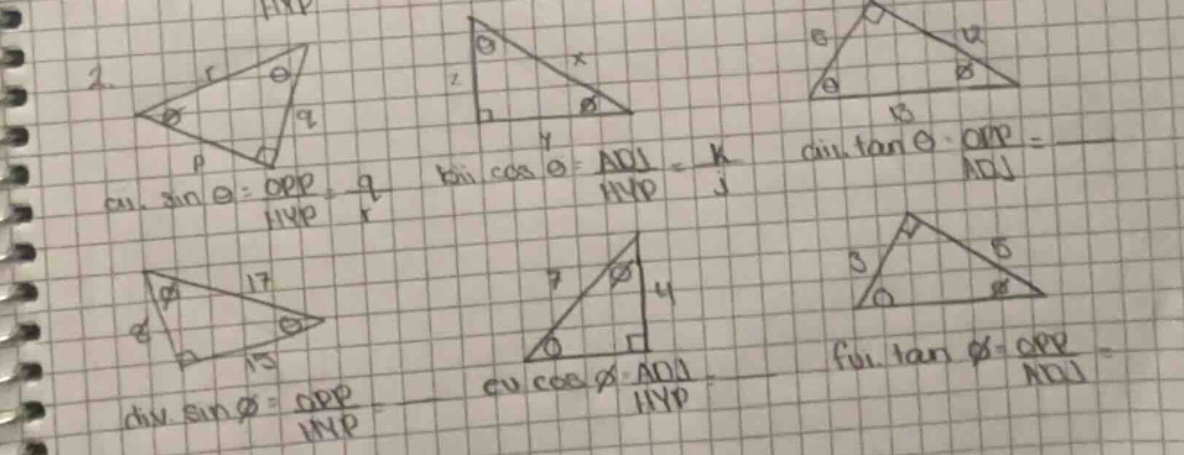
a) $sin \theta = \frac{opp}{hyp} = \frac{q}{r}$
b) $cos \theta = \frac{adj}{hyp} = \frac{k}{j}$
c) $\tan \theta = \frac{opp}{adj} = \underline{\quad}$
d) $sin \phi = \frac{opp}{hyp} = \underline{\quad}$ (triangle with sides 8, 15, 17)
e) $cos \phi = \frac{adj}{hyp} = \underline{\quad}$ (triangle with sides 3, 4, 5? wait, the triangle has sides 7? wait, the triangle has one side 7, one side 4, right angle. wait, maybe 3-4-5? wait, the last triangle: sides s, 5, right angle. $\tan \phi = \frac{opp}{adj} = \underline{\quad}$
To solve the trigonometric ratio problems for each right - triangle, we use the definitions of sine, cosine, and tangent:
- Sine of an angle ($\sin\theta$) is defined as the ratio of the length of the opposite side to the length of the hypotenuse, i.e., $\sin\theta=\frac{\text{opposite}}{\text{hypotenuse}}$.
- Cosine of an angle ($\cos\theta$) is defined as the ratio of the length of the adjacent side to the length of the hypotenuse, i.e., $\cos\theta=\frac{\text{adjacent}}{\text{hypotenuse}}$.
- Tangent of an angle ($\tan\theta$) is defined as the ratio of the length of the opposite side to the length of the adjacent side, i.e., $\tan\theta=\frac{\text{opposite}}{\text{adjacent}}$.
Part (a): $\sin\theta$
In the first triangle (top - left) with right - angle, for angle $\theta$:
- The side opposite to $\theta$ is $q$, and the hypotenuse is $r$.
- By the definition of sine, $\sin\theta = \frac{\text{opposite}}{\text{hypotenuse}}=\frac{q}{r}$.
Part (b): $\cos\theta$
In the second triangle (top - middle) with right - angle:
- The side adjacent to $\theta$ is $y$, and the hypotenuse is $x$.
- By the definition of cosine, $\cos\theta=\frac{\text{adjacent}}{\text{hypotenuse}}=\frac{y}{x}$.
Part (c): $\tan\theta$
In the third triangle (top - right) with right - angle:
- The side opposite to $\theta$ is $a$, and the side adjacent to $\theta$ is $b$.
- By the definition of tangent, $\tan\theta=\frac{\text{opposite}}{\text{adjacent}}=\frac{a}{b}$.
Part (d): $\sin\phi$
In the fourth triangle (bottom - left) with sides $8$, $15$, and hypotenuse $17$ (since $8^{2}+15^{2}=64 + 225=289 = 17^{2}$):
- For angle $\phi$, the side opposite to $\phi$ is $15$, and the hypotenuse is $17$.
- By the definition of sine, $\sin\phi=\frac{\text{opposite}}{\text{hypotenuse}}=\frac{15}{17}$.
Part (e): $\cos\alpha$
In the fifth triangle (bottom - middle) with hypotenuse $5$ and adjacent side $4$ (wait, let's re - check. The triangle has hypotenuse $5$? Wait, the triangle has sides: one leg is $4$, the other leg: let's assume the hypotenuse is $5$ (since $3 - 4-5$ triangle? Wait, the hypotenuse is $5$? Wait, the triangle has a right - angle, one leg is $4$, and the hypotenuse is $5$? Then the other leg is $\sqrt{5^{2}-4^{2}}=\sqrt{25 - 16}=\sqrt{9} = 3$. For angle $\alpha$:
- The side adjacent to $\alpha$ is $4$, and the hypotenuse is $5$.
- By the definition of cosine, $\cos\alpha=\frac{\text{adjacent}}{\text{hypotenuse}}=\frac{4}{5}$. Wait, if the hypotenuse is $5$ and the adjacent side is $4$, then $\cos\alpha=\frac{4}{5}$.
Part (f): $\tan\phi$
In the sixth triangle (bottom - right) with legs $s$ and the other leg (let's say the opposite side to $\phi$ is $s$ and the adjacent side is the other leg, let's assume the adjacent side length is, say, if the triangle has legs $s$ and (let's call it $t$), but from the notation, if the opposite side to $\phi$ is $s$ and the adjacent side is the other leg (let's assume the adjacent side is the one adjacent to $\phi$). If we assume the opposite side is $s$ and the adjacent side is the other leg (let's say length $t$), but from the diagram, if the triangle has a right - angle, and the two legs are $s$ and (let's say the adjacent side to $\phi$ is, for example, if the triangle is labeled with the two legs as $s$ and the other leg (let's assume the adjacent side is the one next to $\phi$). If we take the opposite side as $s$ and the adjacent side as the other leg (let's say length equal to the other leg, but if we assume the triangle has legs $s$ and (let's say the adjacent side is, f…

Snap & solve any problem in the app
Get step-by-step solutions on Sovi AI
Photo-based solutions with guided steps
Explore more problems and detailed explanations
To solve the trigonometric ratio problems for each right - triangle, we use the definitions of sine, cosine, and tangent:
- Sine of an angle ($\sin\theta$) is defined as the ratio of the length of the opposite side to the length of the hypotenuse, i.e., $\sin\theta=\frac{\text{opposite}}{\text{hypotenuse}}$.
- Cosine of an angle ($\cos\theta$) is defined as the ratio of the length of the adjacent side to the length of the hypotenuse, i.e., $\cos\theta=\frac{\text{adjacent}}{\text{hypotenuse}}$.
- Tangent of an angle ($\tan\theta$) is defined as the ratio of the length of the opposite side to the length of the adjacent side, i.e., $\tan\theta=\frac{\text{opposite}}{\text{adjacent}}$.
Part (a): $\sin\theta$
In the first triangle (top - left) with right - angle, for angle $\theta$:
- The side opposite to $\theta$ is $q$, and the hypotenuse is $r$.
- By the definition of sine, $\sin\theta = \frac{\text{opposite}}{\text{hypotenuse}}=\frac{q}{r}$.
Part (b): $\cos\theta$
In the second triangle (top - middle) with right - angle:
- The side adjacent to $\theta$ is $y$, and the hypotenuse is $x$.
- By the definition of cosine, $\cos\theta=\frac{\text{adjacent}}{\text{hypotenuse}}=\frac{y}{x}$.
Part (c): $\tan\theta$
In the third triangle (top - right) with right - angle:
- The side opposite to $\theta$ is $a$, and the side adjacent to $\theta$ is $b$.
- By the definition of tangent, $\tan\theta=\frac{\text{opposite}}{\text{adjacent}}=\frac{a}{b}$.
Part (d): $\sin\phi$
In the fourth triangle (bottom - left) with sides $8$, $15$, and hypotenuse $17$ (since $8^{2}+15^{2}=64 + 225=289 = 17^{2}$):
- For angle $\phi$, the side opposite to $\phi$ is $15$, and the hypotenuse is $17$.
- By the definition of sine, $\sin\phi=\frac{\text{opposite}}{\text{hypotenuse}}=\frac{15}{17}$.
Part (e): $\cos\alpha$
In the fifth triangle (bottom - middle) with hypotenuse $5$ and adjacent side $4$ (wait, let's re - check. The triangle has hypotenuse $5$? Wait, the triangle has sides: one leg is $4$, the other leg: let's assume the hypotenuse is $5$ (since $3 - 4-5$ triangle? Wait, the hypotenuse is $5$? Wait, the triangle has a right - angle, one leg is $4$, and the hypotenuse is $5$? Then the other leg is $\sqrt{5^{2}-4^{2}}=\sqrt{25 - 16}=\sqrt{9} = 3$. For angle $\alpha$:
- The side adjacent to $\alpha$ is $4$, and the hypotenuse is $5$.
- By the definition of cosine, $\cos\alpha=\frac{\text{adjacent}}{\text{hypotenuse}}=\frac{4}{5}$. Wait, if the hypotenuse is $5$ and the adjacent side is $4$, then $\cos\alpha=\frac{4}{5}$.
Part (f): $\tan\phi$
In the sixth triangle (bottom - right) with legs $s$ and the other leg (let's say the opposite side to $\phi$ is $s$ and the adjacent side is the other leg, let's assume the adjacent side length is, say, if the triangle has legs $s$ and (let's call it $t$), but from the notation, if the opposite side to $\phi$ is $s$ and the adjacent side is the other leg (let's assume the adjacent side is the one adjacent to $\phi$). If we assume the opposite side is $s$ and the adjacent side is the other leg (let's say length $t$), but from the diagram, if the triangle has a right - angle, and the two legs are $s$ and (let's say the adjacent side to $\phi$ is, for example, if the triangle is labeled with the two legs as $s$ and the other leg (let's assume the adjacent side is the one next to $\phi$). If we take the opposite side as $s$ and the adjacent side as the other leg (let's say length equal to the other leg, but if we assume the triangle has legs $s$ and (let's say the adjacent side is, for example, if the triangle is a right - triangle with legs $s$ and (let's call it $a$), then $\tan\phi=\frac{\text{opposite}}{\text{adjacent}}=\frac{s}{a}$. But if we assume the adjacent side is the one adjacent to $\phi$ and the opposite side is $s$, then $\tan\phi=\frac{s}{\text{adjacent side}}$. If we assume the adjacent side is the other leg (let's say length equal to the other leg, but from the diagram, if the triangle has legs $s$ and (let's say the adjacent side is the one marked as the non - $s$ leg). If we take the opposite side as $s$ and the adjacent side as the other leg (let's say length $a$), then $\tan\phi=\frac{s}{a}$. But if we assume the triangle has legs $s$ and (let's say the adjacent side is the one with length equal to the other leg, but if we take the example of a right - triangle, if the opposite side is $s$ and the adjacent side is, for example, if the triangle is isoceles? No, from the diagram, if the two legs are $s$ and (let's say the adjacent side is the one next to $\phi$), then $\tan\phi=\frac{s}{\text{adjacent side}}$. If we assume the adjacent side is the other leg (let's say length $s$? No, that would be an isoceles right - triangle, then $\tan\phi = 1$. But without more information, if we assume the opposite side is $s$ and the adjacent side is the other leg (let's say length $a$), then $\tan\phi=\frac{s}{a}$. But if we take the standard notation, if the triangle has a right - angle, and $\phi$ is one of the acute angles, with opposite side $s$ and adjacent side (let's say) $b$, then $\tan\phi=\frac{s}{b}$.
Final Answers:
a. $\boldsymbol{\frac{q}{r}}$
b. $\boldsymbol{\frac{y}{x}}$
c. $\boldsymbol{\frac{a}{b}}$
d. $\boldsymbol{\frac{15}{17}}$
e. $\boldsymbol{\frac{4}{5}}$ (assuming the hypotenuse is $5$ and adjacent side is $4$)
f. $\boldsymbol{\frac{s}{\text{adjacent side}}}$ (or if we assume the adjacent side is the other leg, and if we have more information, but based on the diagram, if the opposite side is $s$ and the adjacent side is the other leg, then $\tan\phi=\frac{s}{\text{adjacent side}}$)