QUESTION IMAGE
Question
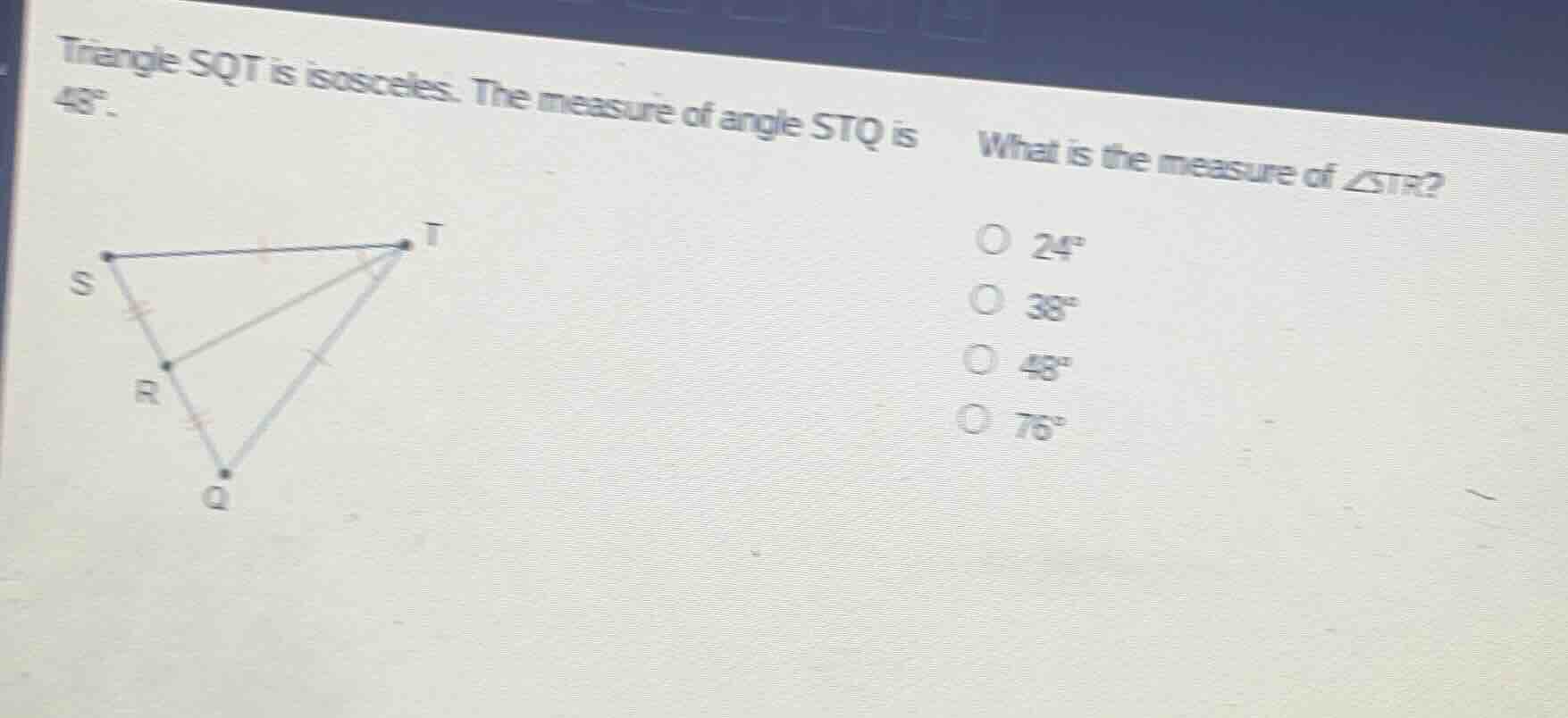
triangle sqt is isosceles. the measure of angle stq is 48°. what is the measure of ∠str?
○ 24°
○ 38°
○ 48°
○ 76°
Step1: Find base angles of isosceles triangle SQT
In isosceles triangle \( SQT \), \( \angle STQ = 48^\circ \). Let \( \angle QST=\angle SQT = x \) (since sides \( ST = QT \) from markings, so base angles are equal). Using triangle angle sum: \( 48^\circ + x + x = 180^\circ \).
Simplify: \( 2x = 180^\circ - 48^\circ = 132^\circ \), so \( x = 66^\circ \). Wait, no—wait, maybe \( ST = SQ \)? Wait, the diagram has markings: \( SQ \) and \( RQ \) are marked equal, \( ST \) and \( QT \) are marked equal? Wait, let's re-examine. Triangle \( SQT \) is isosceles with \( ST = QT \) (markings on \( ST \) and \( QT \)), so \( \angle QST=\angle SQT \). Wait, no, \( \angle STQ = 48^\circ \), so the two equal angles are \( \angle QST \) and \( \angle SQT \). Wait, no, angle at \( T \) is \( 48^\circ \), so the other two angles: \( (180 - 48)/2 = 66^\circ \). But then, \( TR \) is a segment from \( T \) to \( R \) on \( SQ \), with \( SR = RQ \) (markings on \( SQ \)), so \( R \) is the midpoint, and \( TR \) is a median? Wait, no—maybe \( \triangle STR \) and \( \triangle QTR \) are congruent? Wait, maybe I misread. Wait, the problem is to find \( \angle STR \). Let's correct: In \( \triangle SQT \), \( ST = QT \) (isosceles), so \( \angle S = \angle Q \). Then, \( \angle STQ = 48^\circ \), so \( \angle S + \angle Q = 180 - 48 = 132^\circ \), so \( \angle S = \angle Q = 66^\circ \). Now, \( R \) is the midpoint of \( SQ \) (since \( SR = RQ \)), so \( TR \) is the median, and in an isosceles triangle, the median from \( T \) to \( SQ \) is also the angle bisector. So \( \angle STR = \frac{1}{2} \angle STQ \)? Wait, no—wait, \( \angle STQ = 48^\circ \), and \( TR \) bisects \( \angle STQ \)? Wait, no, maybe \( \triangle SQT \) has \( SQ = ST \)? Wait, the markings: \( SQ \) and \( ST \) have one mark, \( QT \) has one mark? Wait, maybe \( SQ = ST \), so \( \angle STQ = \angle SQT = 48^\circ \). Then, \( \angle QST = 180 - 48 - 48 = 84^\circ \). No, this is confusing. Wait, the answer choices are 24, 38, 48, 76. Let's think again. Wait, maybe \( \triangle SQT \) is isosceles with \( SQ = QT \), so \( \angle QST = \angle QTS = 48^\circ \), then \( \angle SQT = 180 - 48 - 48 = 84^\circ \). No, not matching. Wait, maybe the correct approach: In isosceles \( \triangle SQT \), \( ST = SQ \), so \( \angle STQ = \angle SQT = 48^\circ \), then \( \angle QST = 180 - 48 - 48 = 84^\circ \). Then \( TR \) is a median, so \( SR = RQ \), and \( ST = SQ \), so \( \triangle STR \) is isosceles? No. Wait, maybe the diagram shows that \( TR \) is perpendicular? No. Wait, the key is that \( \angle STR \) is half of \( \angle STQ \)? Wait, 48/2=24? But 24 is an option. Wait, maybe \( \triangle SQT \) has \( ST = QT \), so \( \angle S = \angle Q \), \( \angle STQ = 48^\circ \), so \( \angle S = \angle Q = (180 - 48)/2 = 66^\circ \). Then, \( TR \) is the angle bisector? No, maybe \( R \) is the midpoint, and \( TR \) is the median, so in \( \triangle SQT \), median \( TR \) splits \( \angle STQ \) into two equal angles? Wait, no, in an isosceles triangle, the median from the apex (angle at \( T \)) is the angle bisector. So \( \angle STR = \angle QTR = 48^\circ / 2 = 24^\circ \)? Wait, but 24 is an option. Wait, maybe that's it. So step by step:
- Triangle \( SQT \) is isosceles with \( ST = QT \) (markings on \( ST \) and \( QT \)), so \( \angle QST = \angle SQT \).
- Angle sum: \( \angle STQ + \angle QST + \angle SQT = 180^\circ \).
- Given \( \angle STQ = 48^\circ \), so \( 48^\circ + 2\angle QST = 180^\circ \) → \( 2\angle QST = 132^\circ \) → \( \angle QST =…

Snap & solve any problem in the app
Get step-by-step solutions on Sovi AI
Photo-based solutions with guided steps
Explore more problems and detailed explanations
\( 24^\circ \) (Option: 24°)