QUESTION IMAGE
Question
7)
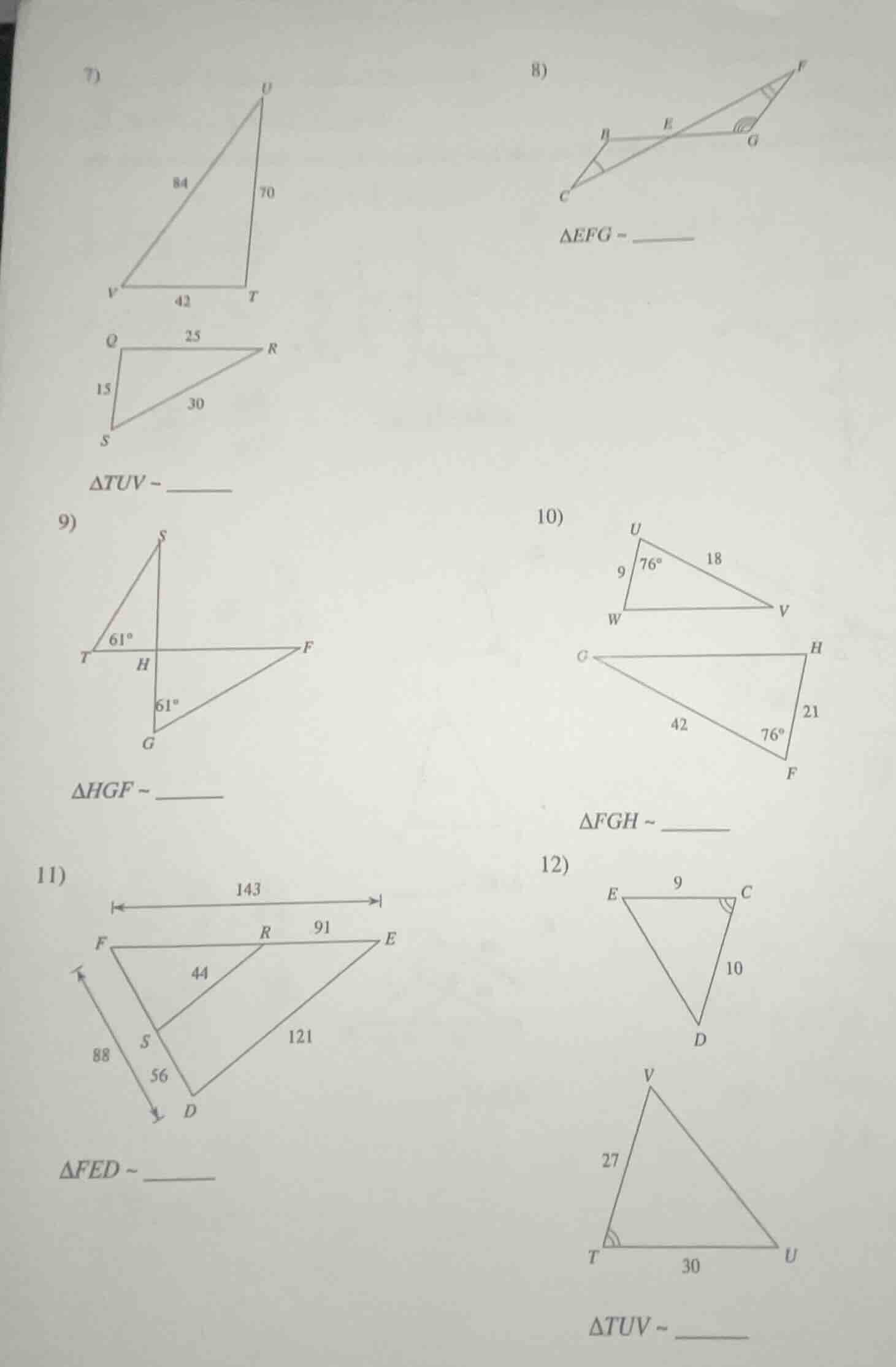
triangle tuv with sides: vu = 84, ut = 70, vt = 42; triangle qsr with sides: qs = 15, qr = 25, sr = 30
δtuv ~ ______
8)
triangle efg and another triangle with angles marked
δefg ~ ______
9)
triangle hgf with angle 61° at g and another triangle with angle 61° at t
δhgf ~ ______
10)
triangle uvw with side 9, 18 and angle 76°; triangle fgh with side 21, 42 and angle 76°
δfgh ~ ______
11)
triangle fed with sides: fe = 143, ed = 121, fd = 88; triangle fsr with sides: fs = 56, sr = 44, fr = 91
δfed ~ ______
12)
triangle ecd with sides: ec = 9, cd = 10; triangle tuv with sides: tv = 27, tu = 30
δtuv ~ ______
Problem 7:
Step 1: Find the ratios of corresponding sides of $\triangle TUV$ and $\triangle QRS$.
For $\triangle TUV$: $TV = 42$, $TU = 70$, $UV = 84$.
For $\triangle QRS$: $QR = 15$, $QS = 25$, $RS = 30$? Wait, no, let's check the sides. Wait, $\triangle TUV$ has sides $TV = 42$, $TU = 70$, $UV = 84$. $\triangle QRS$: $QR = 15$? Wait, no, $Q$ to $R$ is 25, $Q$ to $S$ is 15, $S$ to $R$ is 30. Wait, let's find the ratios:
$\frac{TV}{QS} = \frac{42}{15} = \frac{14}{5}$? No, wait, maybe I mixed up. Wait, $\triangle TUV$: $TV = 42$, $TU = 70$, $UV = 84$. Let's simplify the ratios of $\triangle TUV$: divide by 14? $42\div14 = 3$, $70\div14 = 5$, $84\div14 = 6$. Wait, no, $\triangle QRS$: $QR = 25$, $QS = 15$, $RS = 30$. Let's simplify $\triangle QRS$: divide by 5: $25\div5 = 5$, $15\div5 = 3$, $30\div5 = 6$. Wait, so $\triangle TUV$ sides: 42, 70, 84. Let's divide by 14: 3, 5, 6. $\triangle QRS$ sides: 15, 25, 30. Divide by 5: 3, 5, 6. So the ratio is 14:5? Wait, no, $\frac{42}{15} = \frac{14}{5}$, $\frac{70}{25} = \frac{14}{5}$, $\frac{84}{30} = \frac{14}{5}$. So the corresponding triangle is $\triangle QRS$? Wait, no, the order of the letters. $\triangle TUV$: vertices T, U, V. $\triangle QRS$: Q, R, S? Wait, maybe $\triangle SQR$? Wait, no, let's check the angles. Wait, $\triangle TUV$ is a right triangle? $TV = 42$, $TU = 70$, $UV = 84$. Let's check if it's a right triangle: $42^2 + 70^2 = 1764 + 4900 = 6664$. $84^2 = 7056$. No, not a right triangle. Wait, $\triangle QRS$: $QR = 25$, $QS = 15$, $RS = 30$. $15^2 + 25^2 = 225 + 625 = 850$. $30^2 = 900$. No. Wait, maybe the ratio is 2:1? Wait, 42:21? No, 42, 70, 84. Let's divide by 21: 2, 3.333? No. Wait, 42, 70, 84. GCD is 14. 42/14=3, 70/14=5, 84/14=6. $\triangle QRS$: 15, 25, 30. GCD is 5. 15/5=3, 25/5=5, 30/5=6. So the sides are proportional with ratio 14:5? Wait, no, 3:3, 5:5, 6:6. So the triangles are similar by SSS similarity. So $\triangle TUV \sim \triangle SQR$? Wait, no, the order of the vertices. Let's match the sides: $TV = 42$ (corresponds to $QS = 15$? No, 42/15 = 2.8, 70/25 = 2.8, 84/30 = 2.8. So ratio is 2.8 = 14/5. So $\triangle TUV \sim \triangle SQR$? Wait, $TV = 42$ (side between T and V), $TU = 70$ (T and U), $UV = 84$ (U and V). $\triangle SQR$: $QS = 15$ (S and Q), $QR = 25$ (Q and R), $RS = 30$ (R and S). So $TV/QS = 42/15 = 14/5$, $TU/QR = 70/25 = 14/5$, $UV/RS = 84/30 = 14/5$. So the correspondence is T -> S, U -> Q, V -> R? Wait, no, maybe T -> Q, U -> R, V -> S? No, let's check the order. The correct similarity statement should have corresponding vertices. So $\triangle TUV \sim \triangle SQR$? Wait, maybe I made a mistake. Wait, $\triangle TUV$: sides 42, 70, 84. $\triangle QRS$: sides 15, 25, 30. The ratio is 42/15 = 2.8, 70/25 = 2.8, 84/30 = 2.8. So the triangles are similar, and the correspondence is T -> Q, U -> R, V -> S? No, maybe $\triangle TUV \sim \triangle QRS$? Wait, $TV = 42$, $QR = 25$: no. Wait, maybe $\triangle TUV \sim \triangle SQR$ where SQ = 15, QR = 25, RS = 30. So $TV = 42$ (T to V) corresponds to SQ = 15 (S to Q)? No, 42 and 15: ratio 14/5. $TU = 70$ (T to U) corresponds to QR = 25 (Q to R): 70/25 = 14/5. $UV = 84$ (U to V) corresponds to RS = 30 (R to S): 84/30 = 14/5. So the correspondence is T -> S, U -> Q, V -> R? So $\triangle TUV \sim \triangle SQR$.
Step 2: Confirm the similarity.
Since all three pairs of corresponding sides are in proportion ($\frac{TV}{SQ} = \frac{TU}{QR} = \frac{UV}{RS} = \frac{14}{5}$), by SSS similarity criterion, $\triangle TUV \sim \triangle SQR$.
From the diagram, $\triangle EFG$ and $\triangle CHB$ (or $\triangle CHB$? Wait, the angles: $\angle C$ and $\angle F$ are equal (marked), $\angle B$ and $\angle G$? Wait, no, the diagram shows $\angle C$ and $\angle F$ as equal, and $\angle B$ and $\angle G$? Wait, the triangles are $\triangle EFG$ and $\triangle CHB$? Wait, the notation: $\triangle EFG \sim \triangle CHB$? Wait, the angles: $\angle C$ and $\angle F$ (corresponding angles), $\angle B$ and $\angle G$ (right angles? Wait, $\angle G$ is a right angle? No, the diagram shows $\angle G$ as a right angle? Wait, maybe $\triangle EFG \sim \triangle CHB$ by AA similarity (two angles equal). So the corresponding triangle is $\triangle CHB$.
Step 1: Identify corresponding angles.
$\angle T = 61^\circ$ and $\angle G = 61^\circ$ (given). Also, $\angle THS$ and $\angle GHF$ are vertical angles, so they are equal. Therefore, by AA similarity criterion, $\triangle THS \sim \triangle GHF$? Wait, no, the triangle is $\triangle HGF$. Wait, $\triangle THS$ and $\triangle GHF$: $\angle T = \angle G = 61^\circ$, $\angle THS = \angle GHF$ (vertical angles). So $\triangle THS \sim \triangle GHF$. But the question is $\triangle HGF \sim$ which triangle? So $\triangle HGF \sim \triangle THS$ (since $\angle G = \angle T = 61^\circ$, $\angle GHF = \angle THS$ (vertical angles), so AA similarity).

Snap & solve any problem in the app
Get step-by-step solutions on Sovi AI
Photo-based solutions with guided steps
Explore more problems and detailed explanations
$\triangle SQR$