QUESTION IMAGE
Question
triangles
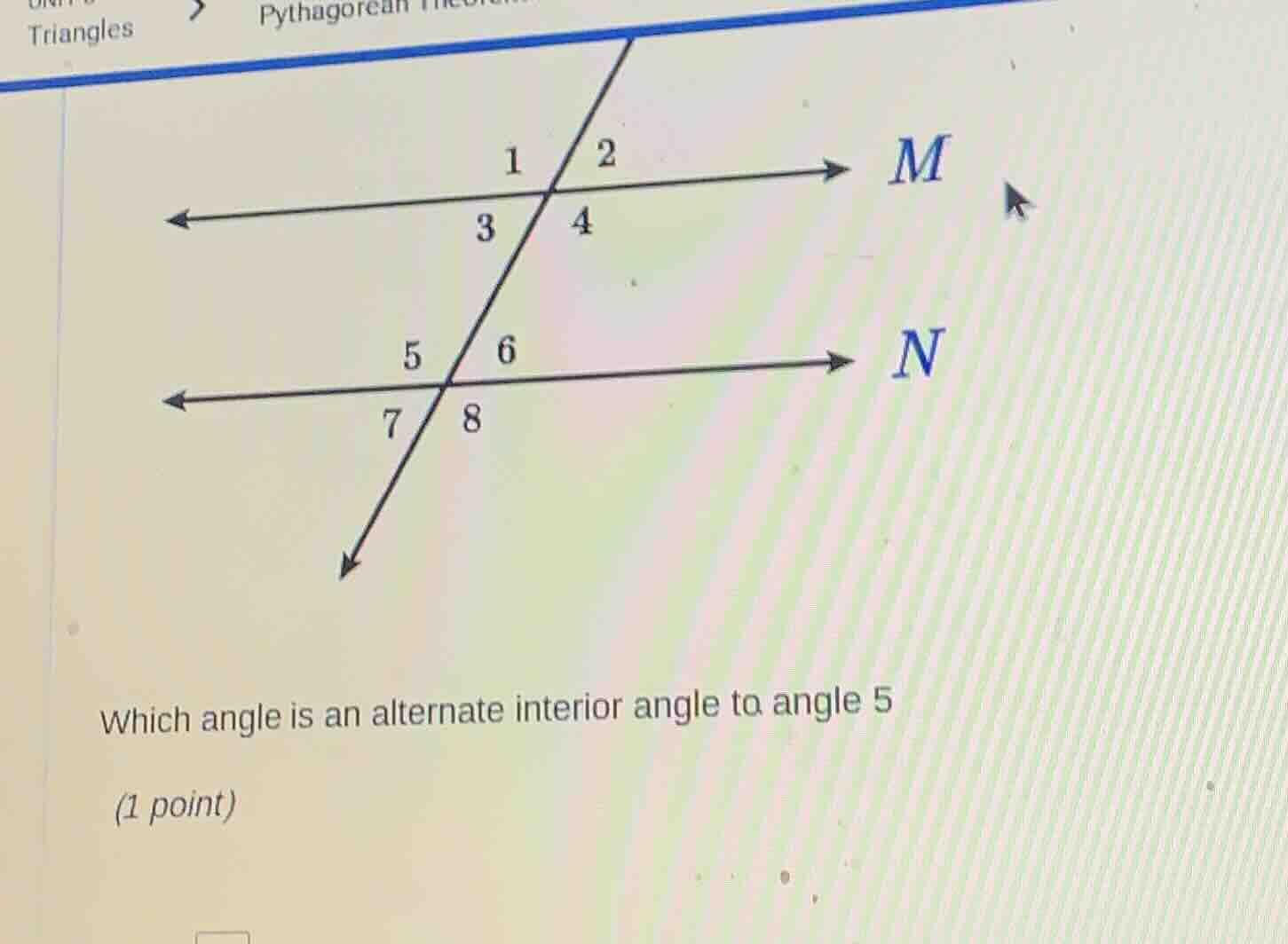
which angle is an alternate interior angle to angle 5
(1 point)
Step1: Recall alternate interior angles definition
Alternate interior angles are formed when a transversal crosses two parallel lines. They lie between the two parallel lines (interior) and on opposite sides of the transversal.
Step2: Identify lines and transversal
Here, lines \( M \) and \( N \) are parallel, and the slanted line is the transversal. Angle 5 is between lines \( M \) and \( N \) (interior) on one side of the transversal. The angle on the opposite side of the transversal, also interior, is angle 3. Wait, no, wait: Wait, line \( M \) has angles 1,2,3,4; line \( N \) has 5,6,7,8. The transversal crosses \( M \) and \( N \). So for angle 5 (which is at the intersection of transversal and \( N \), left - interior), the alternate interior angle should be the angle at the intersection of transversal and \( M \), left - interior? Wait no, alternate interior angles: when two parallel lines are cut by a transversal, alternate interior angles are non - adjacent, on opposite sides of the transversal, and inside the two lines. So angle 5 is inside (between \( M \) and \( N \)) and on the left of the transversal. The angle inside (between \( M \) and \( N \)) and on the right of the transversal, at the intersection with \( M \), is angle 4? Wait no, let's label the positions. Line \( M \): top part (1,2), bottom part (3,4). Line \( N \): top part (5,6), bottom part (7,8). Transversal is the slanted line. So angle 5 is in the bottom - left of the transversal - \( N \) intersection. The alternate interior angle would be the angle in the top - left of the transversal - \( M \) intersection? No, wait, alternate interior angles are between the two lines ( \( M \) and \( N \)) and on opposite sides of the transversal. So angle 5 is between \( M \) and \( N \), on the left - hand side of the transversal. The angle between \( M \) and \( N \), on the right - hand side of the transversal, at the \( M \) line, is angle 4? No, wait, angle 3 is between \( M \) and \( N \), left - hand side of transversal (at \( M \) line). Angle 5 is between \( M \) and \( N \), left - hand side of transversal (at \( N \) line). Wait, no, I think I made a mistake. Let's recall the definition: Alternate interior angles are two angles that lie between the two lines (the "interior"), on opposite sides of the transversal, and are not adjacent. So for the two parallel lines \( M \) and \( N \), cut by the transversal. Angle 5 is at \( N \), between \( M \) and \( N \), and on one side of the transversal. The angle at \( M \), between \( M \) and \( N \), and on the opposite side of the transversal is angle 3? Wait, no, angle 3 is at \( M \), between \( M \) and \( N \), same side as angle 5? Wait, no, the transversal divides the space into two sides. Let's consider the transversal as a slanted line. So angle 5 is below the transversal? No, the lines \( M \) and \( N \) are horizontal (assuming). So the transversal is a non - horizontal line. So angle 5 is on the left of the transversal, between \( M \) and \( N \). The angle on the right of the transversal, between \( M \) and \( N \), at the intersection with \( M \), is angle 4? No, angle 4 is on the right of the transversal, between \( M \) and \( N \) (at \( M \) line). Angle 5 is on the left of the transversal, between \( M \) and \( N \) (at \( N \) line). Wait, no, alternate interior angles: for example, if we have two parallel lines \( l \) and \( m \), cut by transversal \( t \). Then angle \( A \) on \( l \), between \( l \) and \( m \), left of \( t \); angle \( B \) on \( m \), between \( l \) and…

Snap & solve any problem in the app
Get step-by-step solutions on Sovi AI
Photo-based solutions with guided steps
Explore more problems and detailed explanations
Step1: Recall alternate interior angles definition
Alternate interior angles are formed when a transversal crosses two parallel lines. They lie between the two parallel lines (interior) and on opposite sides of the transversal.
Step2: Identify lines and transversal
Here, lines \( M \) and \( N \) are parallel, and the slanted line is the transversal. Angle 5 is between lines \( M \) and \( N \) (interior) on one side of the transversal. The angle on the opposite side of the transversal, also interior, is angle 3. Wait, no, wait: Wait, line \( M \) has angles 1,2,3,4; line \( N \) has 5,6,7,8. The transversal crosses \( M \) and \( N \). So for angle 5 (which is at the intersection of transversal and \( N \), left - interior), the alternate interior angle should be the angle at the intersection of transversal and \( M \), left - interior? Wait no, alternate interior angles: when two parallel lines are cut by a transversal, alternate interior angles are non - adjacent, on opposite sides of the transversal, and inside the two lines. So angle 5 is inside (between \( M \) and \( N \)) and on the left of the transversal. The angle inside (between \( M \) and \( N \)) and on the right of the transversal, at the intersection with \( M \), is angle 4? Wait no, let's label the positions. Line \( M \): top part (1,2), bottom part (3,4). Line \( N \): top part (5,6), bottom part (7,8). Transversal is the slanted line. So angle 5 is in the bottom - left of the transversal - \( N \) intersection. The alternate interior angle would be the angle in the top - left of the transversal - \( M \) intersection? No, wait, alternate interior angles are between the two lines ( \( M \) and \( N \)) and on opposite sides of the transversal. So angle 5 is between \( M \) and \( N \), on the left - hand side of the transversal. The angle between \( M \) and \( N \), on the right - hand side of the transversal, at the \( M \) line, is angle 4? No, wait, angle 3 is between \( M \) and \( N \), left - hand side of transversal (at \( M \) line). Angle 5 is between \( M \) and \( N \), left - hand side of transversal (at \( N \) line). Wait, no, I think I made a mistake. Let's recall the definition: Alternate interior angles are two angles that lie between the two lines (the "interior"), on opposite sides of the transversal, and are not adjacent. So for the two parallel lines \( M \) and \( N \), cut by the transversal. Angle 5 is at \( N \), between \( M \) and \( N \), and on one side of the transversal. The angle at \( M \), between \( M \) and \( N \), and on the opposite side of the transversal is angle 3? Wait, no, angle 3 is at \( M \), between \( M \) and \( N \), same side as angle 5? Wait, no, the transversal divides the space into two sides. Let's consider the transversal as a slanted line. So angle 5 is below the transversal? No, the lines \( M \) and \( N \) are horizontal (assuming). So the transversal is a non - horizontal line. So angle 5 is on the left of the transversal, between \( M \) and \( N \). The angle on the right of the transversal, between \( M \) and \( N \), at the intersection with \( M \), is angle 4? No, angle 4 is on the right of the transversal, between \( M \) and \( N \) (at \( M \) line). Angle 5 is on the left of the transversal, between \( M \) and \( N \) (at \( N \) line). Wait, no, alternate interior angles: for example, if we have two parallel lines \( l \) and \( m \), cut by transversal \( t \). Then angle \( A \) on \( l \), between \( l \) and \( m \), left of \( t \); angle \( B \) on \( m \), between \( l \) and \( m \), right of \( t \) - these are alternate interior angles. So in our case, line \( M \) (top parallel), line \( N \) (bottom parallel), transversal (slanted). Angle 5 is on line \( N \), between \( M \) and \( N \), left of transversal. The angle on line \( M \), between \( M \) and \( N \), right of transversal is angle 4? No, angle 3 is on line \( M \), between \( M \) and \( N \), left of transversal. Angle 5 is on line \( N \), between \( M \) and \( N \), left of transversal. Wait, that can't be. Wait, maybe I mixed up. Let's list the angles:
- At the top intersection (transversal and \( M \)):
- Angle 1: top - left
- Angle 2: top - right
- Angle 3: bottom - left (between \( M \) and \( N \))
- Angle 4: bottom - right (between \( M \) and \( N \))
- At the bottom intersection (transversal and \( N \)):
- Angle 5: top - left (between \( M \) and \( N \))
- Angle 6: top - right (between \( M \) and \( N \))
- Angle 7: bottom - left
- Angle 8: bottom - right
Ah! Now I see. So angle 5 is top - left (between \( M \) and \( N \)) at the \( N \) - transversal intersection. The alternate interior angle would be the angle that is top - right (between \( M \) and \( N \)) at the \( M \) - transversal intersection? No, alternate interior angles are on opposite sides of the transversal. So angle 5 is on the left - hand side of the transversal (if we consider the transversal as going from bottom - left to top - right), and between \( M \) and \( N \). The angle on the right - hand side of the transversal, between \( M \) and \( N \), at the \( M \) line, is angle 4? No, angle 3 is on the left - hand side of the transversal, between \( M \) and \( N \), at the \( M \) line. Angle 5 is on the left - hand side of the transversal, between \( M \) and \( N \), at the \( N \) line. Wait, that's same - side interior. Oh! I made a mistake. Alternate interior angles are on opposite sides. So angle 5 is on the left of the transversal (between \( M \) and \( N \)), angle 3 is on the left of the transversal (between \( M \) and \( N \)) - same side. Angle 4 is on the right of the transversal (between \( M \) and \( N \)) at \( M \) line, angle 6 is on the right of the transversal (between \( M \) and \( N \)) at \( N \) line. So angle 5 (left - between \( M \) and \( N \) at \( N \)) and angle 4 (right - between \( M \) and \( N \) at \( M \))? No, no. Wait, let's use the correct definition: When two parallel lines are cut by a transversal, alternate interior angles are congruent and are located between the two parallel lines, on opposite sides of the transversal. So for angle 5 (which is between \( M \) and \( N \), at \( N \), and let's say the transversal is going from the bottom - left to the top - right). So angle 5 is at the bottom intersection, top - left (between \( M \) and \( N \)). The angle at the top intersection, top - right (between \( M \) and \( N \))? No, that's not. Wait, maybe the transversal is going from top - left to bottom - right. Let's re - orient. If the transversal is going from top - left to bottom - right, then:
- At \( M \) - transversal intersection:
- Angle 1: top - left (above \( M \))
- Angle 2: top - right (above \( M \))
- Angle 3: bottom - left (below \( M \), between \( M \) and \( N \))
- Angle 4: bottom - right (below \( M \), between \( M \) and \( N \))
- At \( N \) - transversal intersection:
- Angle 5: top - left (above \( N \), between \( M \) and \( N \))
- Angle 6: top - right (above \( N \), between \( M \) and \( N \))
- Angle 7: bottom - left (below \( N \))
- Angle 8: bottom - right (below \( N \))
Now, the transversal is going from top - left (where it meets \( M \)) to bottom - right (where it meets \( N \)). So angle 5 is above \( N \), left of the transversal (between \( M \) and \( N \)). The angle above \( M \), right of the transversal (between \( M \) and \( N \)) is angle 4? No, angle 4 is below \( M \), right of the transversal (between \( M \) and \( N \)). Wait, I think I messed up the position of "between the lines". The area between \( M \) and \( N \) is the region that is below \( M \) and above \( N \). So angle 3 (below \( M \), left of transversal), angle 4 (below \( M \), right of transversal), angle 5 (above \( N \), left of transversal), angle 6 (above \( N \), right of transversal) are all between \( M \) and \( N \). Now, angle 5 is between \( M \) and \( N \), left of transversal (at \( N \) line). The angle between \( M \) and \( N \), right of transversal (at \( M \) line) is angle 4? No, angle 3 is between \( M \) and \( N \), left of transversal (at \( M \) line). So angle 5 (left - between \( M \) and \( N \), \( N \) line) and angle 3 (left - between \( M \) and \( N \), \( M \) line) are same - side interior. Angle 5 (left - between \( M \) and \( N \), \( N \) line) and angle 4 (right - between \( M \) and \( N \), \( M \) line) are alternate interior? Wait, no, alternate interior angles are on opposite sides of the transversal. So if the transversal is going from top - left to bottom - right, then the left - hand side of the transversal (relative to the direction of the transversal) and right - hand side. So angle 5 is on the left - hand side of the transversal (between \( M \) and \( N \)), angle 4 is on the right - hand side of the transversal (between \( M \) and \( N \)), and they are at different parallel lines (\( N \) and \( M \)). So angle 5 and angle 4? No, wait, let's take a standard example. If we have two parallel lines \( l \) and \( m \), cut by transversal \( t \). Let \( l \) be above \( m \). At \( l \), the angles between \( l \) and \( m \) are \( \angle 3 \) (left) and \( \angle 4 \) (right). At \( m \), the angles between \( l \) and \( m \) are \( \angle 5 \) (left) and \( \angle 6 \) (right). Then \( \angle 3 \) and \( \angle 6 \) are alternate interior? No, \( \angle 3 \) and \( \angle 5 \) are same - side, \( \angle 4 \) and \( \angle 6 \) are same - side. \( \angle 3 \) and \( \angle 6 \) are alternate? Wait, no, I think I had the definition wrong. Let's check a reference: Alternate interior angles are two angles that lie between the two lines (the "interior"), on opposite sides of the transversal, and are not adjacent. So in the standard diagram, with two horizontal parallel lines and a transversal going from bottom - left to top - right:
- Top line ( \( l \)): angles \( \angle 1 \) (top - left), \( \angle 2 \) (top - right), \( \angle 3 \) (bottom - left, between \( l \) and \( m \)), \( \angle 4 \) (bottom - right, between \( l \) and \( m \))
- Bottom line ( \( m \)): angles \( \angle 5 \) (top - left, between \( l \) and \( m \)), \( \angle 6 \) (top - right, between \( l \) and \( m \)), \( \angle 7 \) (bottom - left), \( \angle 8 \) (bottom - right)
Then alternate interior angles are \( \angle 3 \) and \( \angle 6 \), \( \angle 4 \) and \( \angle 5 \). Ah! There we go. So \( \angle 4 \) (bottom - right, between \( l \) and \( m \), top line) and \( \angle 5 \) (top - left, between \( l \) and \( m \), bottom line) are alternate interior angles. Because they are between the two lines, on opposite sides of the transversal. So in our problem, angle 5 is at the bottom line ( \( N \)) top - left (between \( M \) and \( N \)), and angle 4 is at the top line ( \( M \)) bottom - right (between \( M \) and \( N \)). So angle 4 is the alternate interior angle to angle 5? Wait, no, in the standard example, \( \angle 4 \) (bottom - right, top line) and \( \angle 5 \) (top - left, bottom line) are alternate interior. So yes, angle 4 is the alternate interior angle to angle 5. Wait, but let's confirm. The transversal cuts \( M \) and \( N \). Angle 5 is inside (between \( M \) and \( N \)) and on one side of the transversal. Angle 4 is inside (between \( M \) and \( N \)) and on the opposite side of the transversal. So angle 4 is the alternate interior angle to angle 5. Wait, but in the diagram, angle 3 is also inside. Wait, no, in the standard example, \( \angle 3 \) (bottom - left, top line) and \( \angle 6 \) (top - right, bottom line) are alternate interior. \( \angle 4 \) (bottom - right, top line) and \( \angle 5 \) (top - left, bottom line) are alternate interior. So in our problem, angle 5 is at \( N \), top - left (between \( M \) and \( N \)), so its alternate interior angle is at \( M \), bottom - right (between \( M \) and \( N \)), which is angle 4. Wait, but maybe I had the labels wrong. Let's re - label the diagram as per the standard:
- Top line ( \( M \)):
- Top - left: \( \angle 1 \)
- Top - right: \( \angle 2 \)
- Bottom - left (between \( M \) and \( N \)): \( \angle 3 \)
- Bottom - right (between \( M \) and \( N \)): \( \angle 4 \)
- Bottom line ( \( N \)):
- Top - left (between \( M \) and \( N \)): \( \angle 5 \)
- Top - right (between \( M \) and \( N \)): \( \angle 6 \)
- Bottom - left: \( \angle 7 \)
- Bottom - right: \( \angle 8 \)
Transversal is from bottom - left (where it meets \( N \) at \( \angle 7 \)) to top - right (where it meets \( M \) at \( \angle 2 \)). So the direction of the transversal is bottom - left to top - right. Now, angle 5 is between \( M \) and \( N \), top - left of the transversal (since transversal is going to top - right). Angle 4 is between \( M \) and \( N \), bottom - right of the transversal. Wait, no, the "sides" of the transversal: if you stand on the transversal, facing the direction it's going (bottom - left to top - right), then your left - hand side is the side where \( \angle 3 \), \( \angle 5 \), \( \angle 7 \) are, and your right - hand side is where \( \angle 2 \), \( \angle 4 \), \( \angle 8 \) are. So angle 5 is on the left - hand side of the transversal, between \( M \) and \( N \), at \( N \) line. Angle 4 is on the right - hand side of the transversal, between \( M \) and \( N \), at \( M \) line. So they are alternate interior angles (between the lines, opposite sides of transversal). So angle 4 is the alternate interior angle to angle 5. Wait,