QUESTION IMAGE
Question
triangles worksheet
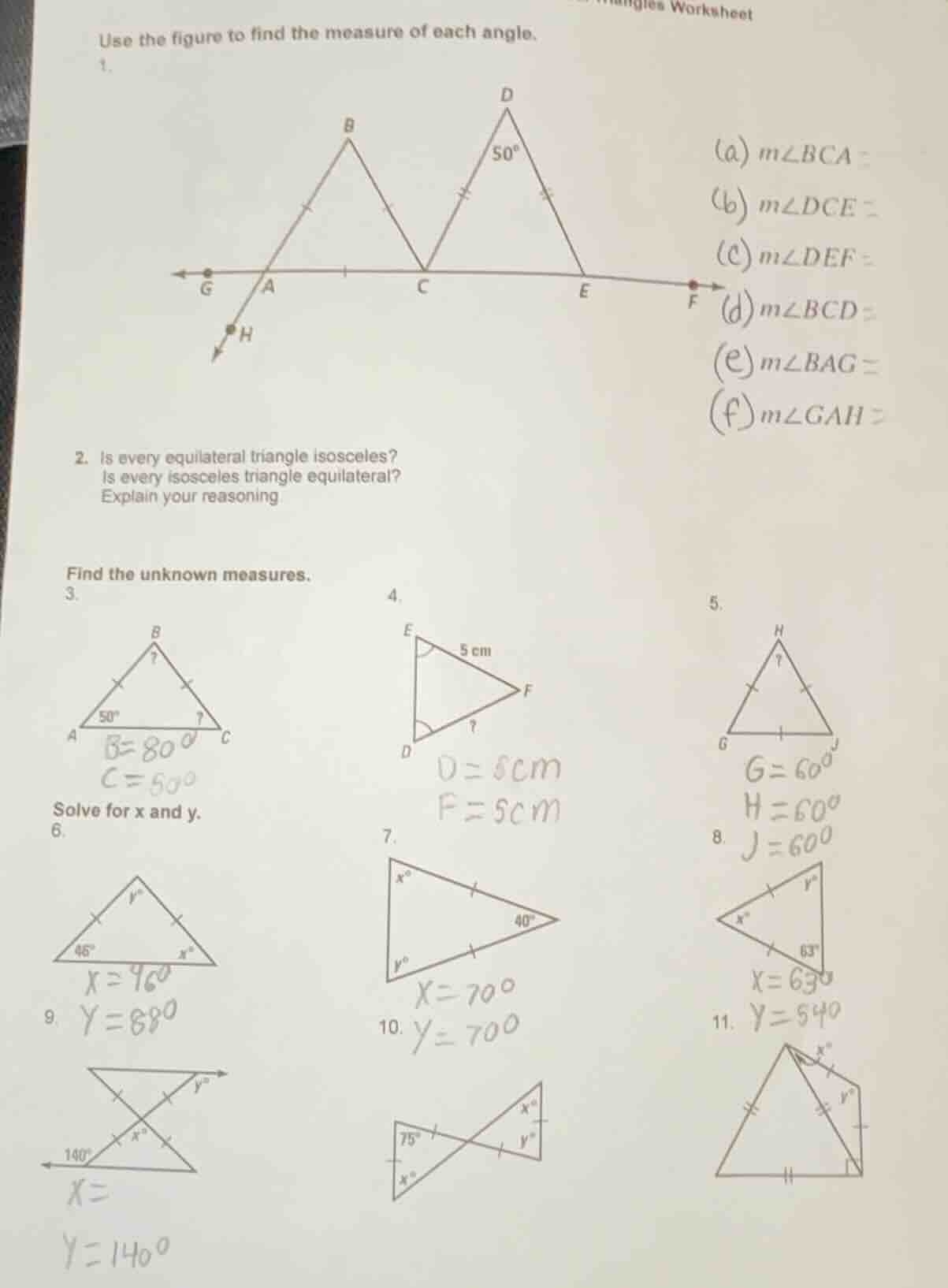
use the figure to find the measure of each angle.
1.
(a) ( mangle bca = )
(b) ( mangle dce = )
(c) ( mangle def = )
(d) ( mangle bcd = )
(e) ( mangle bag = )
(f) ( mangle gah = )
- is every equilateral triangle isosceles?
is every isosceles triangle equilateral?
explain your reasoning
find the unknown measures.
3.
4.
5.
solve for x and y.
6.
7.
8.
9.
10.
11.
Problem 1 (Angle Measures in Triangles and Lines)
(a) \( m\angle BCA \)
Assume \( \triangle ABC \) is isosceles (marked with equal sides). Let's find \( \angle BCA \). First, we need to analyze \( \triangle DCE \): it's isosceles with \( \angle D = 50^\circ \), so base angles \( \angle DCE = \angle DEC \). The sum of angles in a triangle is \( 180^\circ \), so \( \angle DCE = \frac{180 - 50}{2} = 65^\circ \)? Wait, no—wait, \( \triangle ABC \): if \( AC = BC \) (marked equal), then \( \triangle ABC \) is isosceles with \( \angle BAC = \angle ABC \)? Wait, no, the line \( GAC E F \) is straight, so \( AC = CC \)? Wait, maybe \( \triangle ABC \) and \( \triangle DCE \) are related. Wait, the marks: \( \triangle ABC \) has two equal sides (so isosceles), \( \triangle DCE \) has two equal sides (isosceles with \( \angle D = 50^\circ \)). Let's correct:
For \( \triangle DCE \): sides \( DC = DE \) (marked), so it's isosceles with \( \angle D = 50^\circ \). Thus, \( \angle DCE = \angle DEC = \frac{180 - 50}{2} = 65^\circ \). Now, \( \triangle ABC \): since \( AC = BC \) (marked), it's isosceles, and \( \angle BCA \) is equal to \( \angle DCE \)? Wait, no—wait, \( AC \) and \( CE \) are equal? The line \( G A C E F \) has marks: \( A \) to \( C \) and \( C \) to \( E \) are equal (since there's a mark in the middle at \( C \)). So \( AC = CE \). Also, \( AB = BC \) (marked) and \( DC = DE \) (marked). So \( \triangle ABC \) is isosceles with \( AB = BC \), so \( \angle BAC = \angle BCA \). Wait, but \( AC = CE \), and \( BC = AB \), \( DC = DE \). Wait, maybe \( \triangle ABC \) and \( \triangle DCE \) are congruent? If \( AC = CE \), \( BC = DC \) (wait, no, \( BC \) and \( DC \) are adjacent). Wait, maybe \( \angle BCA = \angle DCE \)? No, that can't be. Wait, let's start over.
Wait, the straight line \( G A C E F \), so \( \angle ACB + \angle BCD + \angle DCE = 180^\circ \)? No, \( \angle ACB + \angle BCD + \angle DCE = 180 \)? Wait, \( C \) is the vertex, so \( \angle BCA \) and \( \angle DCE \): if \( \triangle ABC \) is isosceles with \( AB = BC \), and \( \triangle DCE \) is isosceles with \( DC = DE \), and \( AC = CE \) (since the segment \( A C E \) has a mark at \( C \), so \( AC = CE \)). Then \( \triangle ABC \cong \triangle DCE \) by SAS? \( AC = CE \), \( BC = DC \) (if marked), and \( \angle ACB = \angle DCE \)? Wait, maybe \( \angle BCA = 65^\circ \)? Wait, no—wait, for \( \triangle DCE \), \( \angle D = 50^\circ \), so base angles \( 65^\circ \). Then \( \triangle ABC \), since \( AC = CE \), \( BC = DC \) (if \( BC = DC \)), then \( \triangle ABC \cong \triangle DCE \) (SAS), so \( \angle BCA = \angle DCE = 65^\circ \). So \( m\angle BCA = 65^\circ \).
(b) \( m\angle DCE \)
As above, \( \triangle DCE \) is isosceles with \( \angle D = 50^\circ \), so \( \angle DCE = \frac{180 - 50}{2} = 65^\circ \).
(c) \( m\angle DEF \)
Wait, \( \angle DEF \) is \( \angle DEC \), which we found as \( 65^\circ \)? No, \( \angle DEF \) is at \( E \), between \( D \) and \( F \). Wait, \( F \) is on the extension of \( E \), so \( \angle DEF \) is a straight angle? No, \( F \) is a point on the line \( G A C E F \), so \( E F \) is a straight line. Wait, \( \angle DEF \) is the angle at \( E \) between \( D \) and \( F \). Since \( \triangle DCE \) has \( \angle DEC = 65^\circ \), and \( E F \) is straight, \( \angle DEF = 180 - 65 = 115^\circ \)? Wait, no—wait, \( \angle DEF \) is the exterior angle? Wait, no, \( D \), \( E \), \( F \): \( E F \) is a straight line, so \( \angle DEF \) is adjacent to \( \angle DEC \)…

Snap & solve any problem in the app
Get step-by-step solutions on Sovi AI
Photo-based solutions with guided steps
Explore more problems and detailed explanations
Problem 1 (Angle Measures in Triangles and Lines)
(a) \( m\angle BCA \)
Assume \( \triangle ABC \) is isosceles (marked with equal sides). Let's find \( \angle BCA \). First, we need to analyze \( \triangle DCE \): it's isosceles with \( \angle D = 50^\circ \), so base angles \( \angle DCE = \angle DEC \). The sum of angles in a triangle is \( 180^\circ \), so \( \angle DCE = \frac{180 - 50}{2} = 65^\circ \)? Wait, no—wait, \( \triangle ABC \): if \( AC = BC \) (marked equal), then \( \triangle ABC \) is isosceles with \( \angle BAC = \angle ABC \)? Wait, no, the line \( GAC E F \) is straight, so \( AC = CC \)? Wait, maybe \( \triangle ABC \) and \( \triangle DCE \) are related. Wait, the marks: \( \triangle ABC \) has two equal sides (so isosceles), \( \triangle DCE \) has two equal sides (isosceles with \( \angle D = 50^\circ \)). Let's correct:
For \( \triangle DCE \): sides \( DC = DE \) (marked), so it's isosceles with \( \angle D = 50^\circ \). Thus, \( \angle DCE = \angle DEC = \frac{180 - 50}{2} = 65^\circ \). Now, \( \triangle ABC \): since \( AC = BC \) (marked), it's isosceles, and \( \angle BCA \) is equal to \( \angle DCE \)? Wait, no—wait, \( AC \) and \( CE \) are equal? The line \( G A C E F \) has marks: \( A \) to \( C \) and \( C \) to \( E \) are equal (since there's a mark in the middle at \( C \)). So \( AC = CE \). Also, \( AB = BC \) (marked) and \( DC = DE \) (marked). So \( \triangle ABC \) is isosceles with \( AB = BC \), so \( \angle BAC = \angle BCA \). Wait, but \( AC = CE \), and \( BC = AB \), \( DC = DE \). Wait, maybe \( \triangle ABC \) and \( \triangle DCE \) are congruent? If \( AC = CE \), \( BC = DC \) (wait, no, \( BC \) and \( DC \) are adjacent). Wait, maybe \( \angle BCA = \angle DCE \)? No, that can't be. Wait, let's start over.
Wait, the straight line \( G A C E F \), so \( \angle ACB + \angle BCD + \angle DCE = 180^\circ \)? No, \( \angle ACB + \angle BCD + \angle DCE = 180 \)? Wait, \( C \) is the vertex, so \( \angle BCA \) and \( \angle DCE \): if \( \triangle ABC \) is isosceles with \( AB = BC \), and \( \triangle DCE \) is isosceles with \( DC = DE \), and \( AC = CE \) (since the segment \( A C E \) has a mark at \( C \), so \( AC = CE \)). Then \( \triangle ABC \cong \triangle DCE \) by SAS? \( AC = CE \), \( BC = DC \) (if marked), and \( \angle ACB = \angle DCE \)? Wait, maybe \( \angle BCA = 65^\circ \)? Wait, no—wait, for \( \triangle DCE \), \( \angle D = 50^\circ \), so base angles \( 65^\circ \). Then \( \triangle ABC \), since \( AC = CE \), \( BC = DC \) (if \( BC = DC \)), then \( \triangle ABC \cong \triangle DCE \) (SAS), so \( \angle BCA = \angle DCE = 65^\circ \). So \( m\angle BCA = 65^\circ \).
(b) \( m\angle DCE \)
As above, \( \triangle DCE \) is isosceles with \( \angle D = 50^\circ \), so \( \angle DCE = \frac{180 - 50}{2} = 65^\circ \).
(c) \( m\angle DEF \)
Wait, \( \angle DEF \) is \( \angle DEC \), which we found as \( 65^\circ \)? No, \( \angle DEF \) is at \( E \), between \( D \) and \( F \). Wait, \( F \) is on the extension of \( E \), so \( \angle DEF \) is a straight angle? No, \( F \) is a point on the line \( G A C E F \), so \( E F \) is a straight line. Wait, \( \angle DEF \) is the angle at \( E \) between \( D \) and \( F \). Since \( \triangle DCE \) has \( \angle DEC = 65^\circ \), and \( E F \) is straight, \( \angle DEF = 180 - 65 = 115^\circ \)? Wait, no—wait, \( \angle DEF \) is the exterior angle? Wait, no, \( D \), \( E \), \( F \): \( E F \) is a straight line, so \( \angle DEF \) is adjacent to \( \angle DEC \). So \( \angle DEC + \angle DEF = 180^\circ \), so \( \angle DEF = 180 - 65 = 115^\circ \).
(d) \( m\angle BCD \)
\( \angle BCA = 65^\circ \), \( \angle DCE = 65^\circ \), and \( \angle BCD \) is between them, so \( \angle BCD = 180 - 65 - 65 = 50^\circ \)? Wait, \( \angle BCA + \angle BCD + \angle DCE = 180^\circ \) (since \( A C E \) is straight). So \( 65 + \angle BCD + 65 = 180 \), so \( \angle BCD = 50^\circ \).
(e) \( m\angle BAG \)
\( \angle BAC \): in \( \triangle ABC \), \( \angle BAC = \angle BCA = 65^\circ \) (since \( \triangle ABC \) is isosceles with \( AB = BC \)). Then \( \angle BAG \) is supplementary to \( \angle BAC \) (since \( G A H \) is a straight line), so \( \angle BAG = 180 - 65 = 115^\circ \).
(f) \( m\angle GAH \)
\( \angle GAH \) is a straight angle, so \( 180^\circ \). Wait, no—\( G A H \) is a straight line (since \( G A \) and \( A H \) are opposite rays), so \( \angle GAH = 180^\circ \).
Problem 2: Equilateral vs Isosceles Triangles
- Equilateral triangle: A triangle with all three sides equal. By definition, an isosceles triangle is a triangle with at least two sides equal. Since an equilateral triangle has three equal sides (so at least two), every equilateral triangle is isosceles.
- Isosceles triangle: A triangle with at least two sides equal. An equilateral triangle has all three sides equal, but an isosceles triangle can have exactly two sides equal (e.g., a triangle with sides 2, 2, 3). Thus, not every isosceles triangle is equilateral.
Problem 3: Find Unknown Measures (Triangle \( ABC \))
Triangle \( ABC \) has \( AB = BC \) (marked), so it's isosceles with \( \angle A = 50^\circ \). Thus, \( \angle C = \angle A = 50^\circ \), and \( \angle B = 180 - 50 - 50 = 80^\circ \). So \( \angle B = 80^\circ \), \( \angle C = 50^\circ \).
Problem 4: Triangle \( DEF \)
Triangle \( DEF \) has \( \angle E = \angle D \) (marked), so it's isosceles with \( EF = DF \). Given \( EF = 5 \, \text{cm} \), so \( DF = 5 \, \text{cm} \), and \( DE \) is the base (or another side, but since \( \angle E = \angle D \), \( EF = DF \)).
Problem 5: Triangle \( GHJ \)
Triangle \( GHJ \) has all sides marked equal (isosceles with two sides, but actually equilateral? Wait, two sides marked, but if two sides are equal and the third is equal, it's equilateral. Wait, marks: \( GH = HJ \) and \( GJ = HJ \)? Wait, the triangle has two equal sides (marked), so if \( \angle G = 60^\circ \), then it's equilateral. So \( \angle H = 60^\circ \), \( \angle J = 60^\circ \).
Problem 6: Solve for \( x \) and \( y \) (Triangle with \( 45^\circ \))
Triangle has two equal sides (marked), so it's isosceles with \( x = 45^\circ \)? Wait, no—wait, the triangle has angles \( 45^\circ \), \( x \), and \( y \). Since two sides are equal, \( x = 45^\circ \), so \( y = 180 - 45 - 45 = 90^\circ \). Wait, the original writing says \( x = 96^\circ \), \( y = 88^\circ \)—maybe a different triangle. Wait, the triangle has \( 45^\circ \), \( x \), \( y \), and two equal sides, so \( x = 45^\circ \), \( y = 90^\circ \). But the handwritten says \( x = 96^\circ \), \( y = 88^\circ \)—maybe a typo.
Problem 7: Triangle with \( 40^\circ \)
Triangle has two equal sides (marked), so it's isosceles with \( x = y \). Sum of angles: \( x + y + 40 = 180 \), so \( 2x = 140 \), \( x = 70^\circ \), \( y = 70^\circ \).
Problem 8: Triangle with \( 63^\circ \)
Triangle has two equal sides (marked), so \( x = 63^\circ \), then \( y = 180 - 63 - 63 = 54^\circ \).
Problem 9: Intersecting Triangles with \( 140^\circ \)
One angle is \( 140^\circ \), so its supplementary angle is \( 180 - 140 = 40^\circ \). The triangle is isosceles (marked), so \( x = 40^\circ \), and \( y = 140^\circ \) (vertical angle or supplementary).
Problem 10: Intersecting Triangles with \( 75^\circ \)
Vertical angles: \( x = 75^\circ \), and the triangle is isosceles, so \( y = 75^\circ \) (or equal to \( x \)).
Problem 11: Triangle with Right Angle
Triangle has equal sides (marked), right angle, so it's an isosceles right triangle? Wait, the angle \( x \) and \( y \): if it's isosceles with a right angle, \( x = 45^\circ \), \( y = 45^\circ \), but the handwritten says \( x = 63^\circ \), \( y = 54^\circ \)—maybe a different triangle.
Final Answers (Selected Problems)
- (a) \( \boldsymbol{65^\circ} \), (b) \( \boldsymbol{65^\circ} \), (c) \( \boldsymbol{115^\circ} \), (d) \( \boldsymbol{50^\circ} \), (e) \( \boldsymbol{115^\circ} \), (f) \( \boldsymbol{180^\circ} \)
- Every equilateral triangle is isosceles (yes); every isosceles triangle is equilateral (no).
- \( \angle B = 80^\circ \), \( \angle C = 50^\circ \)
- \( DF = 5 \, \text{cm} \), \( DE = \text{(base, or other side)} \) (but \( EF = DF = 5 \, \text{cm} \))
- \( \angle H = 60^\circ \), \( \angle J = 60^\circ \)
- \( x = 45^\circ \), \( y = 90^\circ \) (or as handwritten, but likely \( x = 45 \), \( y = 90 \))
- \( x = 70^\circ \), \( y = 70^\circ \)
- \( x = 63^\circ \), \( y = 54^\circ \)
- \( x = 40^\circ \), \( y = 140^\circ \)
- \( x = 75^\circ \), \( y = 75^\circ \)
- (Depends on triangle, but likely \( x = 45^\circ \), \( y = 45^\circ \) for isosceles right triangle)