QUESTION IMAGE
Question
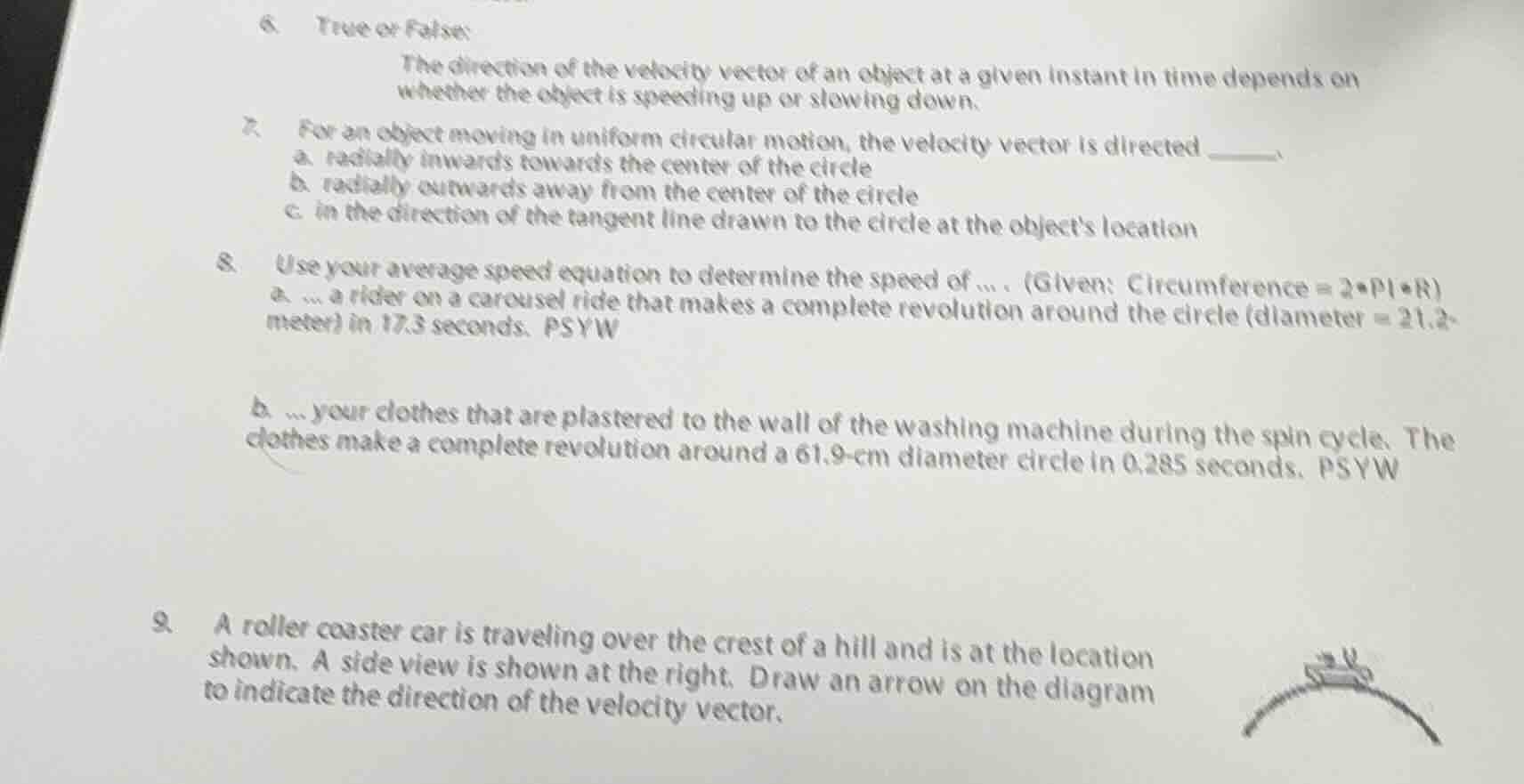
- true or false:
the direction of the velocity vector of an object at a given instant in time depends on
whether the object is speeding up or slowing down.
- for an object moving in uniform circular motion, the velocity vector is directed ______.
a. radially inwards towards the center of the circle
b. radially outwards away from the center of the circle
c. in the direction of the tangent line drawn to the circle at the objects location
- use your average speed equation to determine the speed of .... (given: circumference = 2•pi•r)
a. ... a rider on a carousel ride that makes a complete revolution around the circle (diameter = 21.2-meter) in 17.3 seconds. psyw
b. ... your clothes that are plastered to the wall of the washing machine during the spin cycle. the
clothes make a complete revolution around a 61.9-cm diameter circle in 0.285 seconds. psyw
- a roller coaster car is traveling over the crest of a hill and is at the location
shown. a side view is shown at the right. draw an arrow on the diagram
to indicate the direction of the velocity vector.
Question 6
The velocity vector's direction at an instant depends on the object's path, not acceleration (speeding up/slowing down). Acceleration affects speed magnitude, not velocity direction directly.
In uniform circular motion, velocity is always tangent to the circular path at the object's position, not radial.
Step1: Find radius from diameter
For part a: Radius $r_a = \frac{21.2}{2} = 10.6$ m
For part b: Radius $r_b = \frac{61.9}{2} = 30.95$ cm $= 0.3095$ m
Step2: Calculate circumference
Circumference formula: $C = 2\pi r$
Part a: $C_a = 2\pi(10.6) = 21.2\pi$ m
Part b: $C_b = 2\pi(0.3095) = 0.619\pi$ m
Step3: Compute average speed
Speed formula: $v = \frac{\text{Distance}}{\text{Time}} = \frac{C}{t}$
Part a: $v_a = \frac{21.2\pi}{17.3}$
$v_a \approx \frac{66.60}{17.3} \approx 3.85$ m/s
Part b: $v_b = \frac{0.619\pi}{0.285}$
$v_b \approx \frac{1.945}{0.285} \approx 6.82$ m/s

Snap & solve any problem in the app
Get step-by-step solutions on Sovi AI
Photo-based solutions with guided steps
Explore more problems and detailed explanations
False
---