QUESTION IMAGE
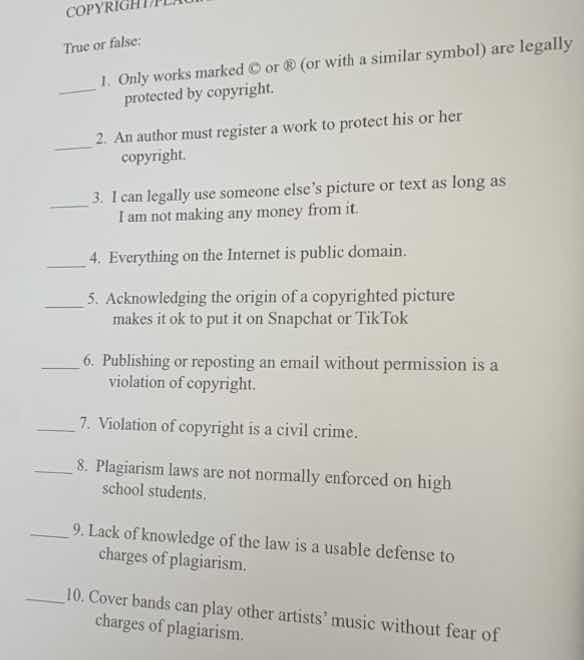
Question
true or false:
- only works marked © or ® (or with a similar symbol) are legally protected by copyright.
- an author must register a work to protect his or her copyright.
- i can legally use someone elses picture or text as long as i am not making any money from it.
- everything on the internet is public domain.
- acknowledging the origin of a copyrighted picture makes it ok to put it on snapchat or tiktok
- publishing or reposting an email without permission is a violation of copyright.
- violation of copyright is a civil crime.
- plagiarism laws are not normally enforced on high school students.
- lack of knowledge of the law is a usable defense to charges of plagiarism.
- cover bands can play other artists music without fear of charges of plagiarism.
Brief Explanations
- Copyright protection applies automatically to original works, even without a © or ™ symbol.
- Copyright protection is automatic upon creation; registration is not required in most jurisdictions.
- Non-commercial use does not automatically grant permission to use copyrighted material; fair use rules apply but are limited.
- Most content on the Internet is protected by copyright, not public domain.
- Acknowledging the source does not override copyright restrictions; explicit permission is needed for sharing on platforms like Snapchat/TikTok.
- Emails are protected by copyright, so publishing/reposting without permission violates this.
- Copyright violations can result in civil lawsuits (civil offense) and in some cases, criminal charges for severe infringement.
- Plagiarism policies (and related laws) apply to high school students, as schools enforce academic integrity rules.
- Ignorance of copyright/plagiarism laws is not a valid legal defense.
- Cover bands need proper licensing to perform other artists' music publicly to avoid copyright infringement.

Snap & solve any problem in the app
Get step-by-step solutions on Sovi AI
Photo-based solutions with guided steps
Explore more problems and detailed explanations
- False
- False
- False
- False
- False
- True
- True (Note: While some severe cases are criminal, most are civil offenses)
- False
- False
- False