QUESTION IMAGE
Question
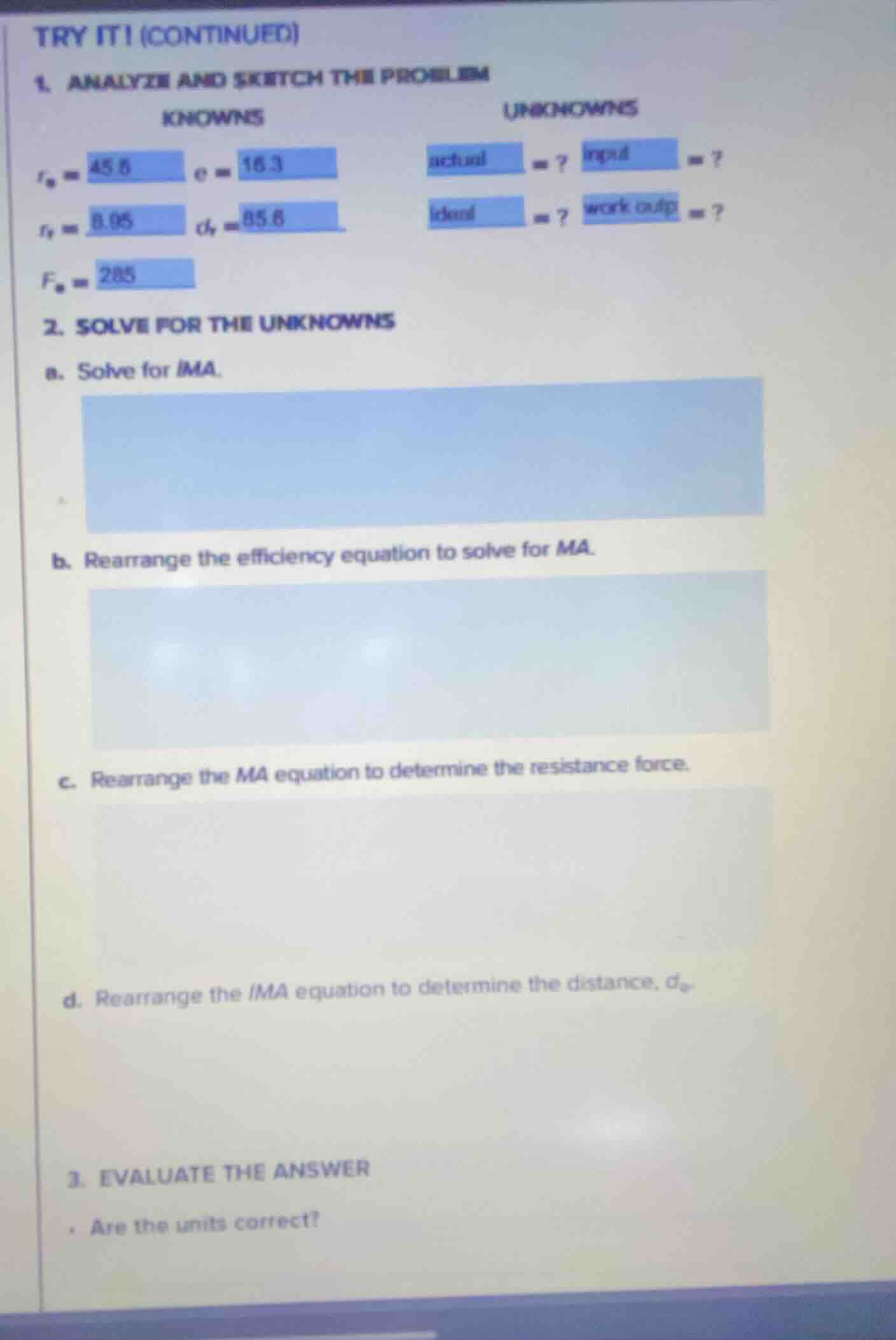
try it! (continued)
- analyze and sketch the problem
known
( r_e = 45.6 ), ( e = 16.3 )
( r_f = 8.95 ), ( d_r = 85.8 )
( f_e = 285 )
unknowns
actual = ?, input = ?
ideal = ?, work output = ?
- solve for the unknowns
a. solve for ima.
b. rearrange the efficiency equation to solve for ma.
c. rearrange the ma equation to determine the resistance force.
d. rearrange the ima equation to determine the distance, ( d_e ).
- evaluate the answer
- are the units correct?
Part a: Solve for IMA (Ideal Mechanical Advantage)
For a wheel - and - axle system, the formula for the Ideal Mechanical Advantage (\(IMA\)) is given by the ratio of the radius of the wheel (\(r_e\)) to the radius of the axle (\(r_r\)):
\[IMA=\frac{r_e}{r_r}\]
We know that \(r_e = 45.6\) and \(r_r=8.05\).
Step 1: Substitute the known values into the formula
Substitute \(r_e = 45.6\) and \(r_r = 8.05\) into the formula for \(IMA\):
\[IMA=\frac{45.6}{8.05}\]
Step 2: Calculate the value
\[IMA\approx5.66\]
Part b: Rearrange the efficiency equation to solve for \(MA\) (Mechanical Advantage)
The formula for efficiency (\(\eta\)) is \(\eta=\frac{MA}{IMA}\times100\%\) (or \(\eta=\frac{MA}{IMA}\) when expressed as a decimal).
Step 1: Start with the efficiency formula
\(\eta=\frac{MA}{IMA}\)
Step 2: Solve for \(MA\)
Multiply both sides of the equation by \(IMA\) to isolate \(MA\):
\[MA=\eta\times IMA\]
Part c: Rearrange the \(MA\) equation to determine the resistance force (\(F_r\))
The formula for Mechanical Advantage (\(MA\)) is \(MA = \frac{F_r}{F_e}\), where \(F_r\) is the resistance force and \(F_e\) is the effort force.
Step 1: Start with the \(MA\) formula
\(MA=\frac{F_r}{F_e}\)
Step 2: Solve for \(F_r\)
Multiply both sides of the equation by \(F_e\) to isolate \(F_r\):
\[F_r=MA\times F_e\]
Part d: Rearrange the \(IMA\) equation to determine the distance (\(d_e\))
For a wheel - and - axle system, the relationship between the distances and the radii is based on the fact that the work done in the ideal case is conserved (\(W = F\times d\)), and also \(IMA=\frac{r_e}{r_r}=\frac{d_e}{d_r}\) (since the distance moved is proportional to the radius for a circular motion, \(d = 2\pi r\), and the \(2\pi\) terms cancel out).
Step 1: Start with the \(IMA\) formula for distance
\(IMA=\frac{d_e}{d_r}\)
Step 2: Solve for \(d_e\)
Multiply both sides of the equation by \(d_r\) to isolate \(d_e\):
\[d_e=IMA\times d_r\]
Part a Answer: \(\approx5.66\)
Part b Answer: \(MA = \eta\times IMA\)
Part c Answer: \(F_r=MA\times F_e\)
Part d Answer: \(d_e = IMA\times d_r\)

Snap & solve any problem in the app
Get step-by-step solutions on Sovi AI
Photo-based solutions with guided steps
Explore more problems and detailed explanations
Part a: Solve for IMA (Ideal Mechanical Advantage)
For a wheel - and - axle system, the formula for the Ideal Mechanical Advantage (\(IMA\)) is given by the ratio of the radius of the wheel (\(r_e\)) to the radius of the axle (\(r_r\)):
\[IMA=\frac{r_e}{r_r}\]
We know that \(r_e = 45.6\) and \(r_r=8.05\).
Step 1: Substitute the known values into the formula
Substitute \(r_e = 45.6\) and \(r_r = 8.05\) into the formula for \(IMA\):
\[IMA=\frac{45.6}{8.05}\]
Step 2: Calculate the value
\[IMA\approx5.66\]
Part b: Rearrange the efficiency equation to solve for \(MA\) (Mechanical Advantage)
The formula for efficiency (\(\eta\)) is \(\eta=\frac{MA}{IMA}\times100\%\) (or \(\eta=\frac{MA}{IMA}\) when expressed as a decimal).
Step 1: Start with the efficiency formula
\(\eta=\frac{MA}{IMA}\)
Step 2: Solve for \(MA\)
Multiply both sides of the equation by \(IMA\) to isolate \(MA\):
\[MA=\eta\times IMA\]
Part c: Rearrange the \(MA\) equation to determine the resistance force (\(F_r\))
The formula for Mechanical Advantage (\(MA\)) is \(MA = \frac{F_r}{F_e}\), where \(F_r\) is the resistance force and \(F_e\) is the effort force.
Step 1: Start with the \(MA\) formula
\(MA=\frac{F_r}{F_e}\)
Step 2: Solve for \(F_r\)
Multiply both sides of the equation by \(F_e\) to isolate \(F_r\):
\[F_r=MA\times F_e\]
Part d: Rearrange the \(IMA\) equation to determine the distance (\(d_e\))
For a wheel - and - axle system, the relationship between the distances and the radii is based on the fact that the work done in the ideal case is conserved (\(W = F\times d\)), and also \(IMA=\frac{r_e}{r_r}=\frac{d_e}{d_r}\) (since the distance moved is proportional to the radius for a circular motion, \(d = 2\pi r\), and the \(2\pi\) terms cancel out).
Step 1: Start with the \(IMA\) formula for distance
\(IMA=\frac{d_e}{d_r}\)
Step 2: Solve for \(d_e\)
Multiply both sides of the equation by \(d_r\) to isolate \(d_e\):
\[d_e=IMA\times d_r\]