QUESTION IMAGE
Question
try it!
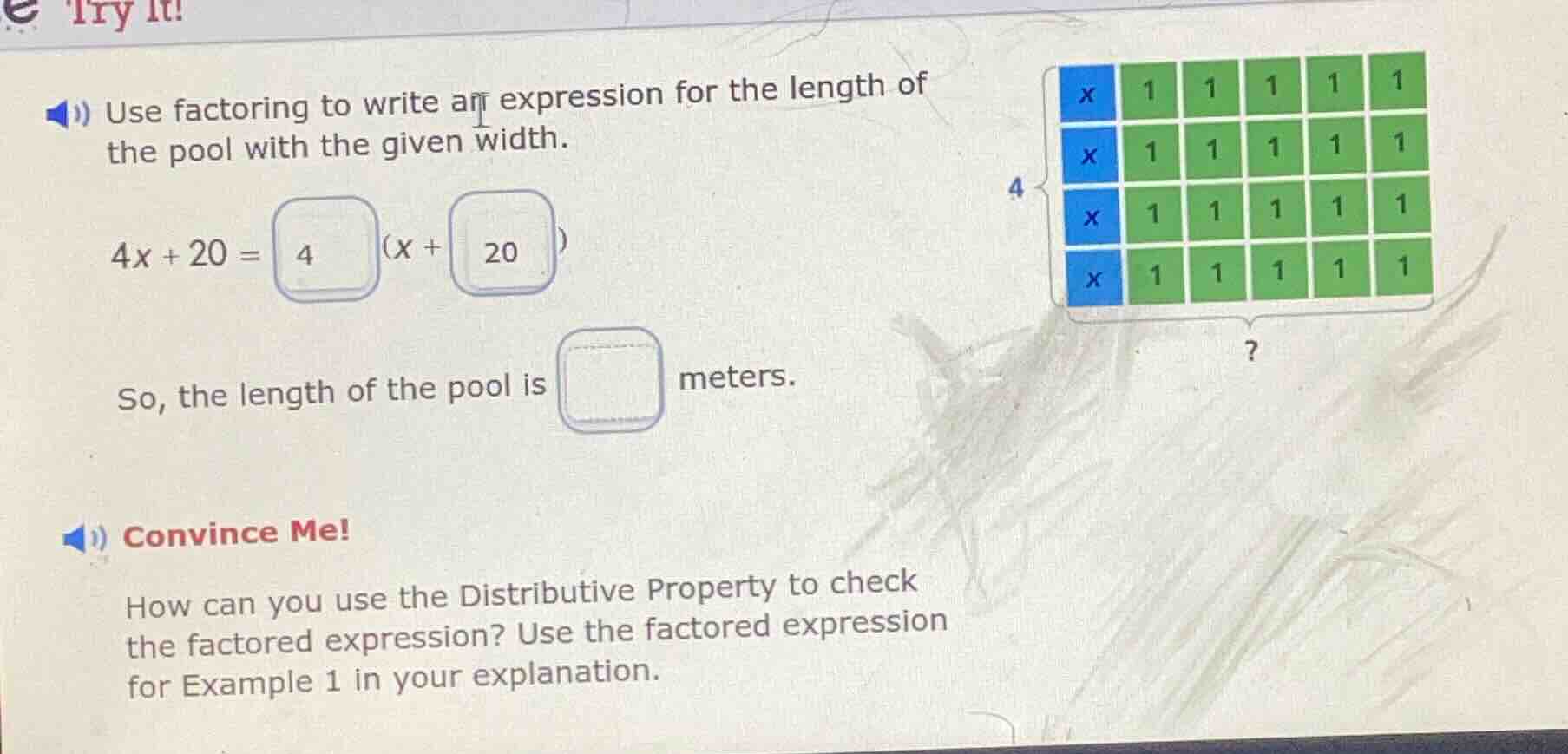
use factoring to write an expression for the length of the pool with the given width.
$4x + 20 = \boxed{4}(x + \boxed{20})$
so, the length of the pool is \boxed{} meters.
convince me!
how can you use the distributive property to check the factored expression? use the factored expression for example 1 in your explanation.
Part 1: Finding the length of the pool
Step 1: Recall the distributive property
The distributive property states that \( a(b + c)=ab + ac \). To factor \( 4x + 20 \), we need to find the greatest common factor (GCF) of \( 4x \) and \( 20 \). The GCF of \( 4x \) and \( 20 \) is \( 4 \).
Step 2: Factor out the GCF
Using the distributive property in reverse (factoring), we have \( 4x+20 = 4(x + 5) \). Wait, the initial wrong filling had \( 20 \) instead of \( 5 \). Let's correct that. We divide each term by \( 4 \): \( \frac{4x}{4}+\frac{20}{4}=x + 5 \). So \( 4x + 20=4(x + 5) \). If we assume the width is \( 4 \) (from the diagram, the height is \( 4 \)), then the area of the rectangle (pool) is \( 4x + 20 \), and since area \( A=\text{length}\times\text{width} \), if width is \( 4 \), then length is \( x + 5 \). But let's go back to the factoring. The correct factoring of \( 4x+20 \) is \( 4(x + 5) \), so the length (the binomial factor) is \( x + 5 \).
To check the factored expression (let's take the correct factored form \( 4(x + 5) \) from the first part), we use the distributive property. The distributive property says \( a(b + c)=ab+ac \). Here, \( a = 4 \), \( b=x \), and \( c = 5 \). So we multiply \( 4 \) by \( x \) and \( 4 \) by \( 5 \): \( 4\times x+4\times5=4x + 20 \), which is the original expression. This shows that the factoring is correct because when we apply the distributive property to the factored form, we get back the original expression.

Snap & solve any problem in the app
Get step-by-step solutions on Sovi AI
Photo-based solutions with guided steps
Explore more problems and detailed explanations
The length of the pool is \( x + 5 \) meters.