QUESTION IMAGE
Question
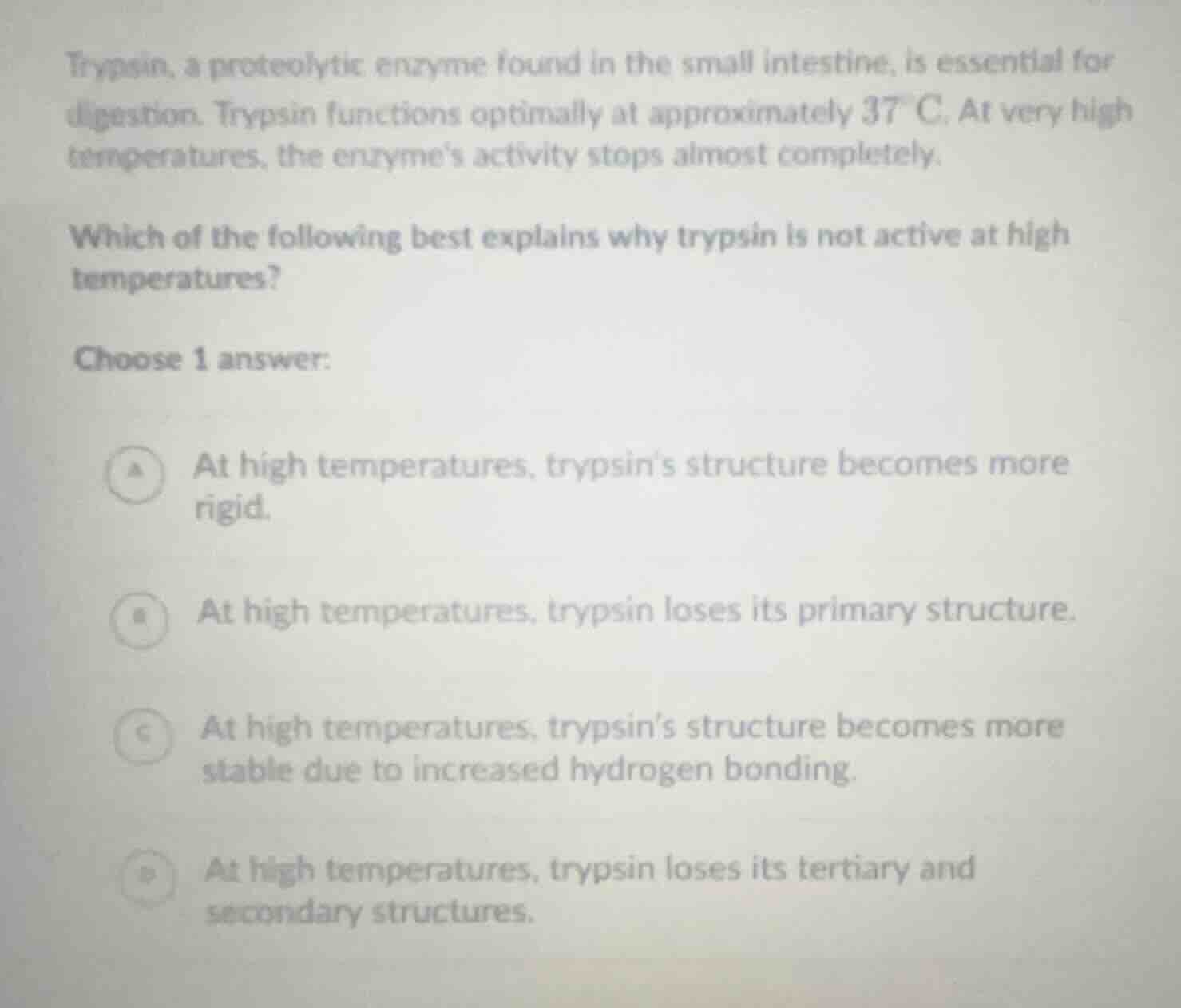
trypsin, a proteolytic enzyme found in the small intestine, is essential for digestion. trypsin functions optimally at approximately $37^circ$c. at very high temperatures, the enzyme’s activity stops almost completely.
which of the following best explains why trypsin is not active at high temperatures?
choose 1 answer:
a at high temperatures, trypsin’s structure becomes more rigid.
b at high temperatures, trypsin loses its primary structure.
c at high temperatures, trypsin’s structure becomes more stable due to increased hydrogen bonding.
d at high temperatures, trypsin loses its tertiary and secondary structures.
Enzymes like trypsin rely on their specific 3D structure (including secondary and tertiary structures) for activity. High temperatures break weak bonds maintaining these structures (denaturation), while primary structure (amino acid sequence) remains intact. Options A, B, and C are incorrect: high temps do not make enzymes rigid, preserve primary structure, or increase stability via more hydrogen bonds.

Snap & solve any problem in the app
Get step-by-step solutions on Sovi AI
Photo-based solutions with guided steps
Explore more problems and detailed explanations
D. At high temperatures, trypsin loses its tertiary and secondary structures.