QUESTION IMAGE
Question
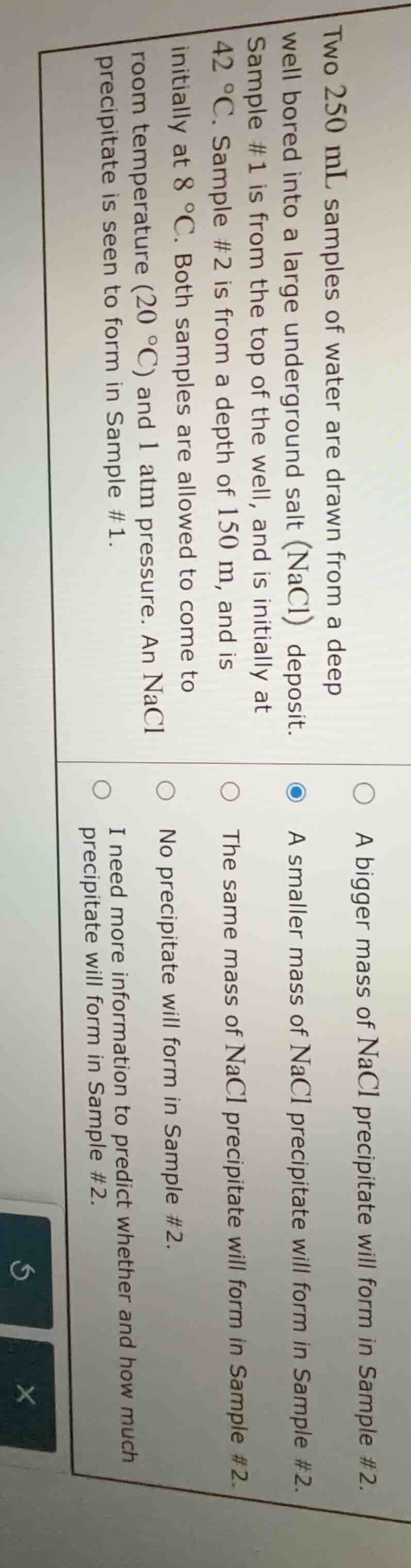
two 250 ml samples of water are drawn from a deep well bored into a large underground salt (nacl) deposit. sample #1 is from the top of the well, and is initially at 42 °c. sample #2 is from a depth of 150 m, and is initially at 8 °c. both samples are allowed to come to room temperature (20 °c) and 1 atm pressure. an nacl precipitate is seen to form in sample #1.
a bigger mass of nacl precipitate will form in sample #2.
a smaller mass of nacl precipitate will form in sample #2.
the same mass of nacl precipitate will form in sample #2.
no precipitate will form in sample #2.
i need more information to predict whether and how much precipitate will form in sample #2.
The solubility of NaCl in water is nearly unaffected by temperature (small change) and pressure (negligible for solids dissolved in liquids). Both samples are 250 mL, and when brought to the same room conditions, the amount of excess NaCl that precipitates depends only on how much more NaCl was dissolved beyond the saturation point at room conditions. Sample #1 was initially colder (8 °C) and precipitated when warmed to 20 °C, meaning it was supersaturated at 8 °C relative to 20 °C. Sample #2 was initially warmer (42 °C); since NaCl solubility increases very slightly with temperature, it could hold slightly more NaCl at 42 °C than at 20 °C. When cooled to 20 °C, if it was saturated at 42 °C, only a tiny amount (or less than Sample #1) would precipitate. Thus, a smaller mass of NaCl precipitate forms in Sample #2 compared to Sample #1.

Snap & solve any problem in the app
Get step-by-step solutions on Sovi AI
Photo-based solutions with guided steps
Explore more problems and detailed explanations
A smaller mass of NaCl precipitate will form in Sample #2.