QUESTION IMAGE
Question
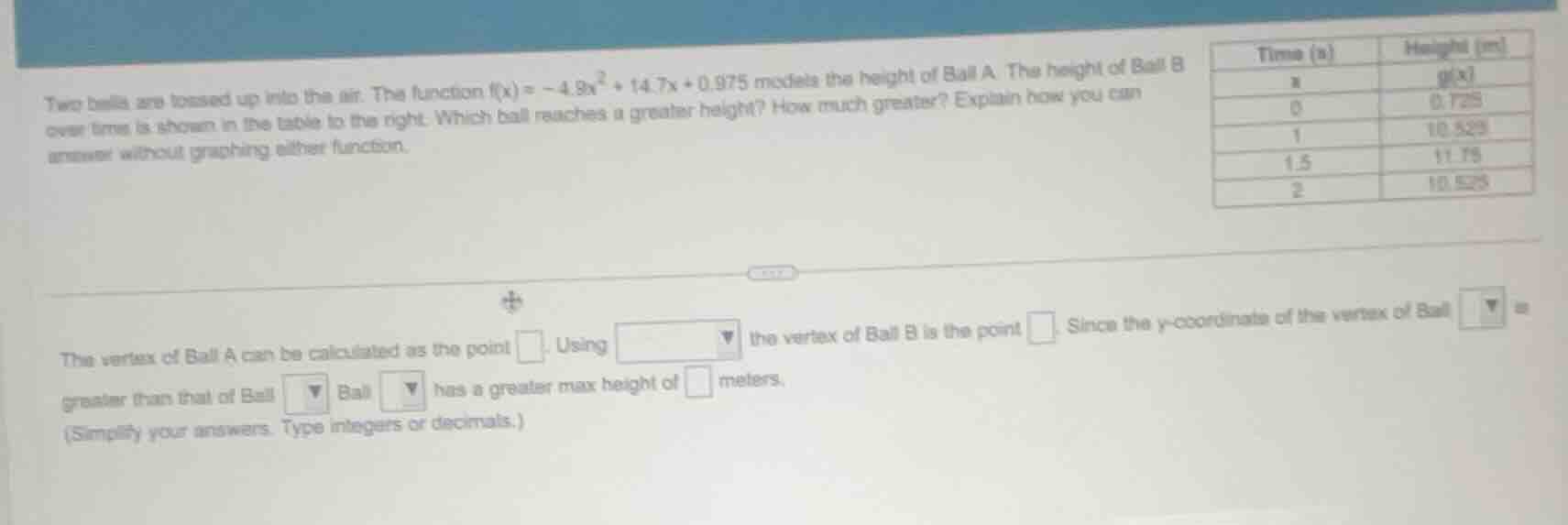
two balls are tossed up into the air. the function $f(x) = -4.9x^{2} + 14.7x + 0.975$ models the height of ball a. the height of ball b over time is shown in the table to the right. which ball reaches a greater height? how much greater? explain how you can answer without graphing either function.
| time (s) $x$ | height (m) $g(x)$ | ---- | ---- | 0 | 0.725 | 1 | 10.525 | 1.5 | 11.75 | 2 | 10.525 | the vertex of ball a can be calculated as the point $square$. using $\boldsymbol{ |
abla}$ the vertex of ball b is the point $square$. since the y-coordinate of the vertex of ball $\boldsymbol{
abla}$ is greater than that of ball $\boldsymbol{
abla}$ ball $\boldsymbol{
abla}$ has a greater max height of $square$ meters.(simplify your answers. type integers or decimals.)
Step1: Find vertex x of Ball A
For quadratic $f(x)=ax^2+bx+c$, $x=-\frac{b}{2a}$
$x=-\frac{14.7}{2(-4.9)} = 1.5$
Step2: Find vertex y of Ball A
Substitute $x=1.5$ into $f(x)$
$f(1.5)=-4.9(1.5)^2+14.7(1.5)+0.975 = 12.0$
Step3: Identify vertex of Ball B
Symmetry of table values: vertex at $x=1.5$
From table, $g(1.5)=11.76$
Step4: Compare max heights
Subtract heights: $12.0 - 11.76 = 0.24$

Snap & solve any problem in the app
Get step-by-step solutions on Sovi AI
Photo-based solutions with guided steps
Explore more problems and detailed explanations
The vertex of Ball A can be calculated as the point $(1.5, 12.0)$. Using symmetry the vertex of Ball B is the point $(1.5, 11.76)$. Since the y-coordinate of the vertex of Ball A is greater than that of Ball B, Ball A has a greater max height of 12.0 meters, which is 0.24 meters greater than Ball B's max height.