QUESTION IMAGE
Question
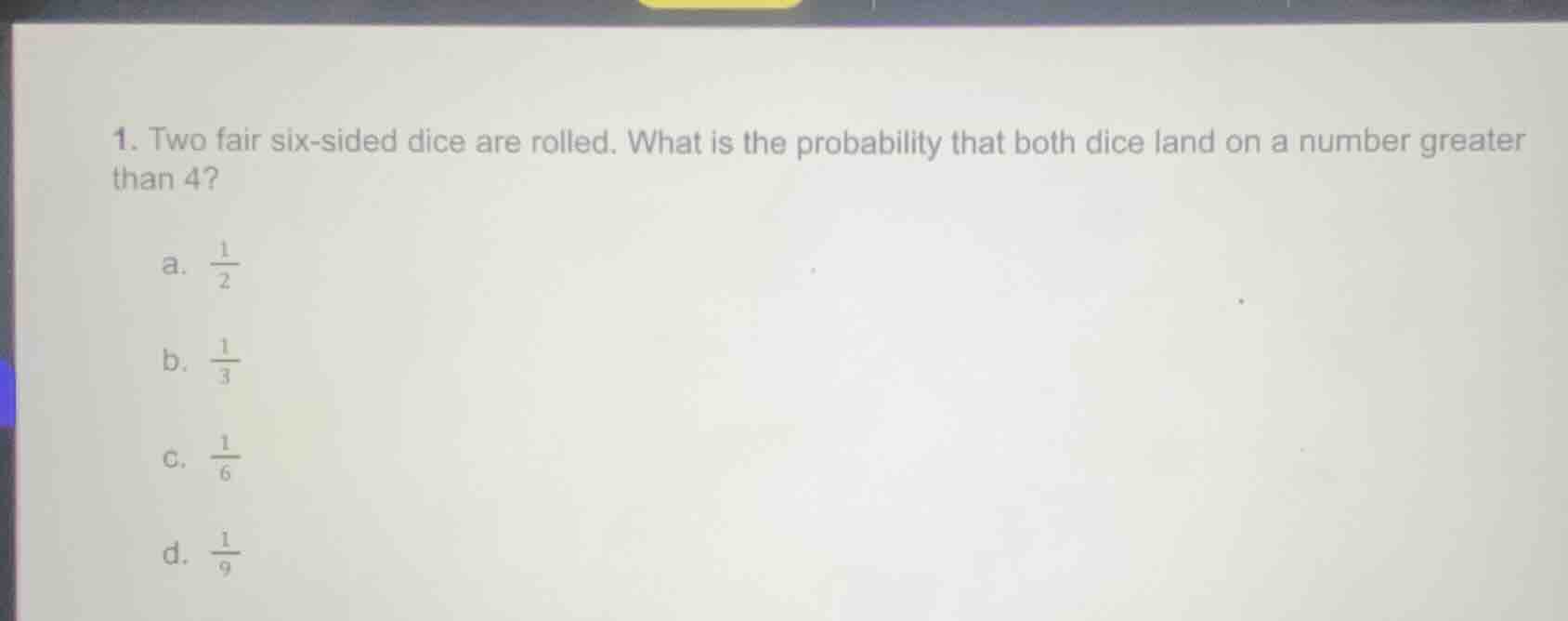
- two fair six - sided dice are rolled. what is the probability that both dice land on a number greater than 4?
a. $\frac{1}{2}$
b. $\frac{1}{3}$
c. $\frac{1}{6}$
d. $\frac{1}{9}$
Step1: Determine possible outcomes for one die
A six - sided die has numbers 1, 2, 3, 4, 5, 6. Numbers greater than 4 are 5 and 6. So, for one die, the number of favorable outcomes (numbers > 4) is 2, and the total number of outcomes is 6. The probability that one die lands on a number greater than 4 is $P(\text{one die})=\frac{2}{6}=\frac{1}{3}$.
Step2: Determine the probability for two independent dice
Since the rolls of the two dice are independent events, the probability that both events occur (both dice land on a number greater than 4) is the product of their individual probabilities. So, $P(\text{both dice}) = P(\text{first die})\times P(\text{second die})$. Substituting the probability for one die, we get $P(\text{both dice})=\frac{1}{3}\times\frac{1}{3}=\frac{1}{9}$.

Snap & solve any problem in the app
Get step-by-step solutions on Sovi AI
Photo-based solutions with guided steps
Explore more problems and detailed explanations
d. $\frac{1}{9}$