QUESTION IMAGE
Question
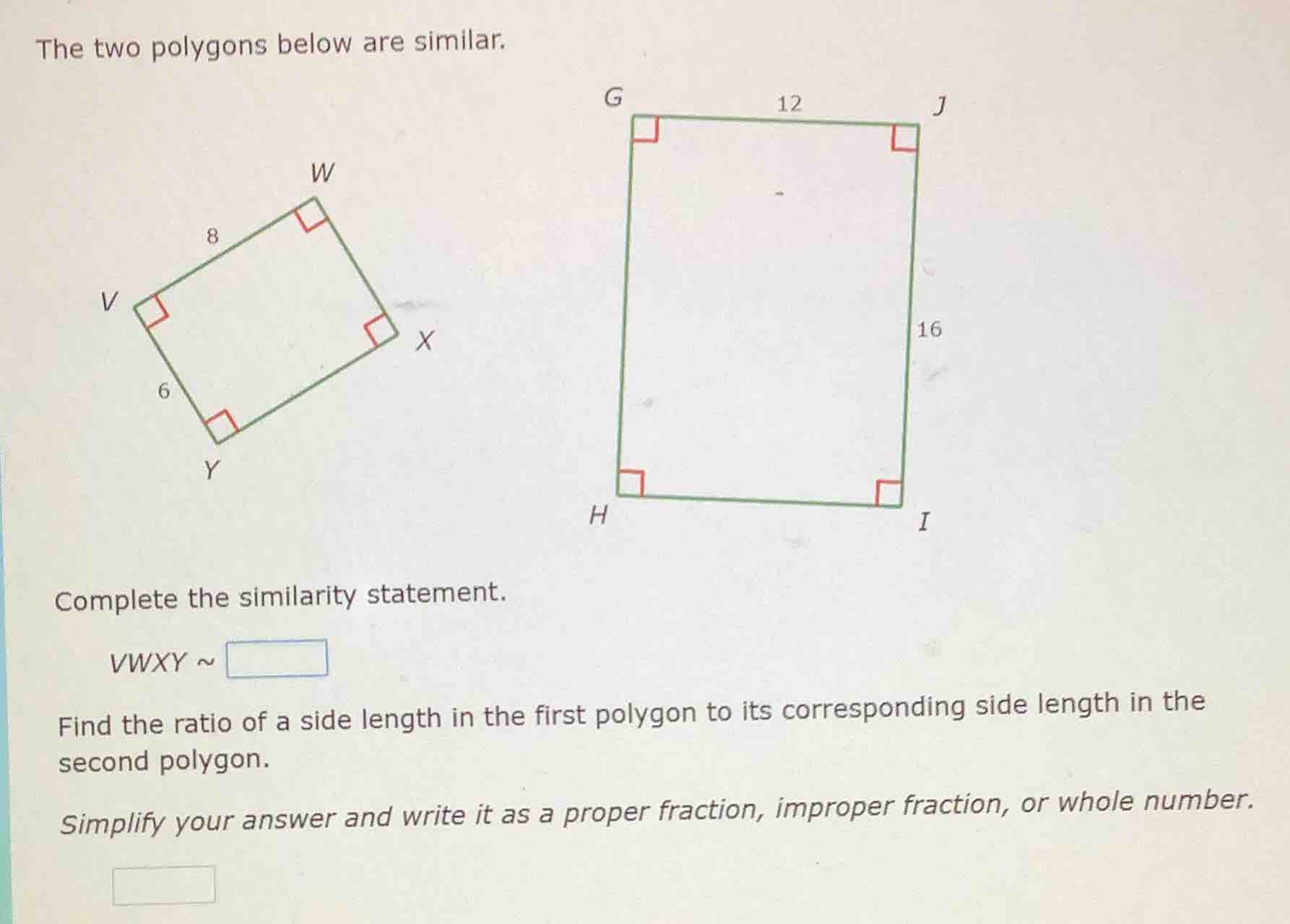
the two polygons below are similar.
complete the similarity statement.
vwxy ~
find the ratio of a side length in the first polygon to its corresponding side length in the second polygon.
simplify your answer and write it as a proper fraction, improper fraction, or whole number.
Part 1: Completing the Similarity Statement
To determine the similarity statement, we need to match the corresponding vertices of the similar polygons. Both polygons are rectangles (all angles are right angles). For rectangle \(VWXY\), we analyze the side lengths. The sides of \(VWXY\) are 6 and 8, and the sides of the other rectangle (with vertices \(G, J, I, H\)) are 12 and 16. Notice that \(6\) corresponds to \(12\) (scaled by 2) and \(8\) corresponds to \(16\) (scaled by 2), but we need to match the order of vertices. By examining the right angles and the order of the vertices (clockwise or counter - clockwise), we find that \(VWXY\) is similar to \(GJIH\) (or \(GJIH\) in the correct vertex order).
Step 1: Identify Corresponding Sides
We can take the side of length 8 in \(VWXY\) and its corresponding side of length 12 in \(GJIH\), or the side of length 6 in \(VWXY\) and its corresponding side of length 16? Wait, no. Wait, let's re - check. Wait, the first polygon \(VWXY\) has sides 6 and 8. The second polygon \(GJIH\) has sides 12 and 16. Let's find the ratio of a side from the first polygon to the corresponding side in the second. Let's take the side \(VW = 8\) and its corresponding side \(GJ=12\)? Wait, no, maybe I mixed up. Wait, no, let's see the rectangles. Let's check the ratio of the shorter sides. The shorter side of \(VWXY\) is 6, and the shorter side of \(GJIH\) is 12? Wait, no, 6 and 12: \(6/12=\frac{1}{2}\), and 8 and 16: \(8/16 = \frac{1}{2}\). Wait, maybe I had the corresponding sides wrong. Wait, the first polygon \(VWXY\): let's assume \(VW = 8\), \(WX\) (the other side) = 6? Wait, no, in a rectangle, adjacent sides are length and width. Let's take the side of length 6 in \(VWXY\) and its corresponding side in \(GJIH\). The side in \(GJIH\) that corresponds to 6: let's see, the sides of \(GJIH\) are 12 (top) and 16 (right). Wait, maybe the ratio is \(8/12\)? No, that can't be. Wait, no, let's do it properly.
The two rectangles are similar, so the ratio of corresponding sides is constant. Let's take the side of length 6 in \(VWXY\) and its corresponding side in \(GJIH\). Wait, no, maybe the first polygon's side \(VW = 8\) and the second's side \(GJ = 12\)? No, that would give a ratio of \(8/12=\frac{2}{3}\), but that's not right. Wait, wait, I think I made a mistake. Let's look at the lengths again. The first rectangle (VWXY) has sides 6 and 8. The second rectangle (GJIH) has sides 12 and 16. Let's find the ratio of a side from the first to the second. Let's take the side of length 8 (from VWXY) and the side of length 12 (from GJIH)? No, that's not corresponding. Wait, no, the correct corresponding sides: if \(VWXY\) has length 8 and width 6, and \(GJIH\) has length 12 and width 16? No, that can't be. Wait, no, I think I flipped. Wait, the first polygon: let's say the horizontal side is 8 and vertical is 6. The second polygon: horizontal side is 12 and vertical is 16? No, that would not be similar. Wait, no, I must have messed up the corresponding sides. Wait, no, 6 and 12: \(6/12=\frac{1}{2}\), 8 and 16: \(8/16=\frac{1}{2}\). Ah! So the ratio of a side in the first polygon (VWXY) to the corresponding side in the second (GJIH) is \(\frac{6}{12}=\frac{1}{2}\) or \(\frac{8}{16}=\frac{1}{2}\).
Step 2: Calculate the Ratio
We can take the side length of 8 from the first polygon (\(VWXY\)) and its corresponding side length of 16? No, wait, no. Wait, 8 and 16: \(8\div16=\frac{1}{2}\), and 6 and 12: \(6\div12=\frac{1}{2}\). So the ratio of a side length in the first polygon to its corresponding side length in the second polygon is \(\frac{6}{12}=\frac{1}{2}\) (or \(\frac{8}{16}=\frac{1}{2}\)).

Snap & solve any problem in the app
Get step-by-step solutions on Sovi AI
Photo-based solutions with guided steps
Explore more problems and detailed explanations
\(GJIH\)