QUESTION IMAGE
Question
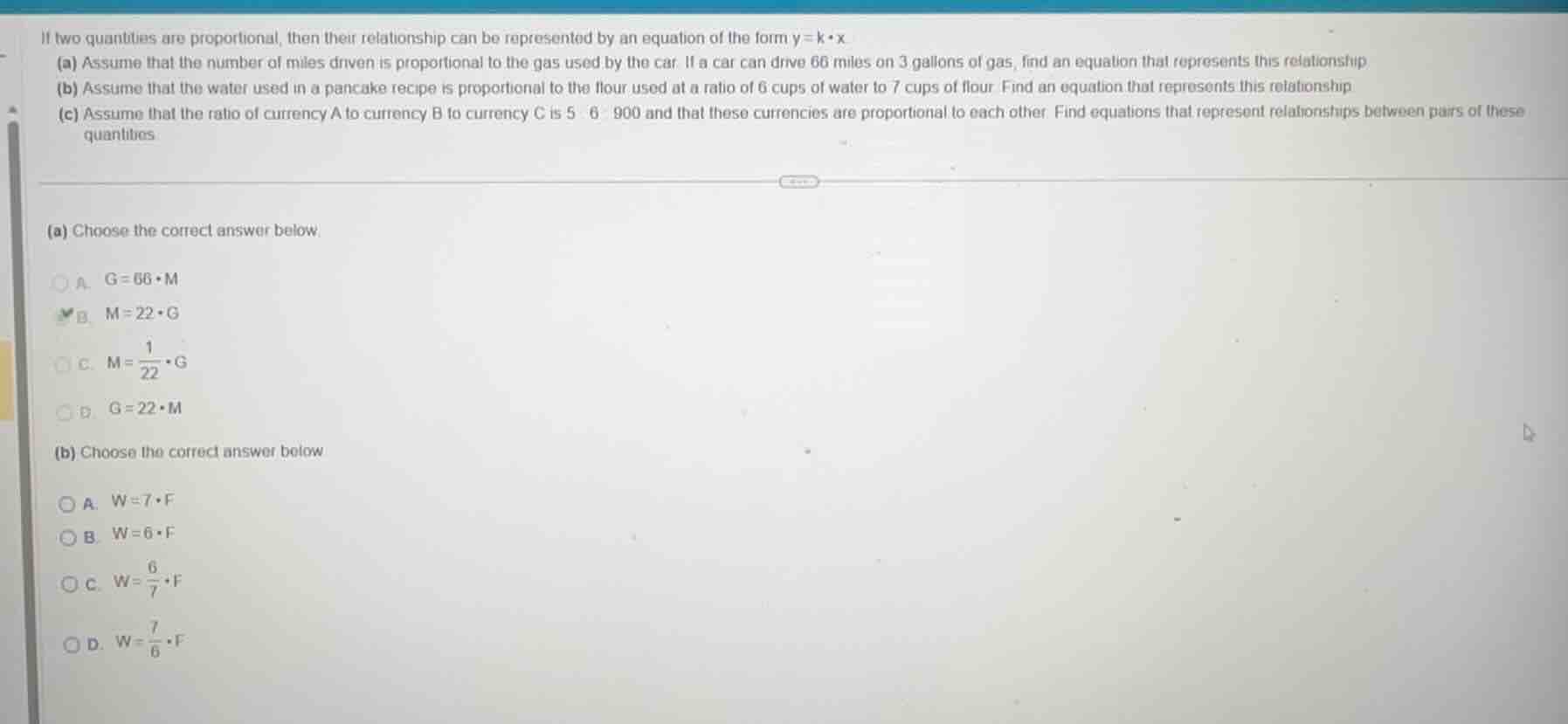
if two quantities are proportional, then their relationship can be represented by an equation of the form $y = k \cdot x$
(a) assume that the number of miles driven is proportional to the gas used by the car. if a car can drive 66 miles on 3 gallons of gas, find an equation that represents this relationship
(b) assume that the water used in a pancake recipe is proportional to the flour used at a ratio of 6 cups of water to 7 cups of flour. find an equation that represents this relationship
(c) assume that the ratio of currency a to currency b to currency c is 5 : 6 : 900 and that these currencies are proportional to each other. find equations that represent relationships between pairs of these quantities
(a) choose the correct answer below.
a. $g = 66 \cdot m$
b. $m = 22 \cdot g$
c. $m = \frac{1}{22} \cdot g$
d. $g = 22 \cdot m$
(b) choose the correct answer below
a. $w = 7 \cdot f$
b. $w = 6 \cdot f$
c. $w = \frac{6}{7} \cdot f$
d. $w = \frac{7}{6} \cdot f$
Part (a)
Step 1: Identify Variables and Proportionality
Let \( M \) be miles driven and \( G \) be gas used (in gallons). The relationship is \( M = k \cdot G \) (since miles are proportional to gas).
Step 2: Calculate the Constant \( k \)
Given \( M = 66 \) when \( G = 3 \). Substitute into \( M = k \cdot G \):
\( 66 = k \cdot 3 \)
Solve for \( k \): \( k = \frac{66}{3} = 22 \).
Step 3: Form the Equation
Substitute \( k = 22 \) into \( M = k \cdot G \): \( M = 22 \cdot G \).
Part (b)
Step 1: Identify Variables and Proportionality
Let \( W \) be water (cups) and \( F \) be flour (cups). The relationship is \( W = k \cdot F \) (water proportional to flour).
Step 2: Determine the Constant \( k \)
Ratio of water to flour is \( 6:7 \), so \( k = \frac{6}{7} \).
Step 3: Form the Equation
Substitute \( k = \frac{6}{7} \) into \( W = k \cdot F \): \( W = \frac{6}{7} \cdot F \).
Part (c)
Step 1: Define Variables
Let \( A \), \( B \), \( C \) represent Currency A, B, C. The ratio \( A:B:C = 5:6:900 \), so they are proportional (\( A = k_1 B \), \( A = k_2 C \), \( B = k_3 C \)).
Relationship between \( A \) and \( B \):
From \( A:B = 5:6 \), \( \frac{A}{B} = \frac{5}{6} \), so \( A = \frac{5}{6}B \) or \( B = \frac{6}{5}A \).
Relationship between \( A \) and \( C \):
From \( A:C = 5:900 \), \( \frac{A}{C} = \frac{5}{900} = \frac{1}{180} \), so \( A = \frac{1}{180}C \) or \( C = 180A \).
Relationship between \( B \) and \( C \):
From \( B:C = 6:900 \), \( \frac{B}{C} = \frac{6}{900} = \frac{1}{150} \), so \( B = \frac{1}{150}C \) or \( C = 150B \).

Snap & solve any problem in the app
Get step-by-step solutions on Sovi AI
Photo-based solutions with guided steps
Explore more problems and detailed explanations
s:
(a) \(\boldsymbol{B. \ M = 22 \cdot G}\)
(b) \(\boldsymbol{C. \ W = \frac{6}{7} \cdot F}\)
(c) Relationships: \( A = \frac{5}{6}B \), \( A = \frac{1}{180}C \), \( B = \frac{1}{150}C \) (or their rearranged forms like \( B = \frac{6}{5}A \), \( C = 180A \), \( C = 150B \)).