QUESTION IMAGE
Question
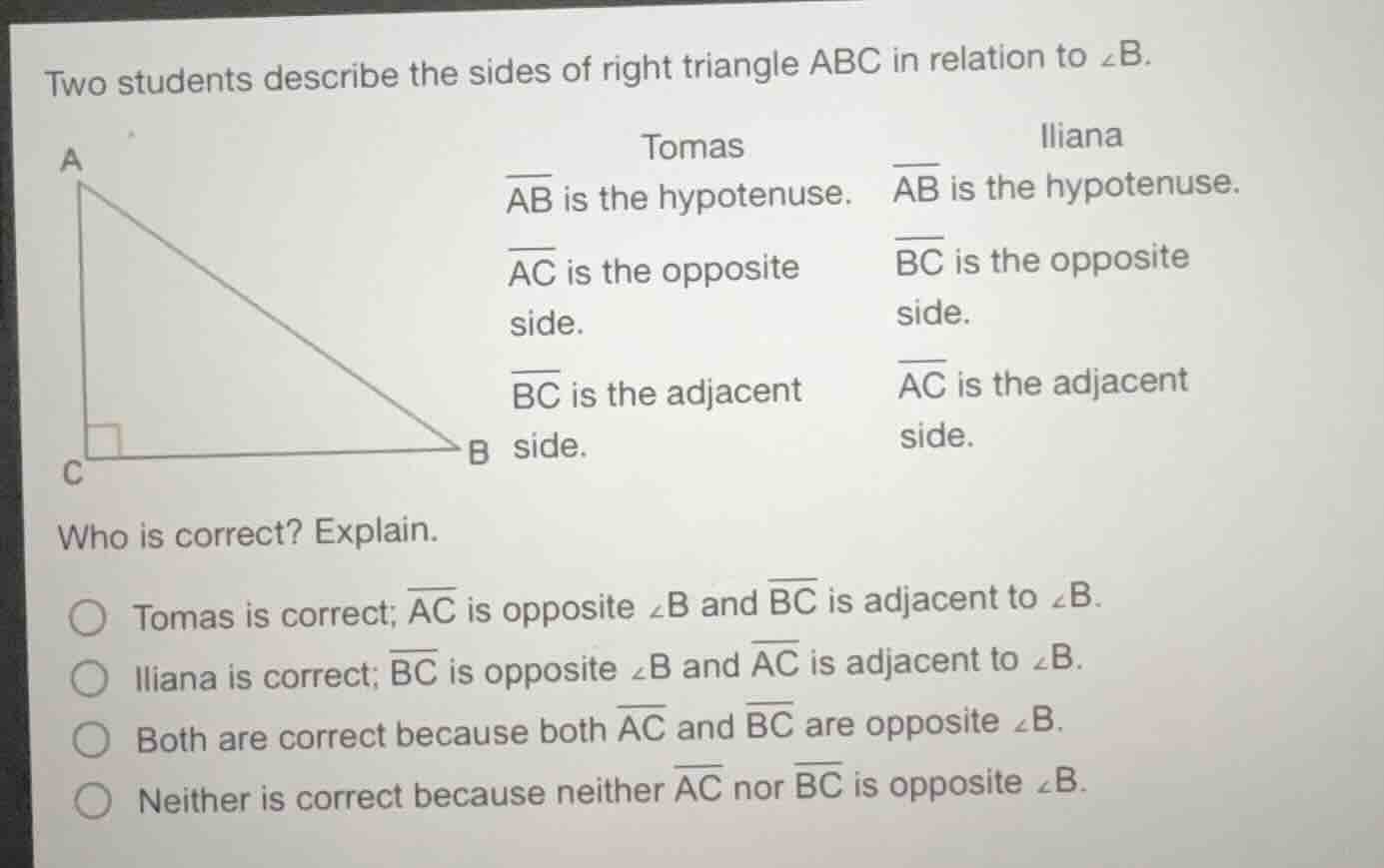
two students describe the sides of right triangle abc in relation to ∠b.
tomas
ab is the hypotenuse.
ac is the opposite side.
bc is the adjacent side.
iliana
ab is the hypotenuse.
bc is the opposite side.
ac is the adjacent side.
who is correct? explain.
○ tomas is correct; ac is opposite ∠b and bc is adjacent to ∠b.
○ iliana is correct; bc is opposite ∠b and ac is adjacent to ∠b.
○ both are correct because both ac and bc are opposite ∠b.
○ neither is correct because neither ac nor bc is opposite ∠b.
To determine who is correct, we analyze the sides of right triangle \( ABC \) (right - angled at \( C \)) in relation to \( \angle B \).
- Hypotenuse: In a right triangle, the hypotenuse is the side opposite the right angle. Since \( \angle C = 90^{\circ} \), \( AB \) is the hypotenuse (both Tomas and Iliana agree on this, so this part is correct for both).
- Opposite and Adjacent Sides:
- The opposite side to an angle in a triangle is the side that does not form the angle. For \( \angle B \), the sides forming \( \angle B \) are \( AB \) and \( BC \). So the side that does not form \( \angle B \) is \( AC \)? Wait, no. Wait, in \( \triangle ABC \), with right angle at \( C \), the vertices are \( A \), \( B \), \( C \). \( \angle B \) is at vertex \( B \), between sides \( AB \) and \( BC \). So the side opposite \( \angle B \) is the side that is not connected to \( B \), which is \( AC \)? Wait, no, let's recall the definitions properly.
- Wait, no, let's label the triangle. Let's consider \( \angle B \). The sides:
- The adjacent side to \( \angle B \) is the side that is part of \( \angle B \) and is not the hypotenuse. Since \( AB \) is the hypotenuse, the adjacent side to \( \angle B \) is \( BC \) (because \( BC \) is one of the sides forming \( \angle B \) and is not the hypotenuse).
- The opposite side to \( \angle B \) is the side that is not part of \( \angle B \), which is \( AC \). Wait, no, wait, maybe I made a mistake. Wait, in a right triangle \( \triangle ABC \) with \( \angle C = 90^{\circ} \), the sides:
- For \( \angle B \):
- The hypotenuse is \( AB \) (correct for both).
- The opposite side to \( \angle B \): The side that is opposite \( \angle B \) is the side that does not have vertex \( B \) as one of its endpoints. So \( AC \) has endpoints \( A \) and \( C \), so it is opposite \( \angle B \) (because \( \angle B \) is at \( B \)).
- The adjacent side to \( \angle B \): The side that has vertex \( B \) as one of its endpoints and is not the hypotenuse. So \( BC \) has endpoints \( B \) and \( C \), so it is adjacent to \( \angle B \).
- Wait, but let's check Iliana's description. Iliana says \( BC \) is the opposite side and \( AC \) is the adjacent side. But according to the definition, the opposite side to \( \angle B \) should be \( AC \) (since it doesn't form \( \angle B \)) and the adjacent side should be \( BC \) (since it forms \( \angle B \) along with \( AB \)). Wait, no, maybe I mixed up. Wait, let's take a right triangle with right angle at \( C \). Let's name the sides: \( AC \) and \( BC \) are the legs, \( AB \) is the hypotenuse.
- For angle \( B \):
- The adjacent side: The side that is next to \( \angle B \) and is not the hypotenuse. So \( BC \) is adjacent (since it is one of the legs and is part of \( \angle B \)).
- The opposite side: The side that is across from \( \angle B \), which is \( AC \) (since it is the other leg and is not part of \( \angle B \)).
- So Tomas says: \( AB \) (hypotenuse, correct), \( AC \) (opposite, correct), \( BC \) (adjacent, correct). Iliana says \( BC \) is opposite (wrong) and \( AC \) is adjacent (wrong). Wait, no, maybe I had the triangle labeled wrong. Wait, maybe the right angle is at \( C \), so the triangle is drawn with \( C \) at the bottom left, \( B \) at the bottom right, and \( A \) at the top left. So \( AC \) is vertical (from \( C \) to \( A \)), \( BC \) is horizontal (from \( C \) to \( B \)), and \( AB \) is the hypotenuse (from \( A \)…

Snap & solve any problem in the app
Get step-by-step solutions on Sovi AI
Photo-based solutions with guided steps
Explore more problems and detailed explanations
Tomas is correct; \( \overline{AC} \) is opposite \( \angle B \) and \( \overline{BC} \) is adjacent to \( \angle B \)