QUESTION IMAGE
Question
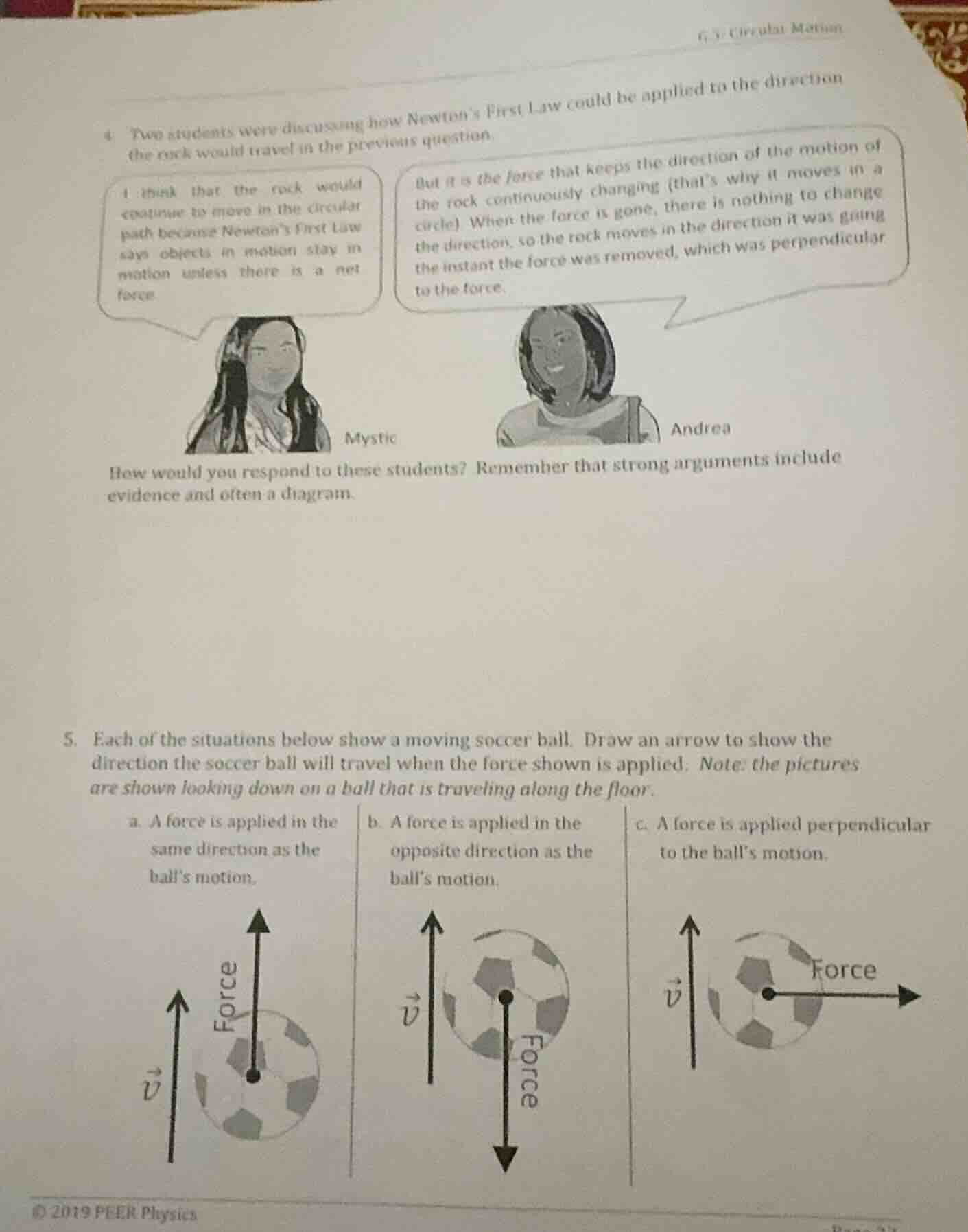
- two students were discussing how newton’s first law could be applied to the direction the rock would travel in the previous question.
mystic: i think that the rock would continue to move in the circular path because newton’s first law says objects in motion stay in motion unless there is a net force.
andrea: but it is the force that keeps the direction of the motion of the rock continuously changing (that’s why it moves in a circle). when the force is gone, there is nothing to change the direction, so the rock moves in the direction it was going the instant the force was removed, which was perpendicular to the force.
how would you respond to these students? remember that strong arguments include evidence and often a diagram.
- each of the situations below show a moving soccer ball. draw an arrow to show the direction the soccer ball will travel when the force shown is applied. note: the pictures are shown looking down on a ball that is traveling along the floor.
a. a force is applied in the same direction as the ball’s motion.
image of a soccer ball with velocity vector upward and force vector upward
b. a force is applied in the opposite direction as the ball’s motion.
image of a soccer ball with velocity vector upward and force vector downward
c. a force is applied perpendicular to the ball’s motion.
image of a soccer ball with velocity vector upward and force vector to the right
Question 4 Response:
- Mystic's Error: Newton’s First Law (Inertia) states an object in motion stays in motion with constant velocity (same speed, same direction) unless a net force acts. In circular motion, the centripetal force changes the direction (so velocity is not constant). If the centripetal force (e.g., tension from a string) is removed, the rock no longer has a force changing its direction.
- Andrea’s Correct Reasoning (with Clarification): The centripetal force is what causes the continuous direction change (keeping it in a circle). When this force is removed, the rock moves in a straight line (tangent to the circle at the instant the force is removed) because there’s no net force to change its direction (Newton’s First Law). A diagram would show the circular path, the centripetal force (toward the center), and the tangent line (direction of motion after force removal) perpendicular to the radius (and the centripetal force vector) at that point.
When a force is applied in the same direction as the ball’s motion, the force causes the ball to accelerate in that direction. So the ball’s velocity will increase, and it will continue moving in the same general direction (with a greater speed). The arrow for the ball’s new direction should be a longer arrow (to represent increased speed) in the same direction as the initial velocity (\(\vec{v}\)) and the applied force.
When a force is applied in the opposite direction of the ball’s motion, the force causes the ball to decelerate (negative acceleration relative to the motion direction). If the force is large enough, it can stop the ball or even reverse its direction, but initially, the ball will slow down while moving in the original direction (until it stops and then reverses if the force persists). The arrow for the ball’s motion will be in the original direction but shorter (to show decreased speed) or eventually reverse direction if the force acts long enough.

Snap & solve any problem in the app
Get step-by-step solutions on Sovi AI
Photo-based solutions with guided steps
Explore more problems and detailed explanations
Mystic is incorrect; Andrea’s reasoning is mostly correct (with clarity on inertia). When the centripetal force (keeping the rock in a circle) is removed, the rock moves in a straight line tangent to the circle (perpendicular to the force’s direction at removal) because Newton’s First Law says motion continues in a straight line at constant velocity without a net force. A diagram can show the circular path, centripetal force (toward the center), and the tangent (straight - line) path after force removal.