QUESTION IMAGE
Question
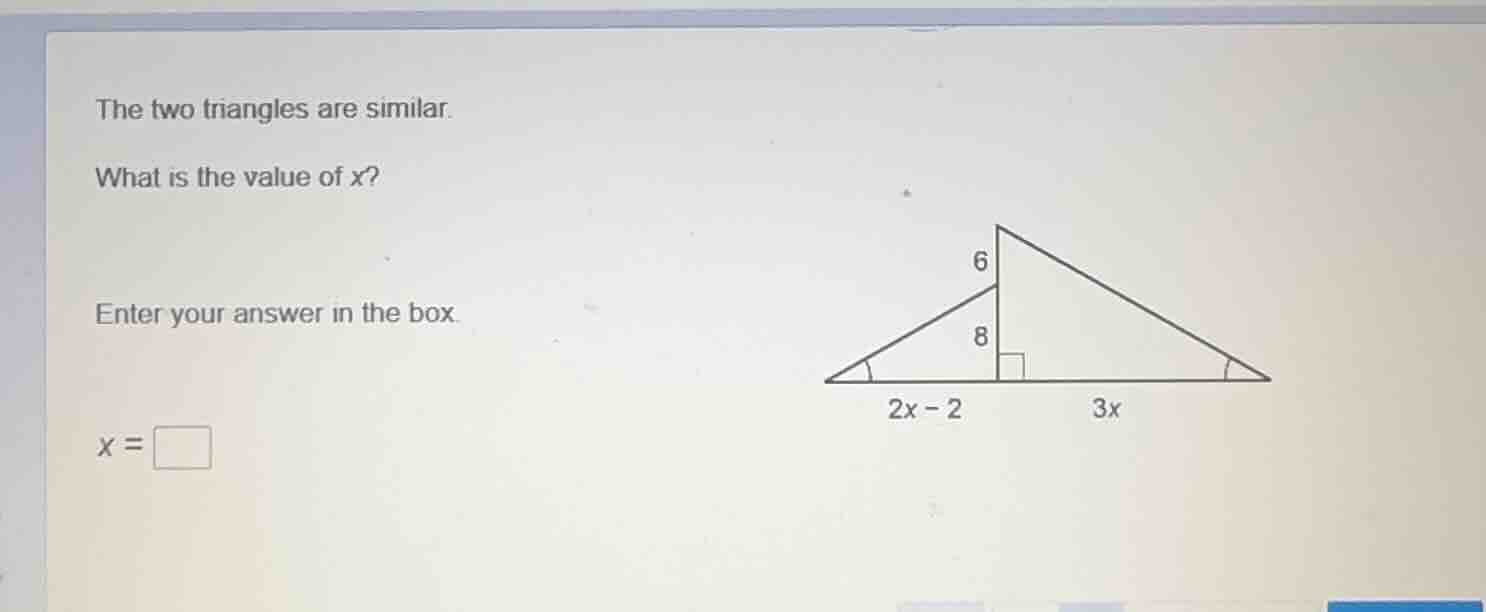
the two triangles are similar.
what is the value of x?
enter your answer in the box.
x = \boxed{}
(the image shows two similar right triangles. the smaller triangle has a vertical segment of length 8 and a horizontal segment of length 2x - 2, and the segment above the 8 is 6. the larger triangle has a horizontal segment of length 3x next to the smaller triangles horizontal segment.)
Step1: Set up proportion for similar triangles
Since the triangles are similar, the ratios of corresponding sides are equal. The vertical sides are \(6 + 8 = 14\) and \(8\), and the horizontal sides are \(2x - 2 + 3x=5x - 2\) and \(2x - 2\)? Wait, no, actually, the smaller triangle has vertical side \(8\) and horizontal side \(2x - 2\), the larger triangle has vertical side \(8 + 6=14\) and horizontal side \(2x - 2+3x = 5x - 2\). Wait, maybe a better way: the two right triangles, the smaller one has legs \(8\) and \(2x - 2\), the larger one has legs \(8 + 6=14\) and \(2x - 2+3x=5x - 2\). But actually, the corresponding sides: the smaller triangle's vertical leg is \(8\), the larger's is \(8 + 6 = 14\); the smaller's horizontal leg is \(2x - 2\), the larger's is \(2x - 2+3x=5x - 2\). But since they are similar, the ratio of vertical legs equals ratio of horizontal legs. So \(\frac{8}{14}=\frac{2x - 2}{5x - 2}\)? Wait, no, maybe I got the corresponding sides wrong. Wait, looking at the diagram, the two triangles share the same angle at the left, and both are right triangles, so the smaller triangle (with vertical side 8) and the larger triangle (with vertical side 8 + 6 = 14) are similar. So the ratio of the smaller vertical side to larger vertical side is equal to the ratio of the smaller horizontal side to larger horizontal side. So \(\frac{8}{8 + 6}=\frac{2x - 2}{2x - 2+3x}\). So \(\frac{8}{14}=\frac{2x - 2}{5x - 2}\). Cross - multiply: \(8(5x - 2)=14(2x - 2)\)
Step2: Expand both sides
Left side: \(8\times5x-8\times2 = 40x-16\)
Right side: \(14\times2x-14\times2=28x - 28\)
Step3: Solve for x
\(40x-16 = 28x-28\)
Subtract \(28x\) from both sides: \(40x-28x-16=28x - 28x-28\)
\(12x-16=-28\)
Add 16 to both sides: \(12x-16 + 16=-28 + 16\)
\(12x=-12\) Wait, that can't be. Wait, maybe I mixed up the corresponding sides. Let's try another approach. Maybe the smaller triangle has vertical side 8 and horizontal side \(2x - 2\), and the other triangle (the one with vertical side 6 + 8 = 14) has horizontal side \(3x\)? No, wait, the base of the smaller triangle is \(2x - 2\), the base of the larger part is \(3x\), and the height of the smaller triangle is 8, the height of the larger triangle (including the smaller) is 8 + 6 = 14. So the two similar triangles: the smaller one (height 8, base \(2x - 2\)) and the larger one (height 14, base \(2x - 2+3x=5x - 2\))? No, maybe the ratio is \(\frac{8}{6 + 8}=\frac{2x - 2}{3x}\). Let's check that. So \(\frac{8}{14}=\frac{2x - 2}{3x}\). Cross - multiply: \(8\times3x=14\times(2x - 2)\)
\(24x = 28x-28\)
Subtract \(24x\) from both sides: \(0 = 4x-28\)
Add 28 to both sides: \(4x=28\)
Divide by 4: \(x = 7\)
Wait, let's verify. If \(x = 7\), then \(2x - 2=14 - 2 = 12\), \(3x = 21\). The smaller triangle has height 8 and base 12, the larger triangle (height 8 + 6 = 14) has base 21. Now, check the ratio: \(\frac{8}{14}=\frac{4}{7}\), \(\frac{12}{21}=\frac{4}{7}\). Yes, that works. So I had the corresponding sides wrong earlier. The smaller triangle's base is \(2x - 2\), the larger triangle's base (the part next to it) is \(3x\), and their heights are 8 and 14 (8 + 6). So the ratio of heights (8/14) equals ratio of bases ( (2x - 2)/3x )? Wait, no, (2x - 2) is the base of the smaller triangle, and 3x is the base of the larger triangle? Wait, no, the two triangles: the smaller one (with height 8) has base \(2x - 2\), the larger one (with height 8 + 6 = 14) has base \(3x\)? No, the total base is \(2x - 2+3x=5x - 2\), but the two triangles are similar, so the smaller triangle (height 8, base \(2x - 2\)) an…

Snap & solve any problem in the app
Get step-by-step solutions on Sovi AI
Photo-based solutions with guided steps
Explore more problems and detailed explanations
\(x = 7\)