QUESTION IMAGE
Question
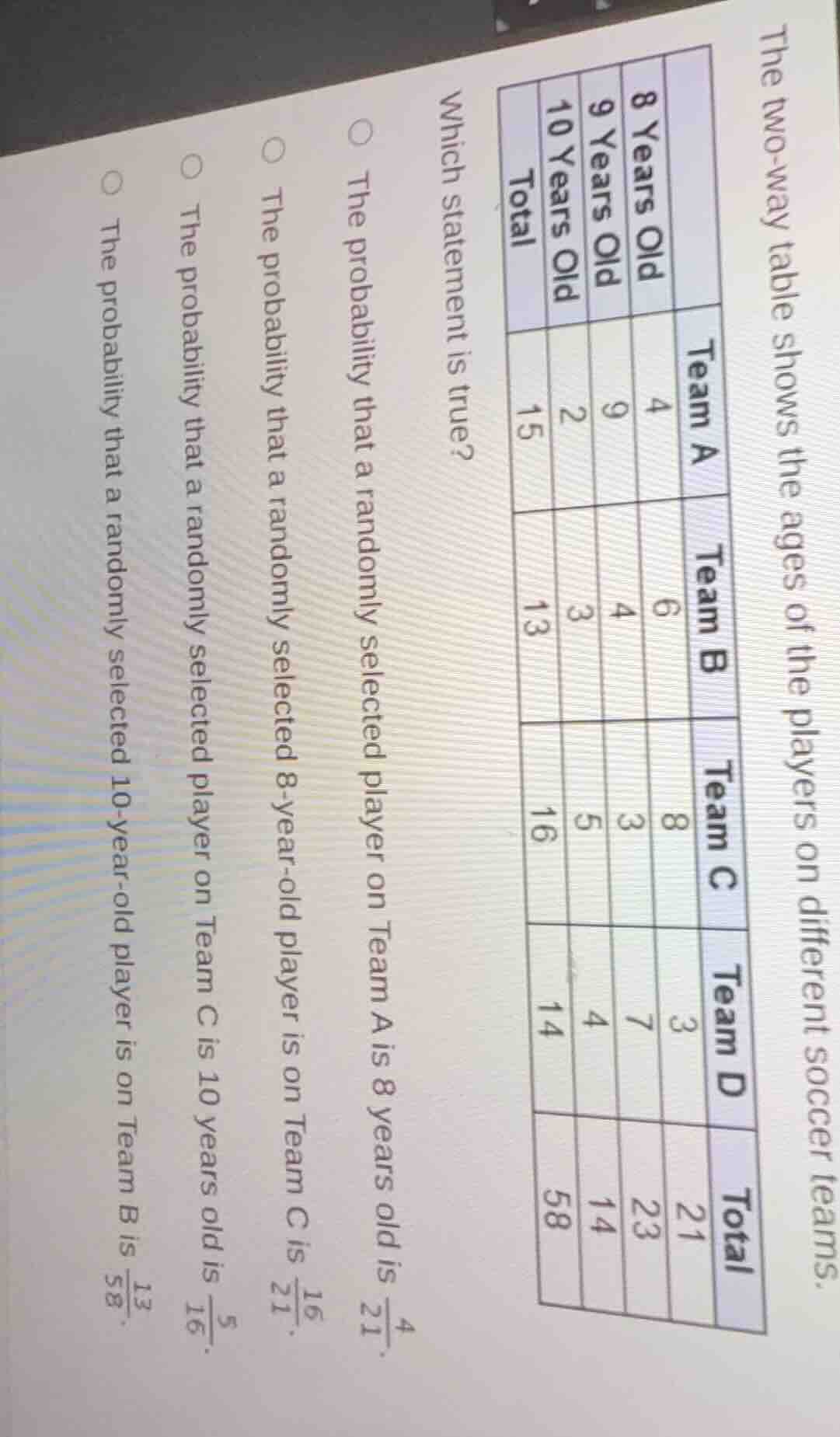
the two - way table shows the ages of the players on different soccer teams. which statement is true? \
\
the probability that a randomly selected player on team a is 8 years old is \\(\frac{4}{21}\\). \
the probability that a randomly selected 8 - year - old player is on team c is \\(\frac{16}{21}\\). \
the probability that a randomly selected player on team c is 10 years old is \\(\frac{5}{16}\\). \
the probability that a randomly selected 10 - year - old player is on team b is \\(\frac{13}{58}\\). \
\
| team a | team b | team c | team d | total | \ | |
| --- | --- | --- | --- | --- | --- | \ |
| 8 years old | 4 | 6 | 8 | 3 | 21 | \ |
| 9 years old | 9 | 4 | 3 | 7 | 23 | \ |
| 10 years old | 2 | 3 | 5 | 4 | 14 | \ |
| total | 15 | 13 | 16 | 14 | 58 |
To solve this, we analyze each statement by calculating the relevant probabilities using the two - way table.
Statement 1: The probability that a randomly selected player on Team A is 8 years old is $\frac{4}{21}$.
- The total number of players on Team A is the sum of the number of 8 - year - old, 9 - year - old, and 10 - year - old players on Team A. From the table, the number of 8 - year - old players on Team A is 4, the number of 9 - year - old players on Team A is 9, and the number of 10 - year - old players on Team A is 2. So, the total number of players on Team A is $4 + 9+2=15$.
- The number of 8 - year - old players on Team A is 4. The probability that a randomly selected player on Team A is 8 years old is the number of 8 - year - old players on Team A divided by the total number of players on Team A, which is $\frac{4}{15}
eq\frac{4}{21}$. So, this statement is false.
Statement 2: The probability that a randomly selected 8 - year - old player is on Team C is $\frac{16}{21}$.
- The total number of 8 - year - old players is 21 (from the "Total" row and "8 Years Old" column). The number of 8 - year - old players on Team C is 8.
- The probability that a randomly selected 8 - year - old player is on Team C is the number of 8 - year - old players on Team C divided by the total number of 8 - year - old players, which is $\frac{8}{21}
eq\frac{16}{21}$. So, this statement is false.
Statement 3: The probability that a randomly selected player on Team C is 10 years old is $\frac{5}{16}$.
- The total number of players on Team C is 16 (from the "Total" column and "Team C" row). The number of 10 - year - old players on Team C is 5.
- The probability that a randomly selected player on Team C is 10 years old is the number of 10 - year - old players on Team C divided by the total number of players on Team C, which is $\frac{5}{16}$. So, this statement is true.
Statement 4: The probability that a randomly selected 10 - year - old player is on Team B is $\frac{13}{58}$.
- The total number of 10 - year - old players is 14 (from the "Total" row and "10 Years Old" column). The number of 10 - year - old players on Team B is 3.
- The probability that a randomly selected 10 - year - old player is on Team B is the number of 10 - year - old players on Team B divided by the total number of 10 - year - old players, which is $\frac{3}{14}
eq\frac{13}{58}$. So, this statement is false.
The true statement is "The probability that a randomly selected player on Team C is 10 years old is $\frac{5}{16}$".

Snap & solve any problem in the app
Get step-by-step solutions on Sovi AI
Photo-based solutions with guided steps
Explore more problems and detailed explanations
To solve this, we analyze each statement by calculating the relevant probabilities using the two - way table.
Statement 1: The probability that a randomly selected player on Team A is 8 years old is $\frac{4}{21}$.
- The total number of players on Team A is the sum of the number of 8 - year - old, 9 - year - old, and 10 - year - old players on Team A. From the table, the number of 8 - year - old players on Team A is 4, the number of 9 - year - old players on Team A is 9, and the number of 10 - year - old players on Team A is 2. So, the total number of players on Team A is $4 + 9+2=15$.
- The number of 8 - year - old players on Team A is 4. The probability that a randomly selected player on Team A is 8 years old is the number of 8 - year - old players on Team A divided by the total number of players on Team A, which is $\frac{4}{15}
eq\frac{4}{21}$. So, this statement is false.
Statement 2: The probability that a randomly selected 8 - year - old player is on Team C is $\frac{16}{21}$.
- The total number of 8 - year - old players is 21 (from the "Total" row and "8 Years Old" column). The number of 8 - year - old players on Team C is 8.
- The probability that a randomly selected 8 - year - old player is on Team C is the number of 8 - year - old players on Team C divided by the total number of 8 - year - old players, which is $\frac{8}{21}
eq\frac{16}{21}$. So, this statement is false.
Statement 3: The probability that a randomly selected player on Team C is 10 years old is $\frac{5}{16}$.
- The total number of players on Team C is 16 (from the "Total" column and "Team C" row). The number of 10 - year - old players on Team C is 5.
- The probability that a randomly selected player on Team C is 10 years old is the number of 10 - year - old players on Team C divided by the total number of players on Team C, which is $\frac{5}{16}$. So, this statement is true.
Statement 4: The probability that a randomly selected 10 - year - old player is on Team B is $\frac{13}{58}$.
- The total number of 10 - year - old players is 14 (from the "Total" row and "10 Years Old" column). The number of 10 - year - old players on Team B is 3.
- The probability that a randomly selected 10 - year - old player is on Team B is the number of 10 - year - old players on Team B divided by the total number of 10 - year - old players, which is $\frac{3}{14}
eq\frac{13}{58}$. So, this statement is false.
The true statement is "The probability that a randomly selected player on Team C is 10 years old is $\frac{5}{16}$".