QUESTION IMAGE
Question
type the correct answer in each box.
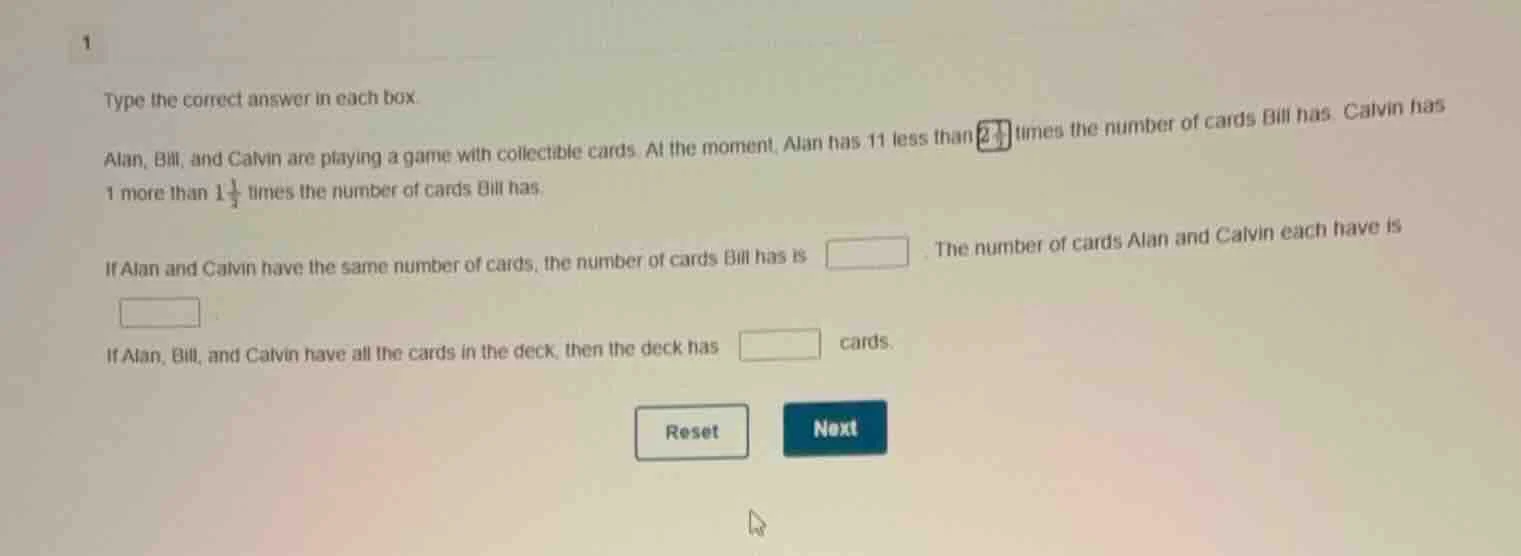
alan, bill, and calvin are playing a game with collectible cards. at the moment, alan has 11 less than 2 times the number of cards bill has. calvin has 1 more than (1\frac{1}{3}) times the number of cards bill has.
if alan and calvin have the same number of cards, the number of cards bill has is (square). the number of cards alan and calvin each have is (square).
if alan, bill, and calvin have all the cards in the deck, then the deck has (square) cards.
Step1: Define variables
Let \( B \) be the number of cards Bill has, \( A \) be the number of cards Alan has, and \( C \) be the number of cards Calvin has.
From the problem, we have:
\( A = 2B - 11 \) (Alan has 11 less than 2 times Bill's cards)
\( C = 1\frac{1}{3}B + 1=\frac{4}{3}B + 1 \) (Calvin has 1 more than \( 1\frac{1}{3} \) times Bill's cards)
And we know \( A = C \).
Step2: Set up the equation
Since \( A = C \), we set \( 2B - 11=\frac{4}{3}B + 1 \)
Step3: Solve for \( B \)
First, multiply both sides of the equation by 3 to eliminate the fraction:
\( 3(2B - 11)=3(\frac{4}{3}B + 1) \)
\( 6B - 33 = 4B + 3 \)
Subtract \( 4B \) from both sides:
\( 6B - 4B - 33=4B - 4B + 3 \)
\( 2B - 33 = 3 \)
Add 33 to both sides:
\( 2B - 33 + 33=3 + 33 \)
\( 2B = 36 \)
Divide both sides by 2:
\( B=\frac{36}{2}=18 \)
Step4: Find \( A \) (and \( C \) since \( A = C \))
Substitute \( B = 18 \) into the equation for \( A \):
\( A = 2(18)-11=36 - 11 = 25 \)
So \( C = 25 \) as well.
Step5: Find the total number of cards in the deck
The total number of cards is \( A + B + C \)
Substitute \( A = 25 \), \( B = 18 \), \( C = 25 \):
\( 25+18 + 25=68 \)

Snap & solve any problem in the app
Get step-by-step solutions on Sovi AI
Photo-based solutions with guided steps
Explore more problems and detailed explanations
The number of cards Bill has is \( \boldsymbol{18} \). The number of cards Alan and Calvin each have is \( \boldsymbol{25} \). The deck has \( \boldsymbol{68} \) cards.