QUESTION IMAGE
Question
type the correct answer in each box. use numerals instead of words. if necessary, use / for the fraction bar(s).
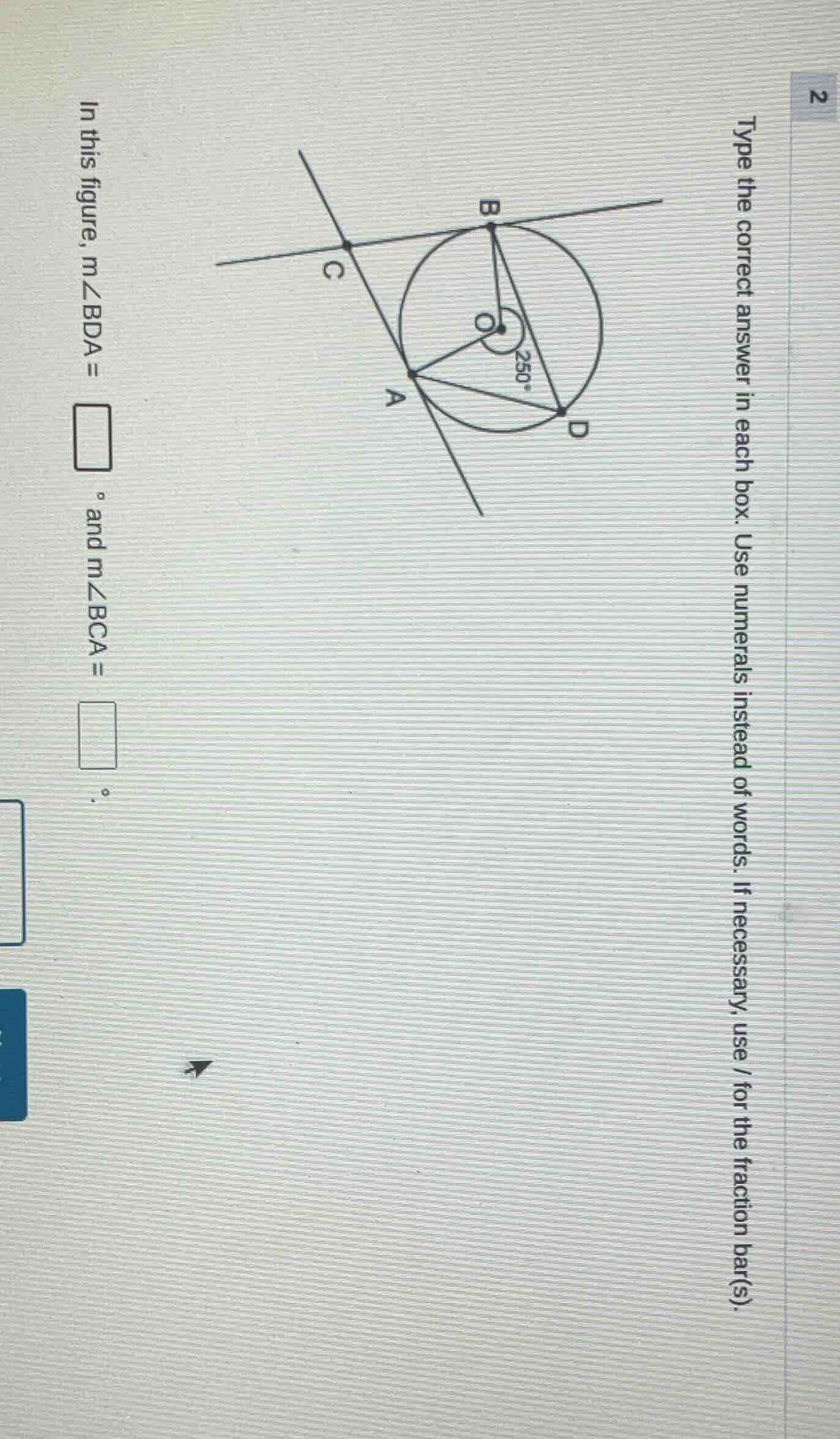
in this figure, m∠bda =
and m∠bca =
.
Step1: Find the central angle for arc AB
The total angle around a point is \(360^\circ\). Given the central angle for arc BD is \(250^\circ\), so the central angle for arc AB is \(360^\circ - 250^\circ = 110^\circ\).
Step2: Find \(m\angle BDA\)
The inscribed angle theorem states that an inscribed angle is half the measure of its subtended central angle. For \(\angle BDA\), it subtends arc AB. So \(m\angle BDA=\frac{1}{2}\times110^\circ = 55^\circ\).
Step3: Find \(m\angle BCA\)
\(\angle BCA\) is an angle formed by a tangent (CB) and a chord (AB). The measure of an angle formed by a tangent and a chord is half the measure of the intercepted arc. The intercepted arc for \(\angle BCA\) is arc AB (measure \(110^\circ\)), so \(m\angle BCA=\frac{1}{2}\times110^\circ = 55^\circ\)? Wait, no, wait. Wait, the tangent-chord angle: the measure is half the measure of the intercepted arc. Wait, actually, the tangent at B, so the angle between tangent CB and chord AB is equal to the inscribed angle on the opposite side of the chord. Wait, maybe I made a mistake. Wait, the central angle for arc AB is \(110^\circ\), so the inscribed angle over arc AB would be \(55^\circ\), but the tangent-chord angle: the measure of \(\angle BCA\) (tangent CB and chord CA? Wait, no, the figure: CB is tangent at B, CA is secant? Wait, no, the points: C, B, A? Wait, maybe the intercepted arc for \(\angle BCA\) is arc AB. Wait, no, let's re - examine.
Wait, the central angle for arc BD is \(250^\circ\), so arc BAD? No, the circle: points A, B, D on the circle, center O. So the central angle \(\angle BOD = 250^\circ\), so the minor arc BD is \(250^\circ\), so the major arc BD is \(360 - 250=110^\circ\)? Wait, no, I had it reversed. Wait, minor arc is less than \(180^\circ\), major arc is more. So if \(\angle BOD = 250^\circ\), that's a major arc, so the minor arc BD is \(360 - 250 = 110^\circ\). Oh! I made a mistake earlier. So the central angle for minor arc BD is \(110^\circ\), and the central angle for major arc BD is \(250^\circ\).
So let's correct:
Step1 (corrected): Find the central angle for minor arc BD
Wait, no, the given angle at the center is \(250^\circ\) for arc BD (major arc), so minor arc BD is \(360 - 250=110^\circ\). Then, for \(\angle BDA\), which is an inscribed angle subtended by arc BA? Wait, no, \(\angle BDA\) subtends arc BA. Wait, the central angle for arc BA: since arc BD (minor) is \(110^\circ\), then arc BA: wait, maybe the central angle for arc AB is \(110^\circ\)? No, let's start over.
The total angle around the center \(O\) is \(360^\circ\). If \(\angle BOD = 250^\circ\) (central angle for arc BD, major arc), then the central angle for arc BD (minor arc) is \(360 - 250=110^\circ\). Now, \(\angle BDA\) is an inscribed angle subtended by arc BA? Wait, no, \(\triangle BDA\): points B, D, A on the circle. So \(\angle BDA\) subtends arc BA. The central angle for arc BA: let's see, the central angle for arc BD (minor) is \(110^\circ\), so if we consider arc BA and arc AD, but maybe I messed up the arcs.
Wait, another approach: the measure of an inscribed angle is half the measure of its intercepted arc. For \(\angle BDA\), it intercepts arc BA. The central angle for arc BA: since the central angle for arc BD (major) is \(250^\circ\), then the central angle for arc BA is \(360 - 250 - \angle AOD\)? No, this is getting confusing. Wait, maybe the first mistake was in identifying the arc. Let's use the property that the inscribed angle over a minor arc is half the central angle.
Wait, the central angle for the minor arc BD is \(360 -…

Snap & solve any problem in the app
Get step-by-step solutions on Sovi AI
Photo-based solutions with guided steps
Explore more problems and detailed explanations
\(m\angle BDA = 55^\circ\) and \(m\angle BCA = 55^\circ\)
So the answers are \(55\) and \(55\) (entered in the respective boxes).