QUESTION IMAGE
Question
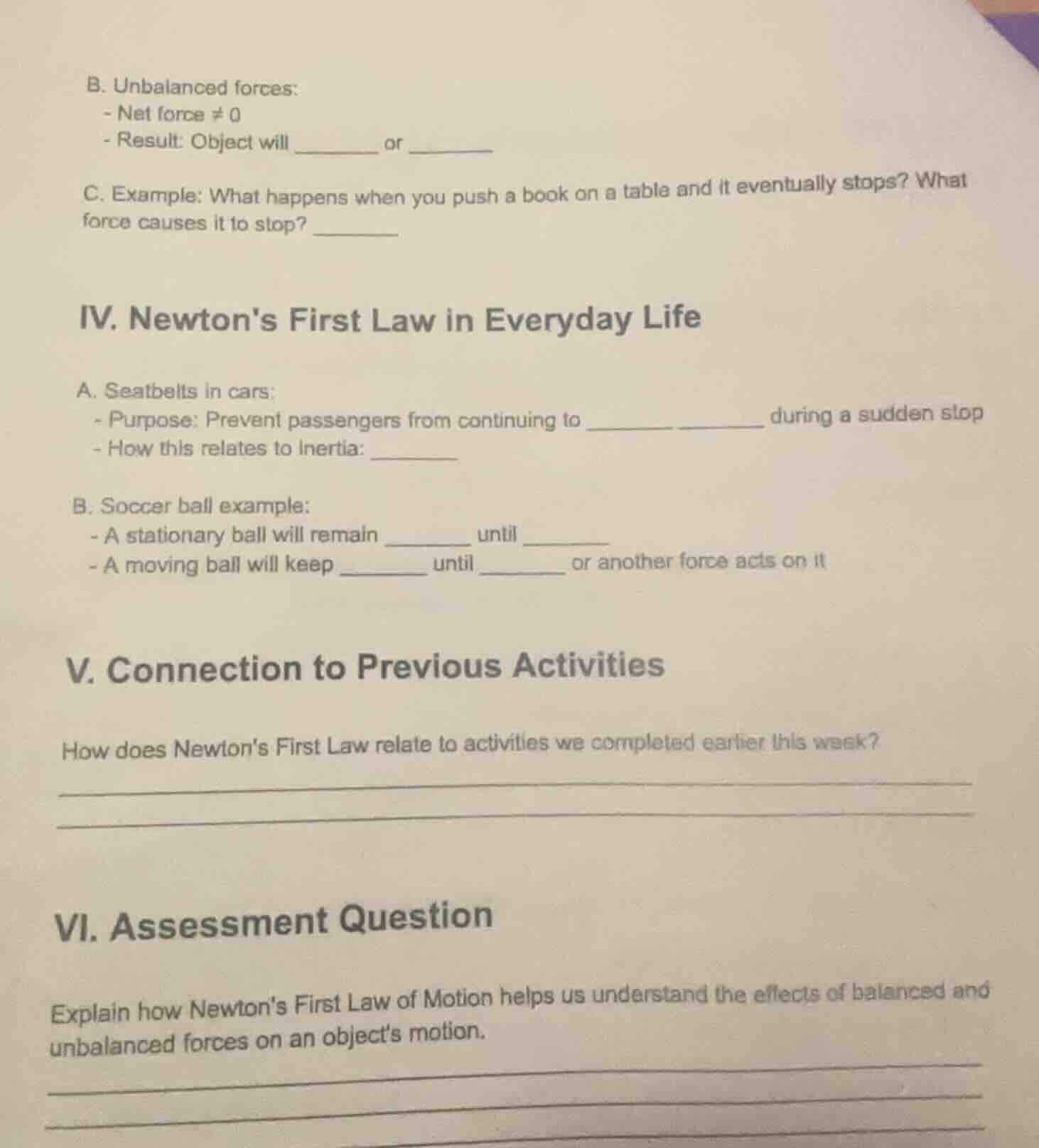
b. unbalanced forces:
- net force ≠ 0
- result: object will ____ or ____
c. example: what happens when you push a book on a table and it eventually stops? what force causes it to stop? ______
iv. newtons first law in everyday life
a. seatbelts in cars:
- purpose: prevent passengers from continuing to ____ ____ during a sudden stop
- how this relates to inertia: ______
b. soccer ball example:
- a stationary ball will remain ____ until ____
- a moving ball will keep ____ until ____ or another force acts on it
v. connection to previous activities
how does newtons first law relate to activities we completed earlier this week?
_____________________________________________________________________
_____________________________________________________________________
vi. assessment question
explain how newtons first law of motion helps us understand the effects of balanced and unbalanced forces on an objects motion.
_____________________________________________________________________
_____________________________________________________________________
Section B (Unbalanced forces)
Unbalanced forces create a non-zero net force, which changes an object's motion state.
Section C (Book on table example)
When a book slides on a table, the contact force opposing its motion is friction.
Section IV A (Seatbelts)
Seatbelts counteract inertia: passengers tend to keep moving forward if a car stops suddenly, as their body resists changes in motion.
Section IV B (Soccer ball)
Newton's first law states stationary objects stay at rest, and moving objects stay in motion, unless acted on by an external force.
Section V (Connection to prior activities)
Newton's first law explains the inertia observed in activities where objects resisted changes to their motion (e.g., moving carts, stationary objects being pushed).
Section VI (Assessment Question)
Newton's first law defines that balanced forces (net force = 0) leave an object's motion unchanged (rest or constant velocity). Unbalanced forces (net force ≠ 0) disrupt this state, causing acceleration or deceleration, directly linking force balance to motion changes.

Snap & solve any problem in the app
Get step-by-step solutions on Sovi AI
Photo-based solutions with guided steps
Explore more problems and detailed explanations
Section B
Result: Object will accelerate or change direction
Section C
What force causes it to stop? Friction
Section IV A
- Purpose: Prevent passengers from continuing to move forward during a sudden stop
- How this relates to inertia: Passengers have inertia (tendency to maintain motion)
Section IV B
- A stationary ball will remain stationary until an unbalanced force acts on it
- A moving ball will keep moving at constant velocity until friction acts on it or another force acts on it
Section V
(Example answer) If prior activities involved pushing objects or observing moving objects slowing down, Newton's First Law explains that objects only change motion when a force (like a push or friction) acts on them, matching the observations of inertia and force effects from those activities.
Section VI
Newton's First Law of Motion states that an object at rest stays at rest, and an object in motion stays in motion at constant velocity, unless acted on by an unbalanced force. This means balanced forces (net force = 0) result in no change to an object's motion (it remains at rest or moves at steady speed). Unbalanced forces (net force ≠ 0) overcome this inertia, causing the object to speed up, slow down, or change direction, directly explaining how force balance dictates an object's motion state.