QUESTION IMAGE
Question
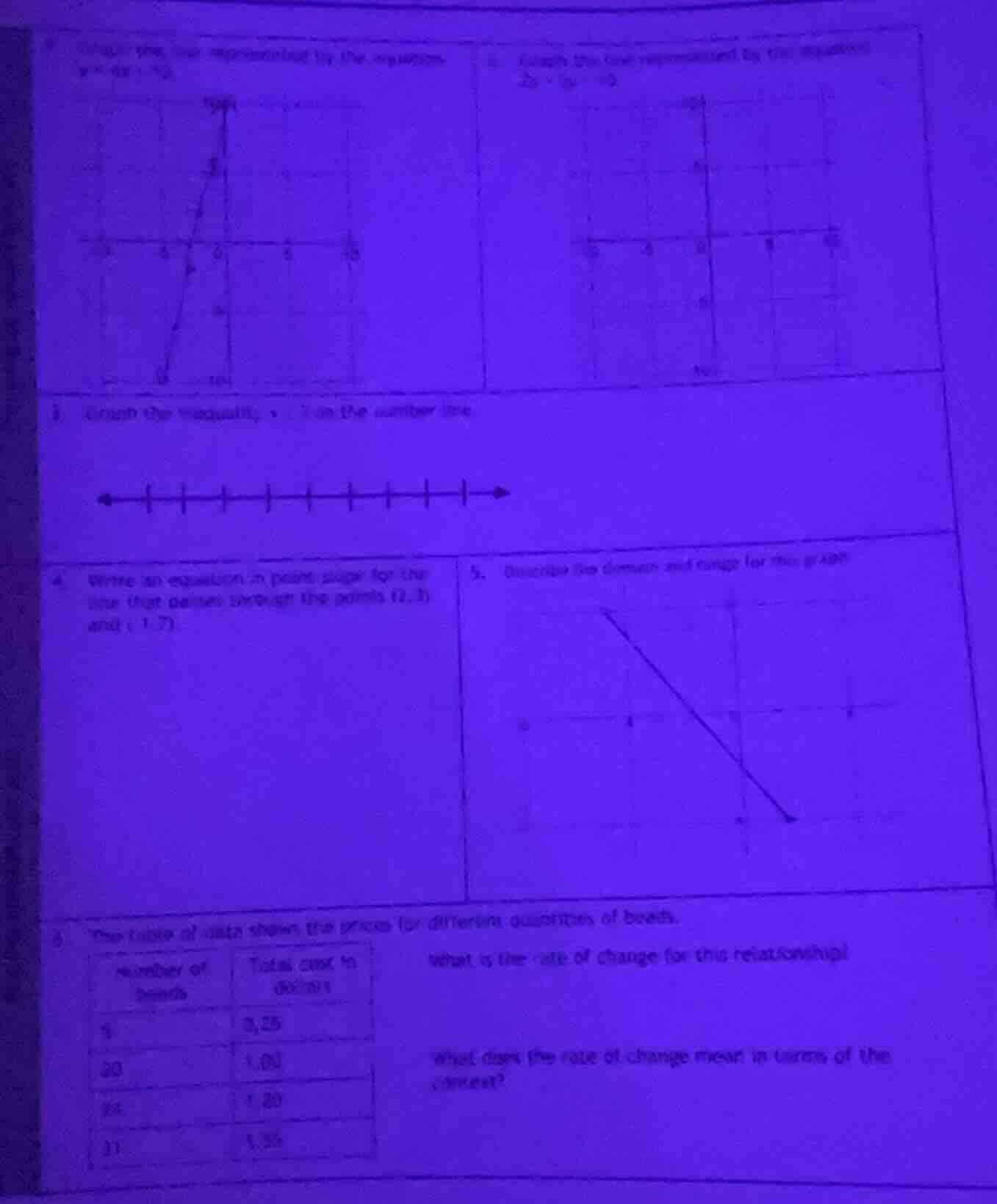
- (unclear text about a line equation, maybe ( y = 6x + 4 )?); 2. graph the line ( 2x + 3y = 12 ); 3. graph the inequality (unclear) on the number line; 4. write an equation in point - slope for the line through (2,1) and (-1,7); 5. describe domain and range for a graph; 6. a table of bread prices: number of breads: 1, 20, 24, 31; total cost (dollars): 0.25, 1.00, 1.20, 1.55. find rate of change and its meaning.
Problem 4: Write an equation in point - slope form for the line that passes through the points (2, 1) and (-1, 7)
Step 1: Find the slope (m)
The formula for the slope \(m\) between two points \((x_1,y_1)\) and \((x_2,y_2)\) is \(m=\frac{y_2 - y_1}{x_2 - x_1}\). Let \((x_1,y_1)=(2,1)\) and \((x_2,y_2)=(-1,7)\). Then \(m=\frac{7 - 1}{-1 - 2}=\frac{6}{-3}=- 2\).
Step 2: Use the point - slope formula
The point - slope form of a line is \(y - y_1=m(x - x_1)\). We can use either of the two points. Let's use the point \((2,1)\) (we could also use \((-1,7)\)). Substituting \(m=-2\), \(x_1 = 2\) and \(y_1=1\) into the formula, we get \(y - 1=-2(x - 2)\). If we use the point \((-1,7)\), substituting \(m = - 2\), \(x_1=-1\) and \(y_1 = 7\) into the formula, we get \(y - 7=-2(x + 1)\).
Step 1: Recall the formula for rate of change
The rate of change (slope) between two points \((x_1,y_1)\) and \((x_2,y_2)\) is given by \(m=\frac{y_2 - y_1}{x_2 - x_1}\). Let's take two points from the table. Let's take \((1,0.25)\) and \((20,1.00)\) (we could also take other pairs like \((20,1.00)\) and \((24,1.20)\) or \((24,1.20)\) and \((31,1.55)\)).
For the points \((1,0.25)\) and \((20,1.00)\): \(m=\frac{1.00 - 0.25}{20 - 1}=\frac{0.75}{19}\approx0.0395\)? Wait, no, maybe I misread the table. Wait, if the first row is number of breads \(n = 1\), total cost \(C=0.25\); second row \(n = 20\), \(C = 1.00\); third row \(n=24\), \(C = 1.20\); fourth row \(n = 31\), \(C=1.55\). Let's take \((20,1.00)\) and \((24,1.20)\). Then \(m=\frac{1.20 - 1.00}{24 - 20}=\frac{0.20}{4}=0.05\). Let's check with \((24,1.20)\) and \((31,1.55)\): \(m=\frac{1.55 - 1.20}{31 - 24}=\frac{0.35}{7}=0.05\). And with \((1,0.25)\) and \((20,1.00)\): \(m=\frac{1.00 - 0.25}{20 - 1}=\frac{0.75}{19}\approx0.0395\) (this is a problem, maybe the first row is a typo? Wait, maybe the first row is \(n = 5\) instead of \(n = 1\)? If we assume the first row is \(n = 5\), \(C=0.25\), then with \((5,0.25)\) and \((20,1.00)\): \(m=\frac{1.00 - 0.25}{20 - 5}=\frac{0.75}{15}=0.05\). So likely a typo, and the rate of change is \(0.05\) dollars per bread.
Step 2: Interpret the rate of change
The rate of change \(m = 0.05\) means that for each additional bread (increase in the number of breads by 1), the total cost (in dollars) increases by \(0.05\) dollars. In other words, the price per bread is \(0.05\) dollars (or 5 cents per bread).

Snap & solve any problem in the app
Get step-by-step solutions on Sovi AI
Photo-based solutions with guided steps
Explore more problems and detailed explanations
Using the point \((2,1)\): \(y - 1=-2(x - 2)\) or using the point \((-1,7)\): \(y - 7=-2(x + 1)\)