QUESTION IMAGE
Question
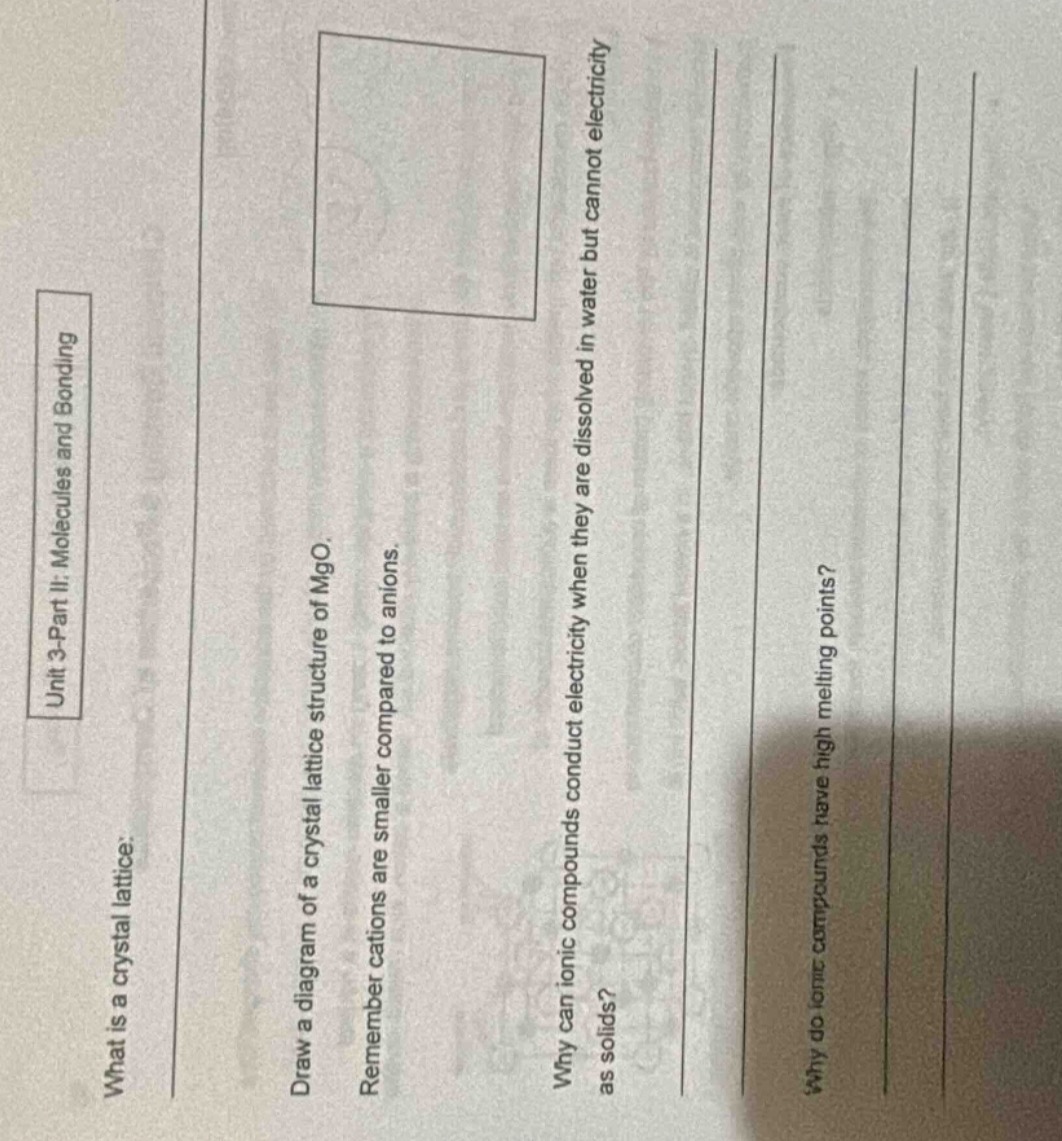
unit 3-part ii: molecules and bonding
what is a crystal lattice:
draw a diagram of a crystal lattice structure of mgo.
remember cations are smaller compared to anions.
why can ionic compounds conduct electricity when they are dissolved in water but cannot electricity as solids?
why do ionic compounds have high melting points?
Brief Explanations
- What is a crystal lattice: A crystal lattice is a repeating 3D arrangement of atoms, ions, or molecules in a crystalline solid, forming a regular, ordered framework.
- Conductivity of ionic compounds: In solid form, the ions in ionic compounds are locked in a fixed lattice and cannot move freely to carry electric charge. When dissolved in water, the lattice breaks apart, releasing mobile, charged ions that can conduct electric current.
- High melting points of ionic compounds: Ionic compounds have strong electrostatic attractions (ionic bonds) between positively charged cations and negatively charged anions in their lattice. A large amount of thermal energy is required to overcome these strong interionic forces and break the lattice structure, resulting in high melting points.
- MgO crystal lattice diagram: MgO has a face-centered cubic (rock salt) structure. Small magnesium cations ($Mg^{2+}$) are surrounded by larger oxide anions ($O^{2-}$), with each ion having a coordination number of 6 (each cation is surrounded by 6 anions and vice versa, forming a repeating grid of alternating positive and negative ions).

Snap & solve any problem in the app
Get step-by-step solutions on Sovi AI
Photo-based solutions with guided steps
Explore more problems and detailed explanations
- A crystal lattice is a regular, repeating three-dimensional arrangement of particles (atoms, ions, or molecules) in a crystalline solid.
- (Diagram description for MgO lattice): Draw a face-centered cubic grid where small circles represent $Mg^{2+}$ cations and larger circles represent $O^{2-}$ anions, arranged such that each cation is surrounded by 6 anions and each anion is surrounded by 6 cations, filling the rectangular box with this repeating alternating pattern.
- Ionic compounds do not conduct electricity as solids because their ions are fixed in a rigid lattice and cannot move to carry charge. When dissolved in water, the lattice dissociates into free, mobile ions that can carry electric current, allowing conductivity.
- Ionic compounds have high melting points because strong electrostatic ionic bonds hold the positive and negative ions together in the lattice. A large amount of energy is needed to overcome these strong interionic attractive forces and disrupt the ordered lattice structure.