QUESTION IMAGE
Question
unit 5 - cell structure and function
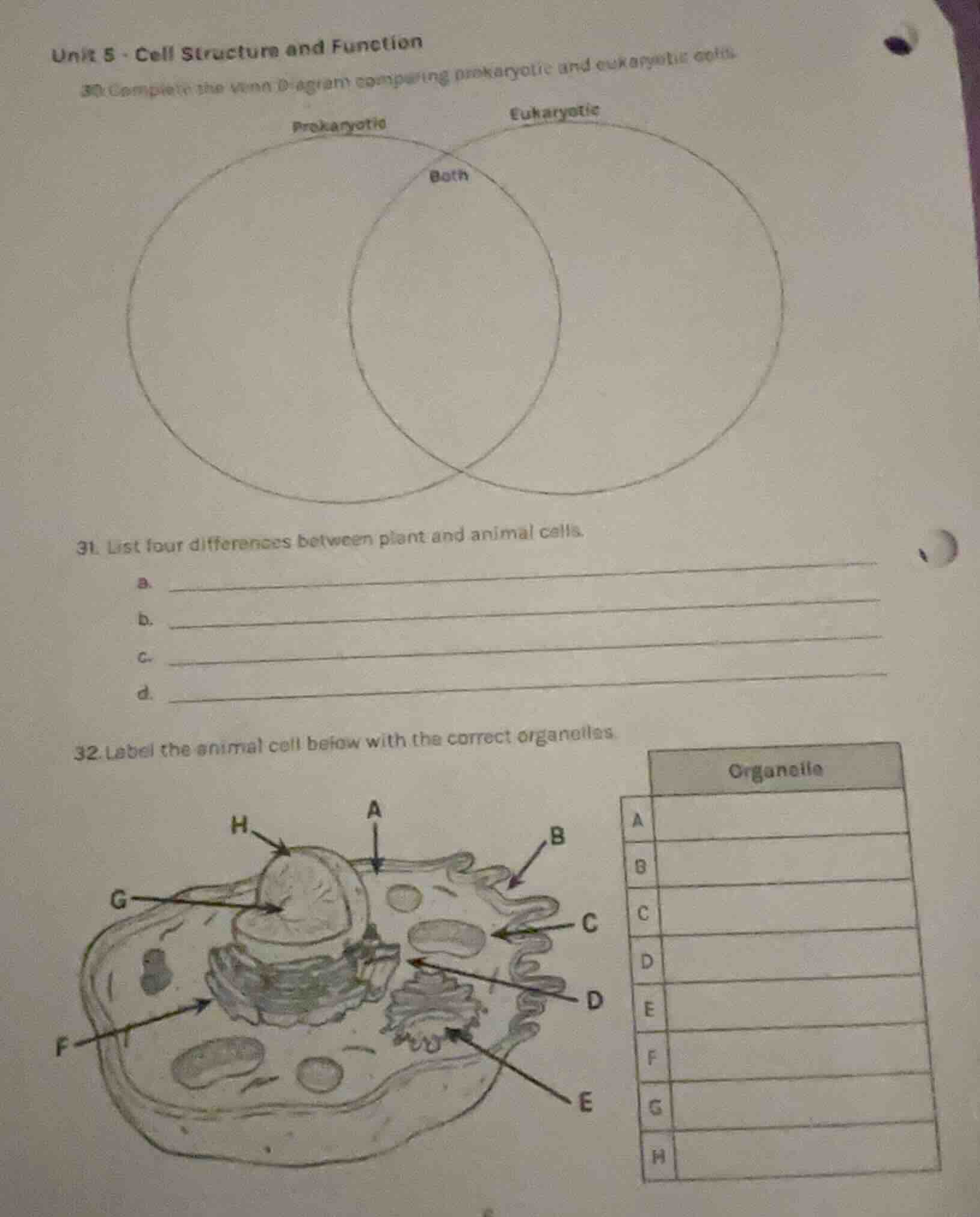
- complete the venn diagram comparing prokaryotic and eukaryotic cells.
- list four differences between plant and animal cells.
a.
b.
c.
d.
- label the animal cell below with the correct organelles.
Question 31:
To answer this, we recall the structural differences between plant and animal cells. Plant cells have a cell wall, chloroplasts, a large central vacuole, and lack centrioles (in most cases), while animal cells lack a cell wall, chloroplasts, have small vacuoles, and have centrioles.
We identify each organelle in an animal cell:
- A: Cell Membrane (surrounds the cell)
- B: Cell Membrane fold (or part of it, but typically cell membrane is labeled here) – wait, more accurately, in an animal cell diagram:
- A: Cytoplasm (the fluid matrix)
- B: Cell Membrane (the outer boundary)
- C: Mitochondrion (powerhouse, oval with folds)
- D: Golgi Apparatus (stacked membranes)
- E: Rough Endoplasmic Reticulum (with ribosomes)
- F: Smooth Endoplasmic Reticulum (without ribosomes)
- G: Nucleolus (inside nucleus)
- H: Nucleus (contains genetic material)
Wait, correcting:
- A: Cytoplasm (the region between cell membrane and nucleus)
- B: Cell Membrane (the outer layer)
- C: Mitochondrion (has cristae, oval)
- D: Golgi Body (stacked, like pancakes)
- E: Rough ER (with ribosomes, near nucleus)
- F: Smooth ER (no ribosomes)
- G: Nucleolus (inside nucleus, dense)
- H: Nucleus (the large organelle with nucleolus)
So labeling:
- A: Cytoplasm
- B: Cell Membrane
- C: Mitochondrion
- D: Golgi Apparatus
- E: Rough Endoplasmic Reticulum
- F: Smooth Endoplasmic Reticulum
- G: Nucleolus
- H: Nucleus
- Prokaryotic (only): No nucleus, no membrane - bound organelles, small in size, e.g., bacteria.
- Both: Have DNA, cell membrane, cytoplasm, ribosomes.
- Eukaryotic (only): Have a nucleus, membrane - bound organelles (mitochondria, ER, etc.), larger in size, e.g., animal, plant cells.
So filling the Venn:
- Prokaryotic circle: No nucleus, No membrane - bound organelles, Small size, Bacteria (examples).
- Both circle: Cell membrane, Cytoplasm, Ribosomes, Contain DNA.
- Eukaryotic circle: Has a nucleus, Has membrane - bound organelles (mitochondria, Golgi, etc.), Larger size, Animal/plant/fungi cells (examples).

Snap & solve any problem in the app
Get step-by-step solutions on Sovi AI
Photo-based solutions with guided steps
Explore more problems and detailed explanations
a. Plant cells have a cell wall; animal cells do not.
b. Plant cells have chloroplasts; animal cells do not.
c. Plant cells have a large central vacuole; animal cells have small vacuoles.
d. Animal cells have centrioles; most plant cells do not.