QUESTION IMAGE
Question
unit 6 concept 4: solubility quiz
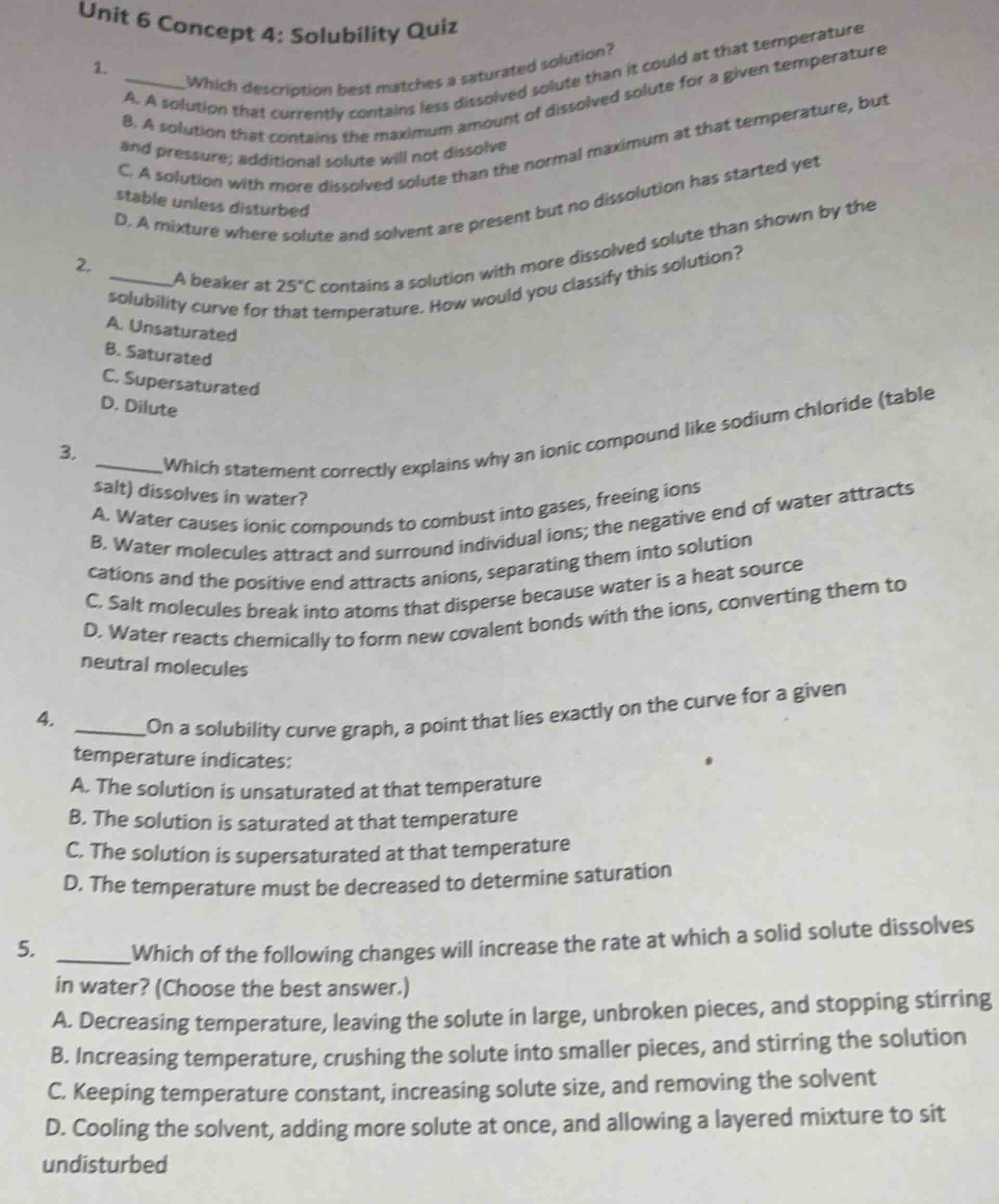
- ______which description best matches a saturated solution?
a. a solution that currently contains less dissolved solute than it could at that temperature
b. a solution that contains the maximum amount of dissolved solute for a given temperature and pressure; additional solute will not dissolve
c. a solution with more dissolved solute than the normal maximum at that temperature, but stable unless disturbed
d. a mixture where solute and solvent are present but no dissolution has started yet
- ______a beaker at 25°c contains a solution with more dissolved solute than shown by the solubility curve for that temperature. how would you classify this solution?
a. unsaturated
b. saturated
c. supersaturated
d. dilute
- ______which statement correctly explains why an ionic compound like sodium chloride (table salt) dissolves in water?
a. water causes ionic compounds to combust into gases, freeing ions
b. water molecules attract and surround individual ions; the negative end of water attracts cations and the positive end attracts anions, separating them into solution
c. salt molecules break into atoms that disperse because water is a heat source
d. water reacts chemically to form new covalent bonds with the ions, converting them to neutral molecules
- ______on a solubility curve graph, a point that lies exactly on the curve for a given temperature indicates:
a. the solution is unsaturated at that temperature
b. the solution is saturated at that temperature
c. the solution is supersaturated at that temperature
d. the temperature must be decreased to determine saturation
- ______which of the following changes will increase the rate at which a solid solute dissolves in water? (choose the best answer.)
a. decreasing temperature, leaving the solute in large, unbroken pieces, and stopping stirring
b. increasing temperature, crushing the solute into smaller pieces, and stirring the solution
c. keeping temperature constant, increasing solute size, and removing the solvent
d. cooling the solvent, adding more solute at once, and allowing a layered mixture to sit undisturbed
- A saturated solution holds the maximum dissolved solute possible at a given temperature and pressure, with no more solute able to dissolve.
- A solution with more dissolved solute than the solubility curve indicates for a temperature is supersaturated.
- Ionic compounds dissolve in water because polar water molecules surround and separate ions via ion-dipole attractions.
- Points exactly on a solubility curve represent saturated solutions at that temperature.
- Increasing temperature, crushing solute (to raise surface area), and stirring all speed up the dissolution rate of a solid in water.

Snap & solve any problem in the app
Get step-by-step solutions on Sovi AI
Photo-based solutions with guided steps
Explore more problems and detailed explanations
- B. A solution that contains the maximum amount of dissolved solute for a given temperature and pressure; additional solute will not dissolve
- C. Supersaturated
- B. Water molecules attract and surround individual ions; the negative end of water attracts cations and the positive end attracts anions, separating them into solution
- B. The solution is saturated at that temperature
- B. Increasing temperature, crushing the solute into smaller pieces, and stirring the solution