QUESTION IMAGE
Question
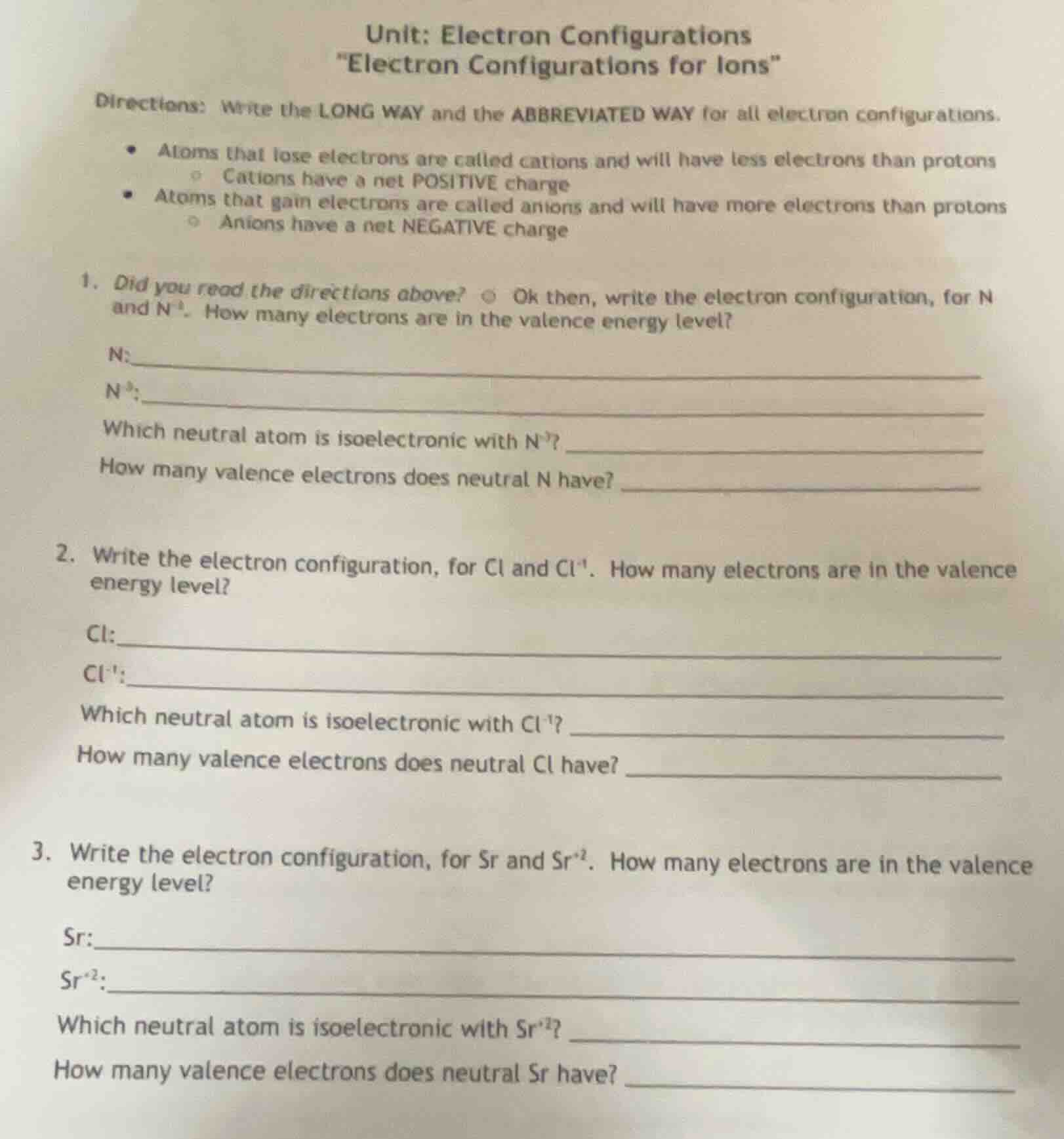
unit: electron configurations
\electron configurations for ions\
directions: write the long way and the abbreviated way for all electron configurations.
- atoms that lose electrons are called cations and will have less electrons than protons
- cations have a net positive charge
- atoms that gain electrons are called anions and will have more electrons than protons
- anions have a net negative charge
- did you read the directions above? ok then, write the electron configuration, for n and n⁻³. how many electrons are in the valence energy level?
n:
n⁻³:
which neutral atom is isoelectronic with n⁻³?
how many valence electrons does neutral n have?
- write the electron configuration, for cl and cl⁻¹. how many electrons are in the valence energy level?
cl:
cl⁻¹:
which neutral atom is isoelectronic with cl⁻¹?
how many valence electrons does neutral cl have?
- write the electron configuration, for sr and sr⁺². how many electrons are in the valence energy level?
sr:
sr⁺²:
which neutral atom is isoelectronic with sr⁺²?
how many valence electrons does neutral sr have?
Step1: Find N's electron count
Neutral N has 7 electrons.
Step2: Write N's long config
$1s^2 2s^2 2p^3$
Step3: Write N's abbreviated config
$[He] 2s^2 2p^3$
Step4: Find N⁻³ electron count
N gains 3 electrons: $7+3=10$ electrons.
Step5: Write N⁻³ long config
$1s^2 2s^2 2p^6$
Step6: Write N⁻³ abbreviated config
$[Ne]$
Step7: Identify isoelectronic atom for N⁻³
Ne has 10 electrons, matches N⁻³.
Step8: Count N's valence electrons
Valence shell is n=2: $2+3=5$ electrons.
---
Step9: Find Cl's electron count
Neutral Cl has 17 electrons.
Step10: Write Cl's long config
$1s^2 2s^2 2p^6 3s^2 3p^5$
Step11: Write Cl's abbreviated config
$[Ne] 3s^2 3p^5$
Step12: Find Cl⁻¹ electron count
Cl gains 1 electron: $17+1=18$ electrons.
Step13: Write Cl⁻¹ long config
$1s^2 2s^2 2p^6 3s^2 3p^6$
Step14: Write Cl⁻¹ abbreviated config
$[Ar]$
Step15: Identify isoelectronic atom for Cl⁻¹
Ar has 18 electrons, matches Cl⁻¹.
Step16: Count Cl's valence electrons
Valence shell is n=3: $2+5=7$ electrons.
---
Step17: Find Sr's electron count
Neutral Sr has 38 electrons.
Step18: Write Sr's long config
$1s^2 2s^2 2p^6 3s^2 3p^6 4s^2 3d^{10} 4p^6 5s^2$
Step19: Write Sr's abbreviated config
$[Kr] 5s^2$
Step20: Find Sr⁺² electron count
Sr loses 2 electrons: $38-2=36$ electrons.
Step21: Write Sr⁺² long config
$1s^2 2s^2 2p^6 3s^2 3p^6 4s^2 3d^{10} 4p^6$
Step22: Write Sr⁺² abbreviated config
$[Kr]$
Step23: Identify isoelectronic atom for Sr⁺²
Kr has 36 electrons, matches Sr⁺².
Step24: Count Sr's valence electrons
Valence shell is n=5: $2$ electrons.

Snap & solve any problem in the app
Get step-by-step solutions on Sovi AI
Photo-based solutions with guided steps
Explore more problems and detailed explanations
1.
N (long): $1s^2 2s^2 2p^3$; N (abbreviated): $[He] 2s^2 2p^3$
N⁻³ (long): $1s^2 2s^2 2p^6$; N⁻³ (abbreviated): $[Ne]$
Which neutral atom is isoelectronic with N⁻³?: Neon (Ne)
How many valence electrons does neutral N have?: 5
2.
Cl (long): $1s^2 2s^2 2p^6 3s^2 3p^5$; Cl (abbreviated): $[Ne] 3s^2 3p^5$
Cl⁻¹ (long): $1s^2 2s^2 2p^6 3s^2 3p^6$; Cl⁻¹ (abbreviated): $[Ar]$
Which neutral atom is isoelectronic with Cl⁻¹?: Argon (Ar)
How many valence electrons does neutral Cl have?: 7
3.
Sr (long): $1s^2 2s^2 2p^6 3s^2 3p^6 4s^2 3d^{10} 4p^6 5s^2$; Sr (abbreviated): $[Kr] 5s^2$
Sr⁺² (long): $1s^2 2s^2 2p^6 3s^2 3p^6 4s^2 3d^{10} 4p^6$; Sr⁺² (abbreviated): $[Kr]$
Which neutral atom is isoelectronic with Sr⁺²?: Krypton (Kr)
How many valence electrons does neutral Sr have?: 2