QUESTION IMAGE
Question
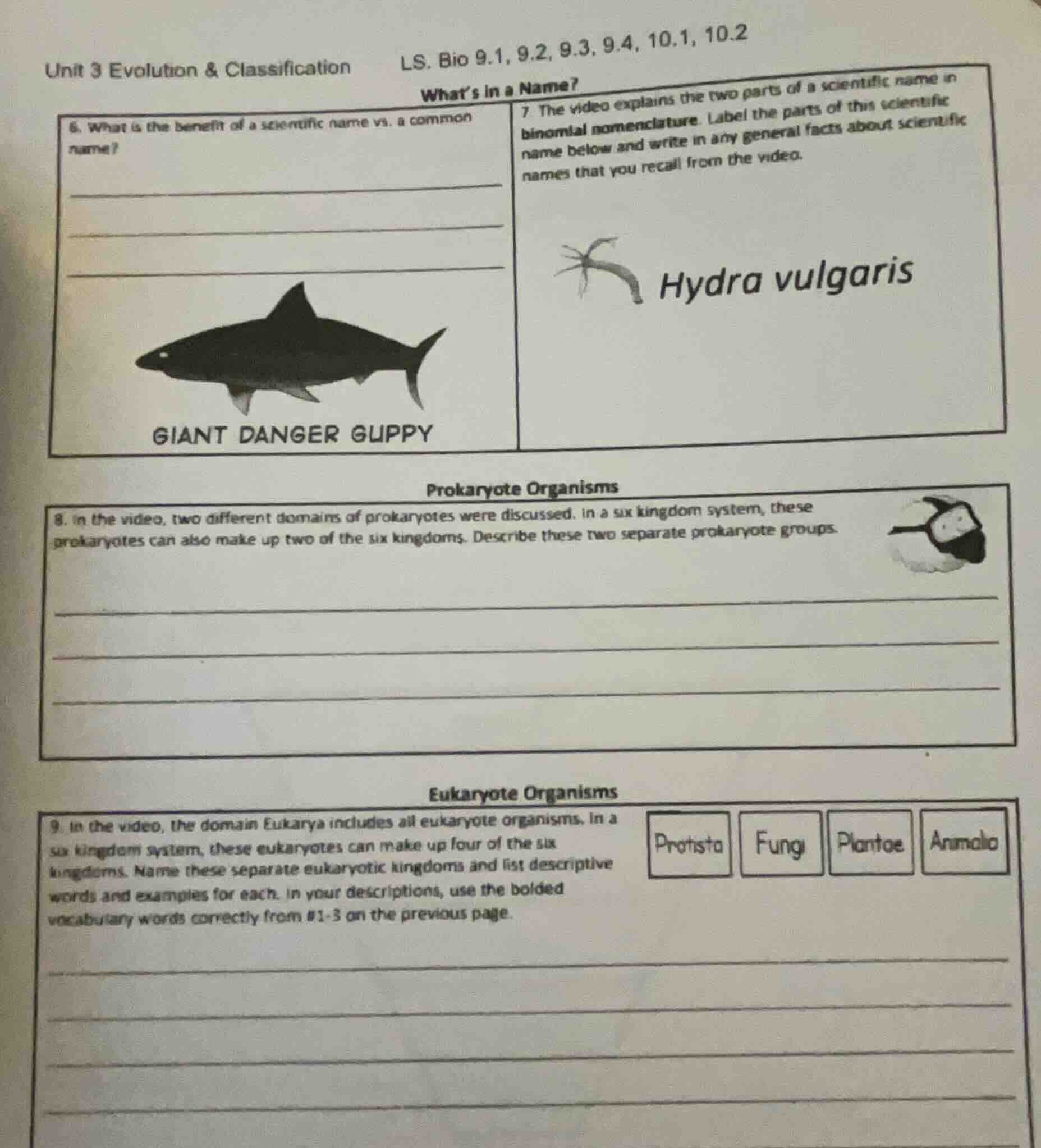
unit 3 evolution & classificationls. bio 9.1, 9.2, 9.3, 9.4, 10.1, 10.2whats in a name?6. what is the benefit of a scientific name vs. a common name?giant danger guppy7. the video explains the two parts of a scientific name in binomial nomenclature. label the parts of this scientific name below and write in any general facts about scientific names that you recall from the video.hydra vulgarisprokaryote organisms8. in the video, two different domains of prokaryotes were discussed. in a six kingdom system, these prokaryotes can also make up two of the six kingdoms. describe these two separate prokaryote groups.eukaryote organisms9. in the video, the domain eukarya includes all eukaryote organisms. in a six kingdom system, these eukaryotes can make up four of the six kingdoms. name these separate eukaryotic kingdoms and list descriptive words and examples for each. in your descriptions, use the bolded vocabulary words correctly from #1-3 on the previous page.protista fungi plantae animalia
Question 6:
Scientific names are standardized, universal (used by scientists globally to avoid confusion from region-specific common names), and carry taxonomic information about the organism's relatedness. Common names vary by language/region and can refer to multiple different organisms, or the same organism can have many common names.
Question 7:
- Hydra: Genus (capitalized, italicized; the first part of binomial nomenclature, groups closely related species)
- vulgaris: Species epithet (lowercase, italicized; the second part, unique to the species within the genus)
General facts: Scientific names use Latinized terms, follow binomial nomenclature developed by Carolus Linnaeus, are italicized (or underlined when handwritten), and the genus name can be abbreviated after the first use (e.g., H. vulgaris).
Question 8:
- Kingdom Eubacteria (Domain Bacteria): Unicellular prokaryotes with peptidoglycan in their cell walls; most are common, free-living (some are pathogenic, some are beneficial decomposers or symbionts). Example: E. coli.
- Kingdom Archaebacteria (Domain Archaea): Unicellular prokaryotes without peptidoglycan in cell walls; they live in extreme environments (hot springs, deep-sea hydrothermal vents, salt flats) and have biochemistry more similar to eukaryotes than eubacteria. Example: Thermoplasma.
Question 9:
- Protista: Mostly unicellular (some multicellular colonial forms), eukaryotic; includes heterotrophic, autotrophic, and mixotrophic organisms. Example: Amoeba, Chlamydomonas.
- Fungi: Eukaryotic, heterotrophic (absorptive nutrition), cell walls made of chitin; most are multicellular (molds, mushrooms) with some unicellular (yeast). Example: Agaricus bisporus (button mushroom), Saccharomyces cerevisiae (baker's yeast).
- Plantae: Eukaryotic, autotrophic (photosynthetic with chloroplasts), cell walls made of cellulose; multicellular, mostly terrestrial. Example: Quercus robur (oak tree), Arabidopsis thaliana.
- Animalia: Eukaryotic, heterotrophic (ingestive nutrition), no cell walls; multicellular, motile (at some life stage). Example: Canis lupus familiaris (domestic dog), Hydra vulgaris.

Snap & solve any problem in the app
Get step-by-step solutions on Sovi AI
Photo-based solutions with guided steps
Explore more problems and detailed explanations
- Scientific names are universal, standardized, and convey taxonomic relationships, eliminating confusion from regionally variable common names that can misidentify organisms.
7.
- Hydra: Genus (first, capitalized italicized term)
- vulgaris: Species epithet (second, lowercase italicized term)
General facts: Follows Linnaean binomial nomenclature, uses Latinized language, is italicized/underlined, and is a global scientific standard.
8.
- Eubacteria: Peptidoglycan cell walls, common environments, e.g., E. coli.
- Archaebacteria: No peptidoglycan, extreme environments, e.g., Thermoplasma.
9.
- Protista: Unicellular/multicellular eukaryotes, e.g., Amoeba, Chlamydomonas.
- Fungi: Chitin cell walls, absorptive heterotrophs, e.g., button mushrooms, yeast.
- Plantae: Cellulose cell walls, photosynthetic, e.g., oak trees, Arabidopsis.
- Animalia: No cell walls, ingestive heterotrophs, e.g., dogs, Hydra vulgaris.