QUESTION IMAGE
Question
unit 3 • finance
topic c: loans and financed purchases
use the given information to complete problems 8–10.
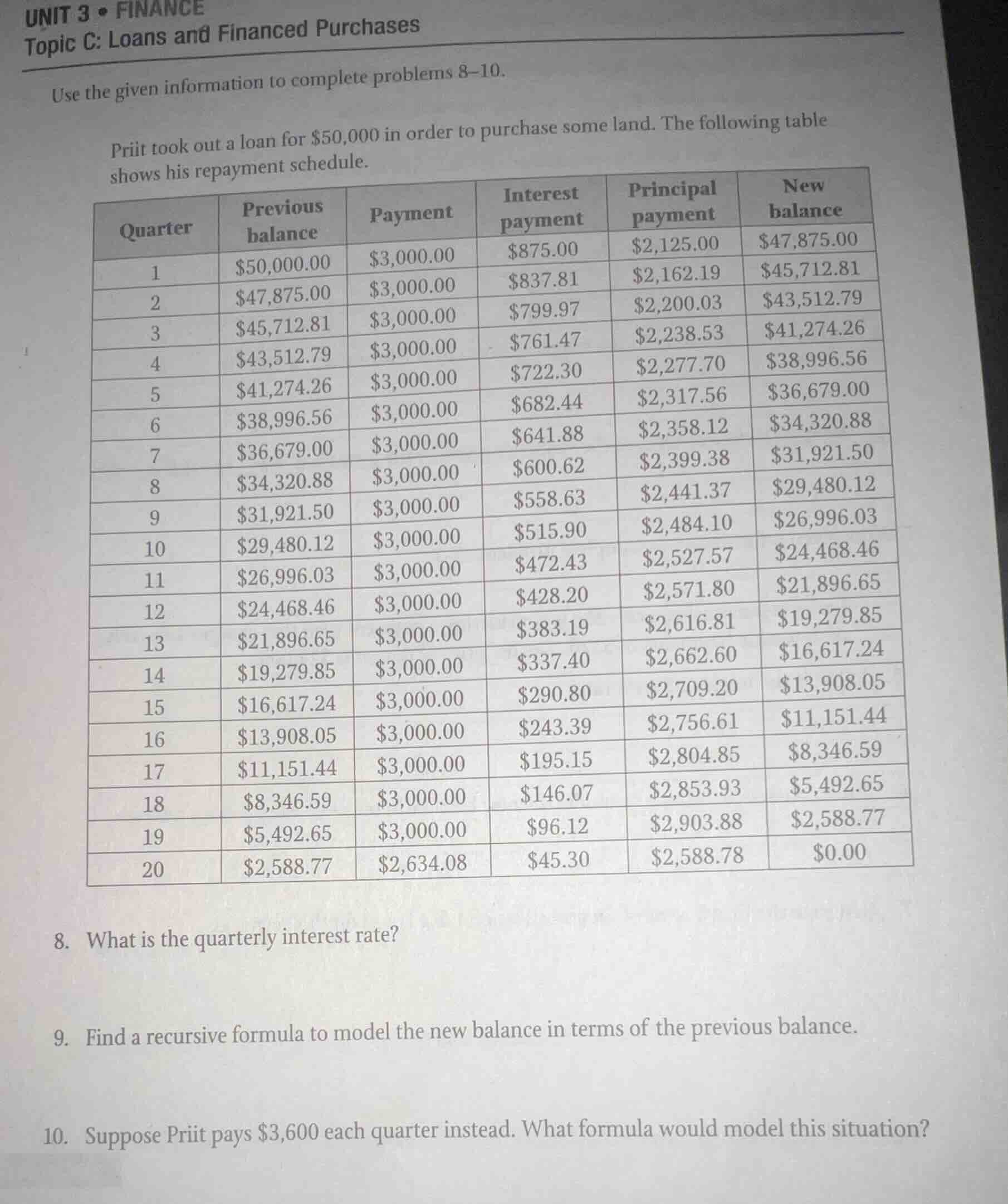
priit took out a loan for $50,000 in order to purchase some land. the following table
shows his repayment schedule.
| quarter | previous balance | payment | interest payment | principal payment | new balance |
|---|---|---|---|---|---|
| 2 | $47,875.00 | $3,000.00 | $837.81 | $2,162.19 | $45,712.81 |
| 3 | $45,712.81 | $3,000.00 | $799.97 | $2,200.03 | $43,512.79 |
| 4 | $43,512.79 | $3,000.00 | $761.47 | $2,238.53 | $41,274.26 |
| 5 | $41,274.26 | $3,000.00 | $722.30 | $2,277.70 | $38,996.56 |
| 6 | $38,996.56 | $3,000.00 | $682.44 | $2,317.56 | $36,679.00 |
| 7 | $36,679.00 | $3,000.00 | $641.88 | $2,358.12 | $34,320.88 |
| 8 | $34,320.88 | $3,000.00 | $600.62 | $2,399.38 | $31,921.50 |
| 9 | $31,921.50 | $3,000.00 | $558.63 | $2,441.37 | $29,480.12 |
| 10 | $29,480.12 | $3,000.00 | $515.90 | $2,484.10 | $26,996.03 |
| 11 | $26,996.03 | $3,000.00 | $472.43 | $2,527.57 | $24,468.46 |
| 12 | $24,468.46 | $3,000.00 | $428.20 | $2,571.80 | $21,896.65 |
| 13 | $21,896.65 | $3,000.00 | $383.19 | $2,616.81 | $19,279.85 |
| 14 | $19,279.85 | $3,000.00 | $337.40 | $2,662.60 | $16,617.24 |
| 15 | $16,617.24 | $3,000.00 | $290.80 | $2,709.20 | $13,908.05 |
| 16 | $13,908.05 | $3,000.00 | $243.39 | $2,756.61 | $11,151.44 |
| 17 | $11,151.44 | $3,000.00 | $195.15 | $2,804.85 | $8,346.59 |
| 18 | $8,346.59 | $3,000.00 | $146.07 | $2,853.93 | $5,492.65 |
| 19 | $5,492.65 | $3,000.00 | $96.12 | $2,903.88 | $2,588.77 |
| 20 | $2,588.77 | $2,634.08 | $45.30 | $2,588.78 | $0.00 |
- what is the quarterly interest rate?
- find a recursive formula to model the new balance in terms of the previous balance.
- suppose priit pays $3,600 each quarter instead. what formula would model this situation?
Problem 8
Step 1: Recall the interest formula
The interest payment for a period is calculated as \( \text{Interest} = \text{Previous Balance} \times r \), where \( r \) is the quarterly interest rate. We can use the first quarter's data: Previous balance = $50,000, Interest payment = $875.
Step 2: Solve for \( r \)
Using the formula \( 875 = 50000 \times r \), we solve for \( r \) by dividing both sides by 50000: \( r=\frac{875}{50000} \).
Step 3: Calculate the rate
\( r = 0.0175 \) or \( 1.75\% \).
Step 1: Analyze the new balance
The new balance is calculated as: \( \text{New Balance} = \text{Previous Balance} + \text{Interest Payment} - \text{Payment} \). But since \( \text{Interest Payment} = \text{Previous Balance} \times r \) (with \( r = 0.0175 \)) and \( \text{Principal Payment} = \text{Payment} - \text{Interest Payment} \), we can also write the new balance as: \( \text{New Balance} = \text{Previous Balance} \times (1 + r) - \text{Payment} \).
Step 2: Substitute values
We know \( r = 0.0175 \) and the payment is $3,000. So the recursive formula is: Let \( B_n \) be the new balance at quarter \( n \) and \( B_{n - 1} \) be the previous balance. Then \( B_n = B_{n - 1} \times (1 + 0.0175) - 3000 \), with the initial condition \( B_0 = 50000 \).
Step 1: Modify the payment in the formula
From the previous recursive formula, we only change the payment amount. The interest rate \( r = 0.0175 \) remains the same, but the payment is now $3,600 instead of $3,000.
Step 2: Write the new formula
Using the same structure as in Problem 9, the new recursive formula is: \( B_n = B_{n - 1} \times (1 + 0.0175) - 3600 \), with the initial condition \( B_0 = 50000 \).

Snap & solve any problem in the app
Get step-by-step solutions on Sovi AI
Photo-based solutions with guided steps
Explore more problems and detailed explanations
The quarterly interest rate is \( 1.75\% \) (or \( 0.0175 \) in decimal form).