QUESTION IMAGE
Question
unit 3: instructional sequence 3
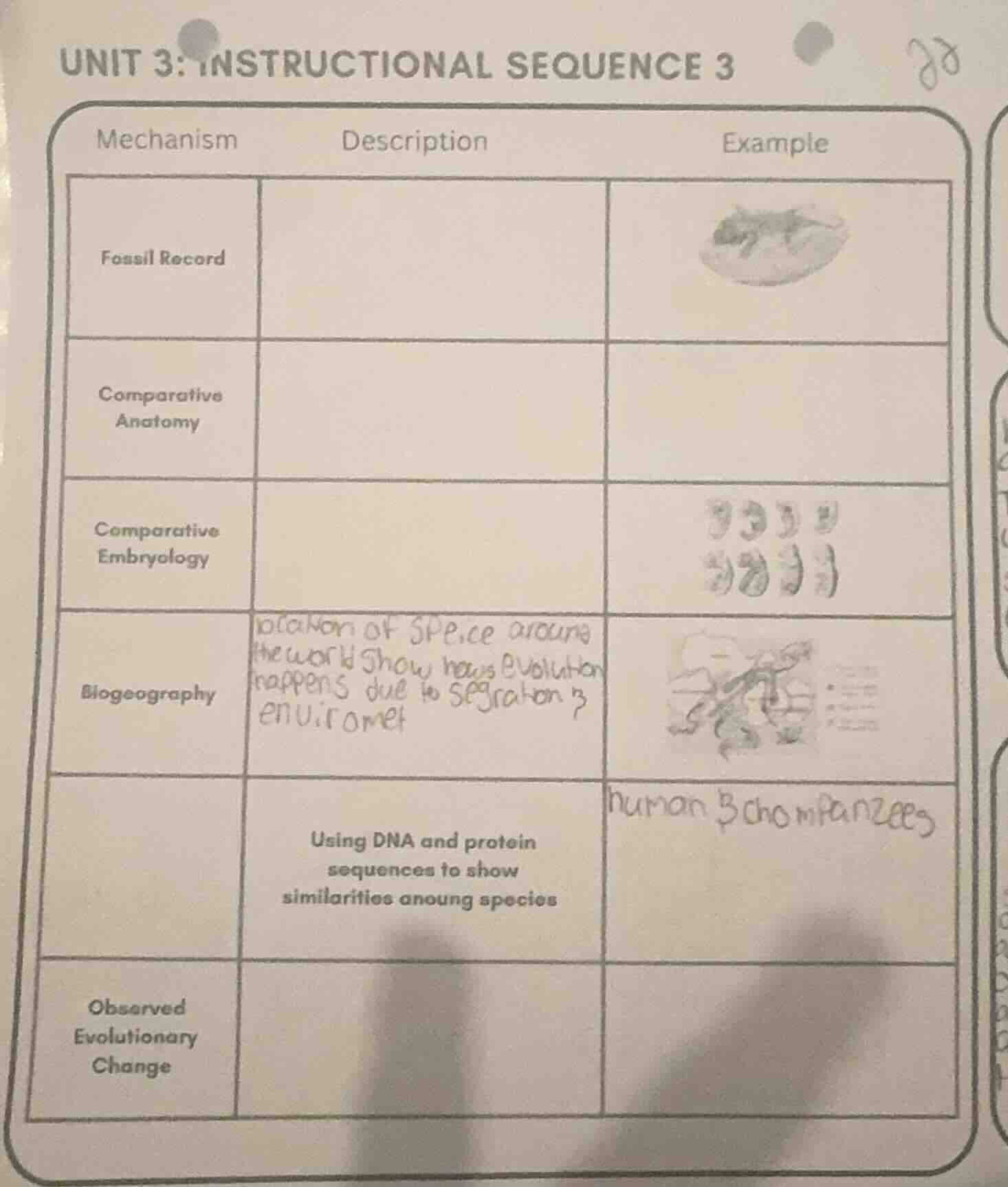
| mechanism | description | example |
|---|---|---|
| comparative anatomy | ||
| comparative embryology | ||
| biogeography | location of speice around the world show hows evolution happens due to segrabon & enviromet | |
| using dna and protein sequences to show similarities anoung species | human & chompanzees | |
| observed evolutionary change |
Brief Explanations
This table covers evidence for evolution. Each row is completed with standard scientific descriptions and examples for each evolutionary evidence mechanism:
- Fossil Record: Preserved remains/traces show species change over time; the example is a fossil (like the provided image of an ancient organism fossil).
- Comparative Anatomy: Compares body structures of different species to find shared evolutionary origins; a common example is homologous structures like human arms, bat wings, and whale flippers.
- Comparative Embryology: Studies early embryo development to reveal shared ancestry; the provided image shows similar early embryos of different vertebrates, which is the key example.
- Biogeography: The provided description is refined to clarify it's the geographic distribution of species showing evolution via isolation/habitat differences; the map example shows unique island species (like Galápagos finches) that evolved in isolation.
- Molecular Biology: This is the correct mechanism name for the given description; the example of humans and chimpanzees (highly similar DNA/proteins) fits.
- Observed Evolutionary Change: Tracks real-time evolution in living populations; a classic example is antibiotic-resistant bacteria or peppered moths adapting to pollution.

Snap & solve any problem in the app
Get step-by-step solutions on Sovi AI
Photo-based solutions with guided steps
Explore more problems and detailed explanations
| Mechanism | Description | Example |
|---|---|---|
| Comparative Anatomy | Compares body structures for shared ancestry | Homologous structures: human arm, bat wing, whale flipper |
| Comparative Embryology | Similar embryo development shows shared origins | Early vertebrate embryos (as pictured, e.g., human, chicken, fish embryos) |
| Biogeography | Species distribution shows evolution via isolation | Galápagos finches (unique island species, as pictured on map) |
| Molecular Biology | Using DNA/protein sequences to show similarities | Humans and chimpanzees (highly matching DNA) |
| Observed Evolutionary Change | Tracks real-time evolution in living populations | Antibiotic-resistant bacteria |