QUESTION IMAGE
Question
unit 8 lesson 33
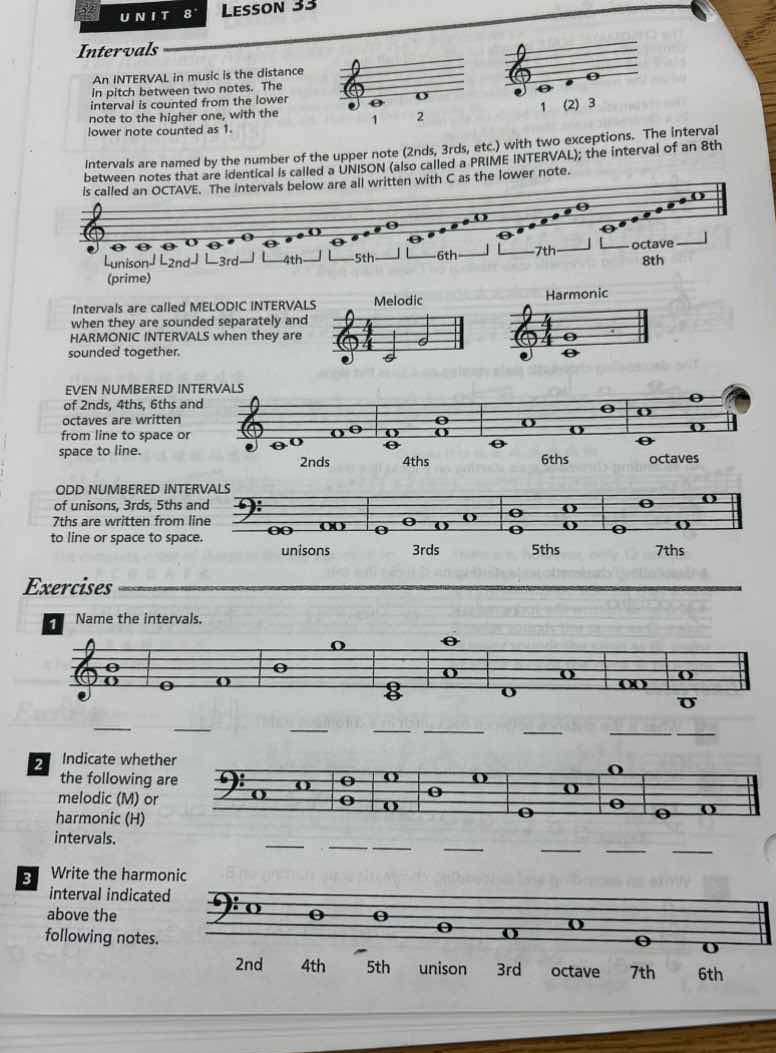
intervals
an interval in music is the distance
in pitch between two notes. the
interval is counted from the lower
note to the higher one, with the
lower note counted as 1.
intervals are named by the number of the upper note (2nds, 3rds, etc.) with two exceptions. the interval
between notes that are identical is called a unison (also called a prime interval); the interval of an 8th
is called an octave. the intervals below are all written with c as the lower note.
intervals are called melodic intervals
when they are sounded separately and
harmonic intervals when they are
sounded together.
even numbered intervals
of 2nds, 4ths, 6ths and
octaves are written
from line to space or
space to line.
odd numbered intervals
of unisons, 3rds, 5ths and
7ths are written from line
to line or space to space.
exercises
1 name the intervals.
2 indicate whether
the following are
melodic (m) or
harmonic (h)
intervals.
3 write the harmonic
interval indicated
above the
following notes.
2nd 4th 5th unison 3rd octave 7th 6th
To solve these music interval problems, we analyze each exercise based on the concepts of intervals (unison, 2nd, 3rd, 4th, 5th, 6th, 7th, octave), melodic vs. harmonic intervals, and their notation rules.
Exercise 1: Name the Intervals
We identify the interval by counting the number of the upper note from the lower note (with the lower note as 1).
- First interval: Lower note (C) to upper note (D) → 2nd.
- Second interval: Lower note (C) to upper note (E) → 3rd.
- Third interval: Lower note (C) to upper note (F) → 4th.
- Fourth interval: Lower note (C) to upper note (G) → 5th.
- Fifth interval: Lower note (C) to upper note (A) → 6th.
- Sixth interval: Lower note (C) to upper note (B) → 7th.
- Seventh interval: Lower note (C) to upper note (C) (same pitch) → Unison (Prime).
- Eighth interval: Lower note (C) to upper note (C) (octave, 8th).
Exercise 2: Melodic (M) or Harmonic (H) Intervals
- Melodic Intervals: Notes are sounded separately (successive).
- Harmonic Intervals: Notes are sounded together (simultaneous).
- First interval: Notes are stacked (played together) → Harmonic (H).
- Second interval: Notes are stacked → Harmonic (H).
- Third interval: Notes are stacked → Harmonic (H).
- Fourth interval: Notes are stacked → Harmonic (H).
- Fifth interval: Notes are stacked → Harmonic (H).
- Sixth interval: Notes are stacked → Harmonic (H).
- Seventh interval: Notes are stacked → Harmonic (H).
- Eighth interval: Notes are stacked → Harmonic (H).
Exercise 3: Write the Harmonic Interval
For harmonic intervals, we write the upper note to form the specified interval with the lower note (C, in the bass clef).
- 2nd: Lower note (C) + upper note (D) (2nd above C).
- 4th: Lower note (C) + upper note (F) (4th above C).
- 5th: Lower note (C) + upper note (G) (5th above C).
- Unison: Lower note (C) + upper note (C) (same pitch).
- 3rd: Lower note (C) + upper note (E) (3rd above C).
- Octave: Lower note (C) + upper note (C) (octave above C).
- 7th: Lower note (C) + upper note (B) (7th above C).
- 6th: Lower note (C) + upper note (A) (6th above C).
Final Answers
Exercise 1:
2nd, 3rd, 4th, 5th, 6th, 7th, Unison (Prime), Octave
Exercise 2:
H, H, H, H, H, H, H, H
Exercise 3:
- 2nd: D (above C)
- 4th: F (above C)
- 5th: G (above C)
- Unison: C (above C)
- 3rd: E (above C)
- Octave: C (above C, octave)
- 7th: B (above C)
- 6th: A (above C)
(Note: For notation, draw the upper note on the staff to form the interval with the lower note (C) in the bass clef.)

Snap & solve any problem in the app
Get step-by-step solutions on Sovi AI
Photo-based solutions with guided steps
Explore more problems and detailed explanations
To solve these music interval problems, we analyze each exercise based on the concepts of intervals (unison, 2nd, 3rd, 4th, 5th, 6th, 7th, octave), melodic vs. harmonic intervals, and their notation rules.
Exercise 1: Name the Intervals
We identify the interval by counting the number of the upper note from the lower note (with the lower note as 1).
- First interval: Lower note (C) to upper note (D) → 2nd.
- Second interval: Lower note (C) to upper note (E) → 3rd.
- Third interval: Lower note (C) to upper note (F) → 4th.
- Fourth interval: Lower note (C) to upper note (G) → 5th.
- Fifth interval: Lower note (C) to upper note (A) → 6th.
- Sixth interval: Lower note (C) to upper note (B) → 7th.
- Seventh interval: Lower note (C) to upper note (C) (same pitch) → Unison (Prime).
- Eighth interval: Lower note (C) to upper note (C) (octave, 8th).
Exercise 2: Melodic (M) or Harmonic (H) Intervals
- Melodic Intervals: Notes are sounded separately (successive).
- Harmonic Intervals: Notes are sounded together (simultaneous).
- First interval: Notes are stacked (played together) → Harmonic (H).
- Second interval: Notes are stacked → Harmonic (H).
- Third interval: Notes are stacked → Harmonic (H).
- Fourth interval: Notes are stacked → Harmonic (H).
- Fifth interval: Notes are stacked → Harmonic (H).
- Sixth interval: Notes are stacked → Harmonic (H).
- Seventh interval: Notes are stacked → Harmonic (H).
- Eighth interval: Notes are stacked → Harmonic (H).
Exercise 3: Write the Harmonic Interval
For harmonic intervals, we write the upper note to form the specified interval with the lower note (C, in the bass clef).
- 2nd: Lower note (C) + upper note (D) (2nd above C).
- 4th: Lower note (C) + upper note (F) (4th above C).
- 5th: Lower note (C) + upper note (G) (5th above C).
- Unison: Lower note (C) + upper note (C) (same pitch).
- 3rd: Lower note (C) + upper note (E) (3rd above C).
- Octave: Lower note (C) + upper note (C) (octave above C).
- 7th: Lower note (C) + upper note (B) (7th above C).
- 6th: Lower note (C) + upper note (A) (6th above C).
Final Answers
Exercise 1:
2nd, 3rd, 4th, 5th, 6th, 7th, Unison (Prime), Octave
Exercise 2:
H, H, H, H, H, H, H, H
Exercise 3:
- 2nd: D (above C)
- 4th: F (above C)
- 5th: G (above C)
- Unison: C (above C)
- 3rd: E (above C)
- Octave: C (above C, octave)
- 7th: B (above C)
- 6th: A (above C)
(Note: For notation, draw the upper note on the staff to form the interval with the lower note (C) in the bass clef.)