QUESTION IMAGE
Question
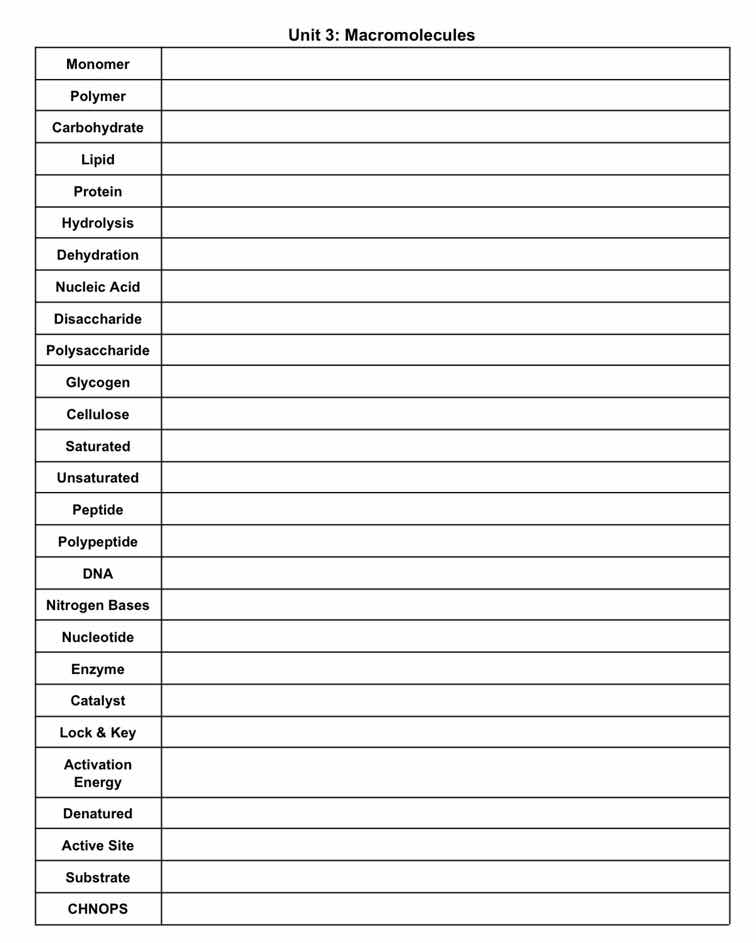
unit 3: macromolecules
monomer
polymer
carbohydrate
lipid
protein
hydrolysis
dehydration
nucleic acid
disaccharide
polysaccharide
glycogen
cellulose
saturated
unsaturated
peptide
polypeptide
dna
nitrogen bases
nucleotide
enzyme
catalyst
lock & key
activation energy
denatured
active site
substrate
chnops
To solve this, we need to provide definitions for each term related to macromolecules (a topic in Biology, a subfield of Natural Science). Here are the definitions:
1. Monomer
Step1: Define Monomer
A monomer is a small molecular unit that can join together with other similar units to form a polymer.
2. Polymer
Step1: Define Polymer
A polymer is a large molecule (macromolecule) made up of many repeated monomer units.
3. Carbohydrate
Step1: Define Carbohydrate
Carbohydrates are organic compounds made of carbon, hydrogen, and oxygen (usually in a 1:2:1 ratio) that serve as energy sources and structural components; examples include sugars and starches.[LLM SSE On Failure]

Snap & solve any problem in the app
Get step-by-step solutions on Sovi AI
Photo-based solutions with guided steps
Explore more problems and detailed explanations
To solve this, we need to provide definitions for each term related to macromolecules (a topic in Biology, a subfield of Natural Science). Here are the definitions:
1. Monomer
Step1: Define Monomer
A monomer is a small molecular unit that can join together with other similar units to form a polymer.
2. Polymer
Step1: Define Polymer
A polymer is a large molecule (macromolecule) made up of many repeated monomer units.
3. Carbohydrate
Step1: Define Carbohydrate
Carbohydrates are organic compounds made of carbon, hydrogen, and oxygen (usually in a 1:2:1 ratio) that serve as energy sources and structural components; examples include sugars and starches.[LLM SSE On Failure]