QUESTION IMAGE
Question
unit 2 quiz 2 review
canvas assignment
name
date
1)
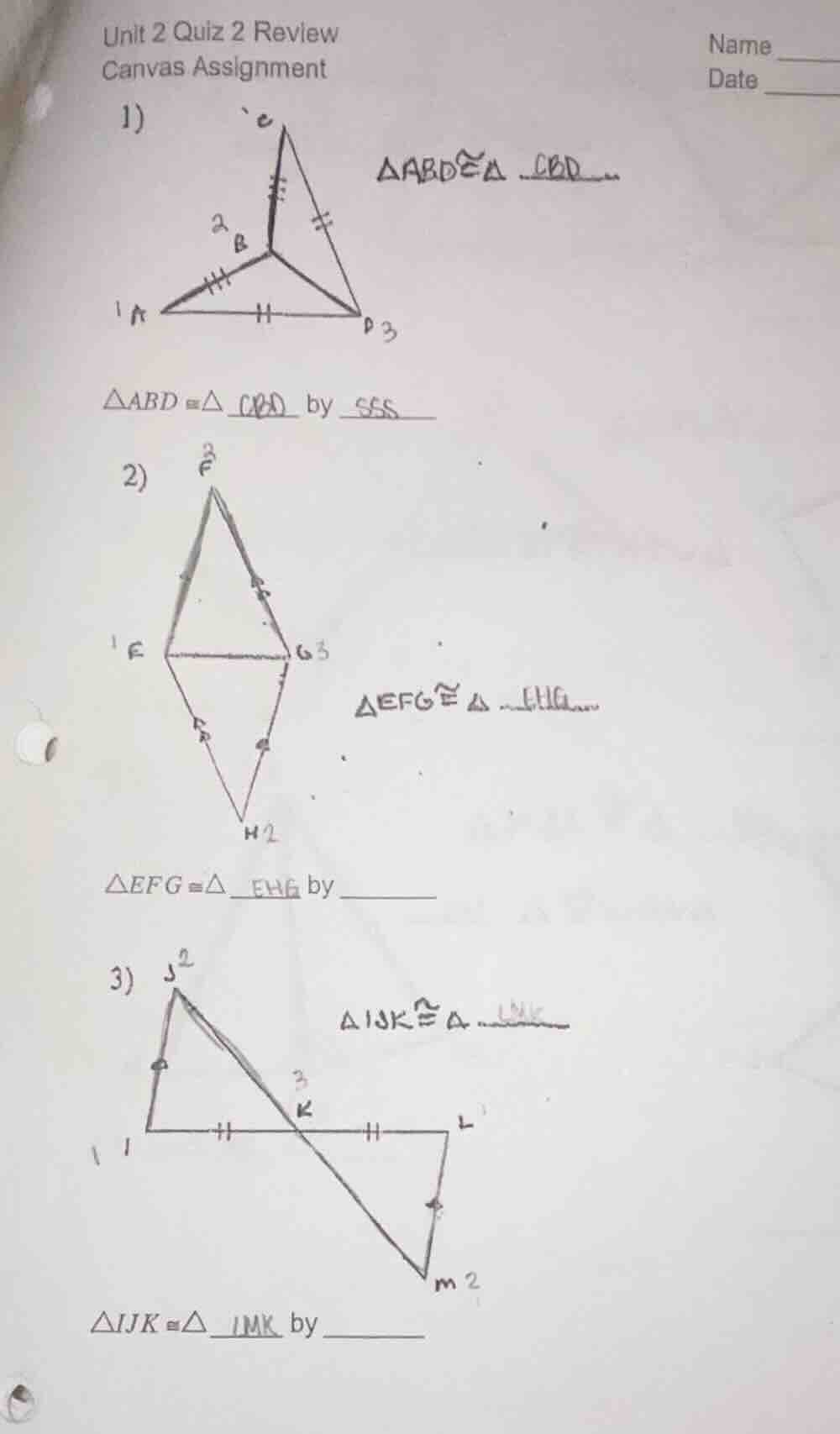
$\triangle abd \cong \triangle$ ____
$\triangle abd \cong \triangle$ __ by __
2)
$\triangle efg \cong \triangle$ ____
$\triangle efg \cong \triangle$ __ by __
3)
$\triangle ijk \cong \triangle$ ____
$\triangle ijk \cong \triangle$ __ by __
Problem 1:
Step 1: Identify congruent sides
In $\triangle ABD$ and $\triangle CBD$, we have $AB = CB$ (marked with 2 ticks), $AD = CD$ (marked with 1 and 3 ticks? Wait, actually, looking at the diagram, $AB$ and $CB$ have the same tick, $AD$ and $CD$? Wait, no, the sides: $AB$ (2 ticks), $BD$ is common, and $AD$ and $CD$? Wait, the diagram shows $AB = CB$ (2 ticks), $AD = CD$? Wait, no, the markings: $AB$ (2 ticks), $BD$ is shared, and $AD$ (1 tick) and $CD$ (3 ticks)? Wait, maybe the correct sides are $AB = CB$, $AD = CD$, and $BD = BD$ (common side). So by SSS (Side - Side - Side) congruence criterion, $\triangle ABD\cong\triangle CBD$.
Step 2: Determine the congruence criterion
Since all three corresponding sides are equal ($AB = CB$, $AD = CD$, $BD = BD$), the congruence criterion is SSS.
Step 1: Identify congruent parts
In $\triangle EFG$ and $\triangle EHG$, we have $EF = EH$ (marked with the same tick), $FG = HG$ (marked with the same tick), and $EG = EG$ (common side). Also, the angles at $F$ and $H$ are equal (marked with the same tick), angles at $G$ are equal (marked with the same tick). But looking at the sides: $EF = EH$, $FG = HG$, $EG = EG$. So by SSS or maybe SAS? Wait, the diagram shows $EF = EH$, $FG = HG$, and $EG$ is common. So by SSS (or maybe SAS, but SSS is more straightforward here). Wait, also, if we consider the triangles $\triangle EFG$ and $\triangle EHG$, $EF = EH$, $FG = HG$, $EG = EG$. So by SSS, $\triangle EFG\cong\triangle EHG$. Alternatively, since $EF = EH$, $EG$ is common, and $\angle FEG=\angle HEG$? Wait, maybe the correct congruence is by SSS.
Step 2: Determine the congruence criterion
Since $EF = EH$, $FG = HG$, and $EG = EG$ (common side), the congruence criterion is SSS (or maybe SAS, but SSS is more likely here).
Step 1: Identify congruent parts
In $\triangle IJK$ and $\triangle LMK$ (wait, no, looking at the diagram: $IJ = LM$ (1 tick and 2 ticks? Wait, $IJ$ (1 tick), $LM$ (2 ticks)? Wait, no, the markings: $IJ$ (1 tick), $LM$ (2 ticks)? Wait, maybe $IJ = LM$, $IK = LK$ (marked with two ticks each), and $\angle IJK=\angle LMK$? Wait, no, the correct triangles: $\triangle IJK$ and $\triangle LMK$? Wait, no, looking at the diagram, $IJ$ (1), $LM$ (2), $IK = LK$ (two ticks), $JK = MK$ (two ticks)? Wait, maybe $\triangle IJK\cong\triangle LMK$? No, wait, the correct correspondence: $IJ = LM$ (1 and 2? Maybe not). Wait, the other way: $\triangle IJK$ and $\triangle LMK$? Wait, no, let's re - examine. The sides: $IJ$ (1), $LM$ (2), $IK = LK$ (two ticks), $JK = MK$ (two ticks), and $\angle IKJ=\angle LKM$ (vertical angles). So by SAS (Side - Angle - Side) congruence criterion: $IK = LK$, $\angle IKJ=\angle LKM$, $JK = MK$. So $\triangle IJK\cong\triangle LMK$ by SAS. Or maybe $\triangle IJK\cong\triangle LMK$? Wait, the diagram shows $IJ$ (1), $LM$ (2), $IK = LK$ (two ticks), $JK = MK$ (two ticks), and $\angle IKJ=\angle LKM$ (vertical angles). So $IK = LK$, $\angle IKJ=\angle LKM$, $JK = MK$. So by SAS, $\triangle IJK\cong\triangle LMK$.
Step 2: Determine the congruence criterion
Since $IK = LK$, $\angle IKJ=\angle LKM$ (vertical angles), and $JK = MK$, the congruence criterion is SAS.

Snap & solve any problem in the app
Get step-by-step solutions on Sovi AI
Photo-based solutions with guided steps
Explore more problems and detailed explanations
$\triangle ABD\cong\triangle \boldsymbol{CBD}$ by $\boldsymbol{SSS}$