QUESTION IMAGE
Question
unit 2 quiz #1
show your work for full credit. read the instructions.
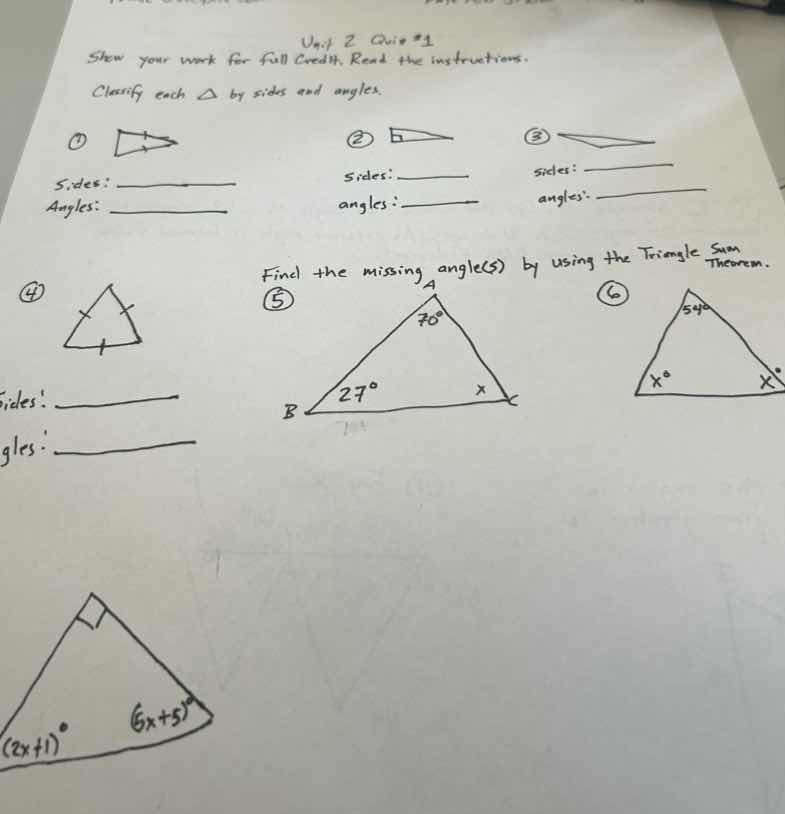
classify each △ by sides and angles.
①
sides:
angles:
②
sides:
angles:
③
sides:
angles:
④
sides:
angles:
find the missing angle(s) by using the triangle sum theorem.
⑤
⑥
Let's solve the missing angle problems (5, 6, and the right triangle at the bottom) using the Triangle Sum Theorem, which states that the sum of the interior angles of a triangle is \(180^\circ\).
Problem 5:
We have triangle \(ABC\) with \(\angle A = 70^\circ\), \(\angle B = 27^\circ\), and we need to find \(\angle C = x\).
Step 1: Recall the Triangle Sum Theorem
The sum of the angles in a triangle is \(180^\circ\), so \(\angle A + \angle B + \angle C = 180^\circ\).
Step 2: Substitute the known values
Substitute \(\angle A = 70^\circ\), \(\angle B = 27^\circ\), and \(\angle C = x\) into the equation:
\[
70^\circ + 27^\circ + x = 180^\circ
\]
Step 3: Simplify and solve for \(x\)
First, add \(70^\circ\) and \(27^\circ\):
\[
97^\circ + x = 180^\circ
\]
Then, subtract \(97^\circ\) from both sides:
\[
x = 180^\circ - 97^\circ = 83^\circ
\]
Problem 6:
We have an isosceles triangle (two equal angles, \(x^\circ\) each) with a third angle of \(54^\circ\).
Step 1: Recall the Triangle Sum Theorem
The sum of the angles in a triangle is \(180^\circ\), so \(x + x + 54^\circ = 180^\circ\).
Step 2: Combine like terms
Combine the two \(x\) terms:
\[
2x + 54^\circ = 180^\circ
\]
Step 3: Solve for \(x\)
Subtract \(54^\circ\) from both sides:
\[
2x = 180^\circ - 54^\circ = 126^\circ
\]
Then, divide both sides by 2:
\[
x = \frac{126^\circ}{2} = 63^\circ
\]
Right Triangle (Bottom):
We have a right triangle (one angle is \(90^\circ\)) with angles \((2x + 1)^\circ\), \((6x + 5)^\circ\), and \(90^\circ\).
Step 1: Recall the Triangle Sum Theorem
The sum of the angles in a triangle is \(180^\circ\), so \((2x + 1)^\circ + (6x + 5)^\circ + 90^\circ = 180^\circ\).
Step 2: Combine like terms
Combine the \(x\) terms and the constant terms:
\[
(2x + 6x) + (1 + 5) + 90^\circ = 180^\circ
\]
\[
8x + 6 + 90 = 180
\]
\[
8x + 96 = 180
\]
Step 3: Solve for \(x\)
Subtract 96 from both sides:
\[
8x = 180 - 96 = 84
\]
Then, divide both sides by 8:
\[
x = \frac{84}{8} = 10.5
\]
Now, we can find the angles:
- \((2x + 1)^\circ = 2(10.5) + 1 = 22^\circ\)
- \((6x + 5)^\circ = 6(10.5) + 5 = 68^\circ\)
Summary of Answers:
- Problem 5: \(x = 83^\circ\)
- Problem 6: \(x = 63^\circ\)
- Right Triangle: \(x = 10.5\), angles are \(22^\circ\), \(68^\circ\), and \(90^\circ\)

Snap & solve any problem in the app
Get step-by-step solutions on Sovi AI
Photo-based solutions with guided steps
Explore more problems and detailed explanations
Let's solve the missing angle problems (5, 6, and the right triangle at the bottom) using the Triangle Sum Theorem, which states that the sum of the interior angles of a triangle is \(180^\circ\).
Problem 5:
We have triangle \(ABC\) with \(\angle A = 70^\circ\), \(\angle B = 27^\circ\), and we need to find \(\angle C = x\).
Step 1: Recall the Triangle Sum Theorem
The sum of the angles in a triangle is \(180^\circ\), so \(\angle A + \angle B + \angle C = 180^\circ\).
Step 2: Substitute the known values
Substitute \(\angle A = 70^\circ\), \(\angle B = 27^\circ\), and \(\angle C = x\) into the equation:
\[
70^\circ + 27^\circ + x = 180^\circ
\]
Step 3: Simplify and solve for \(x\)
First, add \(70^\circ\) and \(27^\circ\):
\[
97^\circ + x = 180^\circ
\]
Then, subtract \(97^\circ\) from both sides:
\[
x = 180^\circ - 97^\circ = 83^\circ
\]
Problem 6:
We have an isosceles triangle (two equal angles, \(x^\circ\) each) with a third angle of \(54^\circ\).
Step 1: Recall the Triangle Sum Theorem
The sum of the angles in a triangle is \(180^\circ\), so \(x + x + 54^\circ = 180^\circ\).
Step 2: Combine like terms
Combine the two \(x\) terms:
\[
2x + 54^\circ = 180^\circ
\]
Step 3: Solve for \(x\)
Subtract \(54^\circ\) from both sides:
\[
2x = 180^\circ - 54^\circ = 126^\circ
\]
Then, divide both sides by 2:
\[
x = \frac{126^\circ}{2} = 63^\circ
\]
Right Triangle (Bottom):
We have a right triangle (one angle is \(90^\circ\)) with angles \((2x + 1)^\circ\), \((6x + 5)^\circ\), and \(90^\circ\).
Step 1: Recall the Triangle Sum Theorem
The sum of the angles in a triangle is \(180^\circ\), so \((2x + 1)^\circ + (6x + 5)^\circ + 90^\circ = 180^\circ\).
Step 2: Combine like terms
Combine the \(x\) terms and the constant terms:
\[
(2x + 6x) + (1 + 5) + 90^\circ = 180^\circ
\]
\[
8x + 6 + 90 = 180
\]
\[
8x + 96 = 180
\]
Step 3: Solve for \(x\)
Subtract 96 from both sides:
\[
8x = 180 - 96 = 84
\]
Then, divide both sides by 8:
\[
x = \frac{84}{8} = 10.5
\]
Now, we can find the angles:
- \((2x + 1)^\circ = 2(10.5) + 1 = 22^\circ\)
- \((6x + 5)^\circ = 6(10.5) + 5 = 68^\circ\)
Summary of Answers:
- Problem 5: \(x = 83^\circ\)
- Problem 6: \(x = 63^\circ\)
- Right Triangle: \(x = 10.5\), angles are \(22^\circ\), \(68^\circ\), and \(90^\circ\)